The Potala Palace ( Tib .: པོ་ ཏ་ ལ , Wh . 布达拉宫 ) [1] is a royal palace and a Buddhist temple complex located in Lhasa , in the Tibet Autonomous Region of the People's Republic of China . Located on a hill high above the city. The total area of the palace complex is 360 thousand square meters.
| Sight | |
| Potala | |
|---|---|
| A country | |
| Location | |
| Founding date | |
 | UNESCO World Heritage Site , object number 707 rus • eng • fr. |


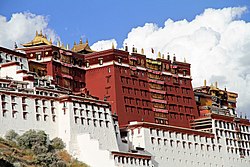

The palace was the main residence of the Dalai Lama , until Dalai Lama XIV , after the invasion of China in Tibet , was forced to leave the country in 1959 and received political asylum in India ( Dharamsala ).
Today, the Potala Palace is a museum actively visited by tourists, remaining a Buddhist pilgrimage site and continuing to be used in Buddhist rituals. Due to its enormous cultural, religious, artistic and historical significance, it was listed as a UNESCO World Heritage Site in 1994 . In 2001, the summer residence of the Dalai Lamas, the palace and Norbulinka Park [2] were included in the “historical ensemble of the Potala Palace”.
Content
History
In 637, the King of Tibet, Songtsen Gampo, erected here the first building where he used to meditate. When he decided to make Lhasa his capital, he built a palace. After his engagement with the Chinese princess, Wen Cheng , he expanded the palace to 999 rooms, erected walls and towers and dug a bypass channel. In the second half of the 8th century , lightning struck the palace and wooden buildings burned down, then the palace collapsed due to internecine wars. Only the cave Chogyel Drupuk and the Phakpa Lhakhang Hall have survived.
The palace in its present form began to be built in 1645 on the initiative of Dalai Lama V. In 1648, the White Palace (Potrang Karpo) was completed, and the Potala was used as the winter residence of the Dalai Lamas. The Red Palace (Potrang Marpo) was completed between 1690 and 1694 . The name of the palace is apparently derived from the legendary Potala Mountain on which the Bodhisattva Chenrezi ( Avalokiteshvara ) dwells , which on the earth is represented by the Dalai Lama .
The best masters of that time from Tibet , Nepal and China took part in the grand construction.
Location and Architecture
The palace is located at an altitude of 3,700 meters on Red Hill (Marpo Ri) in the middle of the Lhasa Valley [3] . Because of the terraces, platforms on the roofs and temples, it does not impress the fortress ( dzong ). The general view of the palace, stretching along a mountain ridge, with towers, walls, stairs, temples and annexes, is a unique artistic solution, its grandeur and beauty appreciated by Buddhists, architects and artists, amaze travelers.
Numerous pilgrims walk around the hill with the palace, making the bark - a ritual detour to the holy site. Along the bark are numerous prayer wheels and malls.
White Palace
The White Palace or Potrang Karpo is part of the Potala Palace and the living space for the Dalai Lama . The first White Palace was built during the time of the Fifth Dalai Lama , in 1649 he and the government moved to it [4] . Then, at the beginning of the 20th century, during the Thirteenth Dalai Lama , the building was expanded to modern dimensions. The palace contains living quarters, seminaries and printing houses. The central, yellow-colored courtyard, known as Deyangshar, separates the living quarters of the lama and his monks of the Red Palace from the sacred palace of Potala, which is entirely dedicated to religious teaching and prayer. In the palace there are sacred golden stupas-tombs of eight Dalai Lamas, halls, libraries with important Buddhist scriptures, for example, Gandzhur in 108 volumes and Dandzhur in 225 volumes. The White Palace consists of a large oriental pavilion, a sun pavilion, the living rooms of the regent and mentor of the Dalai Lama, as well as government offices. The large eastern pavilion was used for official ceremonies, in the Solar Pavilion the Dalai Lama actually lived and worked, read sacred texts, was in charge of management.
Red Palace
The Red Palace or Potrang Marpo served more as a place of prayers and religious rituals, there are pavilions in it. Of great importance are eight memorial stupas , including the Fifth and Thirteenth Dalai Lamas .
In addition to stupas, the palace consists of a string of large and small halls (temples) dedicated to buddhas, bodhisattvas, Dalai Lamas, as well as for audiences and ceremonies. The halls exhibit jewels and relics - spatial mandalas for contemplation, memorial stupas, statues of the Dalai Lamas and teachers, statues of deities and yidams , books, ritual objects, on the walls - a complex painting system.
Religious ceremonies and receptions were usually held in the Western Great Hall.
Of particular importance is the cave Chogyal Drupuk, in which even before the construction of the palace, King Songtsen Gampo meditated.
Photo Gallery
Snow lions
On the upper terrace
Colorful eaves of the palace
Painting on the walls of the palace
Pond behind the Potala Palace ( Lhukhang )
See also
- Dalai Lama
- Lhasa
- Norbuling
- Tibet history
- Tibetan Buddhism
Notes
- ↑ 1 2 archINFORM - 1994.
- ↑ World Heritage Committee Inscribes 31 New Sites on the World Heritage List . UNESCO (December 13, 2001). The date of circulation is May 3, 2011. Archived February 9, 2012.
- ↑ Stein, RA Tibetan Civilization (1962) / Faber & Faber. - 1 ed .. - London : Stanford University Press, 1972. - P. 206.
- ↑ Karmay, Samten C. The Great Fifth . - 2005. - P. 1. Archival copy of September 15, 2013 on the Wayback Machine
Links
- The Potala Palace (sacredsites.com)
- UNESCO: Potala Palace
- Flickr: Photos tagged with potala , photos of Potala Palace