Clever Geek Handbook
📜 ⬆️ ⬇️

Brown ear-flaps

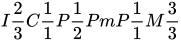
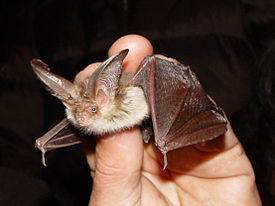
Brown [1] , or ordinary ushanka [2] ( lat. Plecotus auritus ) is one of the species of the genus Ushanka from the family of ordinary bats (Vespertilionidae). Ushans differ from other Palearctic representatives of the family by very long ears (almost equal in length to the forearms). In sleeping animals, the ears are laid back and hidden under the wings. Dental formula :I23ConeonePone2PmPoneoneM33 {\ displaystyle I {2 \ over 3} C {1 \ over 1} P {1 \ over 2} PmP {1 \ over 1} M {3 \ over 3}} I {2 \ over 3} C {1 \ over 1} P {1 \ over 2} PmP {1 \ over 1} M {3 \ over 3} .
Brown ear-flaps
Plecotus auritus 01.jpg
Scientific classification
Domain:Eukaryotes
Kingdom:Animals
Kingdom :Eumetazoi
No rank :Bilateral symmetrical
No rank :Secondary
Type of:Chordate
Subtype :Vertebrates
Infratype :Maxillary
Overclass :Tetrapods
Grade:Mammals
Subclass :Animals
Infraclass :Placental
Squadron :Laurasioteria
Squad:Bats
Suborder :The bats
Superfamily :Vespertilionoidea
Family:Smooth-nosed bats
Subfamily :Vespertilioninae
Tribe :Plecotini
Gender:Ushany
View:Brown ear-flaps
International scientific name

Plecotus auritus ( Linnaeus ), 1758

Security status
Status iucn3.1 LC ru.svg Виды под наименьшей угрозой
Least Concerned
IUCN 3.1 Least Concern : 17596

Distributed throughout the Palearctic from Portugal in the west to Kamchatka in the east, from North Africa, Palestine, Iran and Central China in the south to 60-62 degrees C. w. in the north.

In the summer, it dawns in various natural (crevices under the lagged bark, tree hollows, caves) and artificial shelters (attics and crevices of houses), and takes off for feeding late at night. Often catches insects or spiders sitting on leaves or branches, while it can hang in the air before prey, quickly flapping its wings. Winters in natural caves or artificial underground structures. Females bring one, less often two cubs. [3]

Security Measures

It is included in the European Red List , Red Books of the Sverdlovsk [4] Chelyabinsk , Kurgan and Tomsk [5] regions, the Republic of Tatarstan . It is protected in the Denezhkin Kamen nature reserve and the Deer Brooks nature park.

Notes

  1. ↑ Complete Illustrated Encyclopedia. "Mammals" Prince. 2 = The New Encyclopedia of Mammals / Ed. D. MacDonald . - M .: Omega, 2007 .-- S. 465. - 3000 copies. - ISBN 978-5-465-01346-8 .
  2. ↑ Sokolov V.E. The pagan dictionary of animal names. Mammals Latin, Russian, English, German, French. / edited by Acad. V. E. Sokolova. - M .: Rus. lang., 1984. - S. 77. - 10,000 copies.
  3. ↑ Distribution and lifestyle are given in the essay by Kuzyakin (1944: p. 86-87).
  4. ↑ Regulation on the Red Book of the Sverdlovsk Region (Neopr.) . Russian Bird Conservation Union. Date of treatment March 6, 2011. Archived on August 24, 2011.
  5. ↑ List of protected species of the Tomsk region.

Literature

  • Kuzyakin A.P. Squad of bats. Ordo Chiroptera // Key to mammals of the USSR / ed. N.A. Bobrinsky. - M.: Soviet Science, 1944. - S. 59-108.

Links

  • Vertebrates of Russia: Ushan brown
Source - https://ru.wikipedia.org/w/index.php?title=Bury_ushan&oldid=99659770


More articles:

  • Dunia Engine
  • TQFP
  • Mataram
  • Konotop (Pinsk District)
  • Andrianovka (Tambov Region)
  • Kalongeji Alber
  • Zaberezye (Pinsk district)
  • 1990 World Basketball Championship
  • Lakes
  • Delosperm

All articles

Clever Geek | 2019