Sifnos ( Greek Σίφνος ) is an island in Greece , in the southern Aegean Sea . One of the islands of the Cyclades archipelago, is located between Milos and Serifos about 130 kilometers southeast of Athens .
| Sifnos | |
|---|---|
| Greek Σίφνος | |
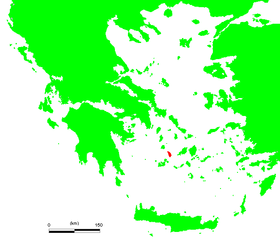 Location of Sifnos in the Aegean Sea | |
| Specifications | |
| Square | 73.9 km² |
| Highest point | 679 m |
| Population | 2442 people (2001) |
| Population density | 33.04 people / km² |
| Location | |
| Archipelago | Cyclades |
| Water area | Aegean Sea |
| A country |
|
| Periphery | South Aegean |



Content
Geography
The island has an elongated shape. The island is about 15 kilometers long and 7.5 kilometers wide. The area of the island is almost 74 km², and the coastline is about 70 kilometers.
History
The island was inhabited by people several thousand years ago. On the island there is evidence of a stay on it in antiquity by the Phoenicians and the inhabitants of Caria . In the second millennium BC Minoan culture existed on the island, the island was closely connected with Crete . Apparently at this time, gold and silver mines began to be developed on the island. During the period of the great Greek migration, the island was inhabited by the Ionians . In the VI century BC e. the island experienced its heyday, mainly due to its gold and silver. The island was so rich that it dedicated an entire treasury to the temple of Apollo at Delphi - the so-called Treasury of the Sifnos . Herodotus mentions this in his “ History ” [1] :
Sifnos then flourished and was the richest of all the islands. On the island there were gold and silver mines, so rich that on a tithe of income from them, the Siphnians erected one of the most magnificent treasures in Delphi. Every year, citizens of the island shared income among themselves
.
But gradually the extraction of gold and silver on the island ceased. Pausanias writes about it this way [2] :
The Siphnians also arranged a treasury for the following reason: the Siphnians on the island discovered gold placers, and God told them to bring a tenth of the Delphi from the proceeds. They built a treasury and began to bring tithing here. But when they ceased these contributions due to greed, the sea spilled and buried their placers by flood.
Another famous product from the island was blue or blue Sifnos stone, which was actively used in the construction and decoration of buildings throughout Hellas, in particular in Athens. The British archaeologist Bent discovered in two places on the seashore traces of ancient workings, and in addition, also on the seashore he discovered a rather long adit. In its walls, cut-out niches for miner lamps were visible. Tools were also found and traces of them on the walls of the adit. Bent examined the bottom of the sea and found the remains of slag. This confirms the data of Pausanias about the earthquake on the island, as a result of which most of the mines were flooded [3] .
In addition to gold and silver, iron was mined on the island. Iron ore deposits have been preserved on the island to this day. Thanks to its special clays, the island was famous throughout Greece for its pottery and ceramics production. This was the main occupation of the inhabitants of the island in ancient times.
In the V century BC e. the island was part of the Athenian Maritime Union , then part of the Roman Empire . In the Roman era, the island was used as a place of exile. After the fall of Rome, the island was part of Byzantium . In 1207, it was captured by the crusaders and transferred by them to the Duchy of Naxos . After the death of the latter, it became part of the Republic of Venice . Unlike other Cycladic islands, the island became part of the Ottoman Empire quite late, only in 1607. Sifnos has been a part of Greece since the reconstruction of the modern state - since 1831.
Settlements
On the island there are several settlements. The harbor of the island of Kamares is located on the west coast and has a little more than 100 permanent residents, connected by bus with the rest of the villages of the island. The capital Apollonia (population about 1000 people), located 6 kilometers from Camares - built on three hills, attracts with its traditional architecture. The city has a Museum of Local History and the Archaeological Museum with a collection of sculptures of the Archaic and Hellenistic eras and ceramics of various periods - from geometric to Byzantine . Both Apollonia and the settlements around it - Artemonas , Exambela , Kato Petali - are examples of Cycladic architecture. This is a kind of architectural ensembles, where everything - walls, stone benches, courtyards, streets - resembles the endless interweaving of cubes, which is in complete harmony with the surrounding landscape. The only exception is the old capital of Castro , which remains a model of medieval architecture. Castro is located 3 kilometers from Apollonia on a small hill; the village also has a small archaeological museum. The island’s landscape is complemented by numerous windmills and 365 churches and chapels that “grow” everywhere like porcini mushrooms on a gray carpet.
Transport
There is a ferry from Piraeus to the island along the route Piraeus - Kitnos - Serifos - Sifnos - Milos - Kimilos . Some ferries to the islands of Paros and Naxos also stop on the island. Numerous boats, catamarans and hydrofoils can be accessed to the neighboring Cyclades islands.
Famous Natives
- Panorios, Konstantinos ( Greek Κωνσταντίνος Πανώριος ; 1857-1892) - Greek artist of the second half of the 19th century, representative of the Munich school of Greek painting.
- Gregory VII - in the world of Zervudakis (Greek Ζερβουδακης), Ecumenical Patriarch [Constantinople] [1923-1924].
- Ioannis Griparis (Greek Ιωάννης Γρυπάρης, 1870-1942) - theater writer and translator, director of the National Theater of Greece.
- Provlengios, Aristomenis ( Greek Αριστομένης Προβελέγγιος , 1850-1936), Greek politician and poet.
Notes
Links
- Official site of the island (English)