Tuvalu ( Tuvalu Tuvalu , English Tuvalu ; until 1975 - Ellis Islands ) - Pacific state in Polynesia . The coastal strip is 21 km long. Tuvalu is located on 5 atolls and 4 islands of the Tuvalu archipelago. The islands are scattered over 350 km; the distance between neighboring islands is usually from 50 to 100 km. The total land area is 26 km². The population of the country is 11 206 people. ( 2011 , estimate). The capital is Funafuti .
| Tuvalu | |||||
|---|---|---|---|---|---|
| Tuvalu Tuvalu English Tuvalu | |||||
| |||||
| Motto : “Tuvalu mo te Atua (Tuvalu is for Almighty God)” | |||||
| Anthem : Tuvalu mo te Atua | |||||
 | |||||
| Independence date | October 1, 1978 (from the UK ) | ||||
| official languages | Tuvalu , English | ||||
| Capital | Funafuti | ||||
| The largest city | Funafuti | ||||
| Form of government | constitutional monarchy [1] | ||||
| Monarch | Elizabeth II | ||||
| Governor General | Jacob Italeli | ||||
| Prime Minister | Enele Sopoaga | ||||
| Territory | 191st in the world | ||||
| • Total | 26 km² | ||||
| •% water surface. | 0 | ||||
| Population | |||||
| • Evaluation (July 2017) | ↗ 11 052 [2] people ( 226th ) | ||||
| • density | 425.08 people / km² | ||||
| GDP | |||||
| • Total (2013) | $ 31.35 million ( 188th ) | ||||
| • Per capita | $ 1,600 | ||||
| Currency | Tuvalu dollar Australian dollar ( AUD, code 36 ) | ||||
| Internet domain | .tv | ||||
| ISO code | |||||
| IOC Code | |||||
| Telephone code | +688 | ||||
| Time Zones | +12 | ||||
| Car traffic | |||||

The islands of Tuvalu were discovered by the Spanish navigator Alvaro Mendanya de Neuro in 1568 . In 1892, the archipelago became a British protectorate of Ellis Island , and in 1916 - part of the British colony of Gilbert Island and Ellis . In a 1974 referendum , the Polynesian population of the Ellis Islands voted to secede from the Micronesian Islands of Gilbert (subsequently Kiribati ), and the following year the archipelago became a separate British colony of Tuvalu . The islands gained independence in 1978 . Tuvalu is a member of the UN , the South Pacific Commission and the Pacific Islands Forum .
Etymology
The archipelago got its modern name only in 1975 , and translated from the Tuvalu language it means “ eight standing together ” [4] (referring to eight traditionally inhabited islands of Tuvalu; the ninth - Niulakita - was settled relatively recently). The European discoverer of the islands, Alvaro Mendanya de Neira , called the archipelago " Lagoon Islands ", and in 1819 he received the name " Ellis Islands ", which was used for almost the entire colonial era [5] .
Physico-geographical characteristics
Geographical position
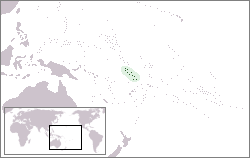
The Polynesian state of Tuvalu is a cluster of atolls and islands located in the Pacific Ocean just south of the equator . The capital of the country, the city of Funafuti Atoll, is located 1050 km north of the city of Suva , the capital of Fiji , and 4000 km northeast of Sydney , Australia's largest city [6] . The nearest archipelagos are the Gilbert Islands , which belong to the Republic of Kiribati and located northwest of Tuvalu, and the Wallis and Futuna Islands , which lie to the southeast and belong to France .
The land area of Tuvalu is only 26 km² [7] , while the area occupied by the lagoons is more than 494 km². The country is located on 5 atolls ( Nanumea , Nui , Nukulaelae , Nukufetau , Funafuti ), 3 low-lying coral islands ( Nanumanga , Niulakita , Niutao ) and one atoll / reef island ( Vaitupu ) [8] , stretching from the northwest to the southeast 595 km [6] The largest island of the archipelago (based on the land area, not the water surface of the lagoon) is Vaitupu Atoll (5.09 km²), and the smallest Niulakita (0.4 km²) [9] . All islands are low-lying, and atolls mainly consist of several islands, or motu , which are exposed to the negative effects of coastal abrasion (mainly the western sides of the islands facing the ocean [10] ). The highest point of the country reaches only 5 m [7] .
The northernmost island of Tuvalu is the Nanumea Atoll, and the southernmost is Niulakita . The smallest distance between the two islands of the archipelago is 67 km (Nukufetau / Vaitupu), and the largest - 172 km (Nui / Vaitupu) [11] .
Geology
Five of the nine islands of Tuvalu are atolls (the remaining islands are elevated atolls ). According to the theory of Charles Darwin , the formation of atolls occurred as a result of the immersion of volcanic islands , on the surface of which corals gradually grew. A fringing reef , and subsequently a barrier , was formed, which was gradually built up by corals. As a result, a dry atoll appeared [12] . Coral and algae growth proceeded most actively in reef areas facing the ocean, as a result of which these outer edges of the reef kept pace with the subsidence of the volcanic island. The inner regions of the island, on the contrary, were submerged under water. Subsequently, the formation of shallow lagoons took place in these places.
On the reef surface, sand gradually accumulated, which was formed under the influence of waves and currents, especially during strong tides. In the tidal zone of the beach, a coastal rock formed, an external inclined bed of stones. As a result, the ground plants appeared support on which they could grow. On the island, vegetation resistant to a high salt content in the soil was formed, which cemented various sedimentary rocks with its roots and prevented water and wind erosion . So the sand islands, or motu , of the atoll were formed [12] .
The elevated atoll is a raised volcanic island , formed as a result of the rise of the coral platform, or makatea , which surrounds the volcanic plateau in the center of the island.
Climate
The climate of Tuvalu is hot, tropical , and is influenced by the southeast trade winds [7] . Two seasons are clearly distinguished: the rainy season and the drought season. The wet season, during which up to 60% of precipitation falls, lasts from November to April, and the driest one - from May to October [13] . The average annual rainfall is about 3000 mm, although sometimes this figure can reach 4000 mm. Thus, the climate on Tuvalu is more humid than on the north islands of Gilbert and the south islands of Fiji . The climate on the northern islands of the country is more arid than on the southern [14] , and they are more prone to droughts, which can last up to three months [15] . Air temperature throughout the year remains high, varying from 26 to 32 ° C [15] .
The Tuvalu Islands lie in the trade winds of the southwestern Pacific Ocean at the border of the equatorial calm zones [13] . The prevailing wind directions are from the northeast or southeast. East / southeast winds prevail from May to October [13] .
Tuvalu is exposed to the negative effects of tropical cyclones , which often reach destructive power. For example, as a result of the Bebe cyclone, almost all residential buildings on the islands were destroyed; more than 90% of the trees were dumped, and the remaining 10% were badly damaged; two people died; two ships ran aground. Only thanks to the financial support of foreign countries in Tuvalu, it was possible to restore the old infrastructure destroyed by the cyclone [15] .
Global Climate Change
A significant threat to the future of the country is global warming, including the associated increase in the level of the World Ocean , as a result of which low-lying islands no higher than 5 m can be under water. Between 1993 and 1999, ocean waters annually attacked land at a speed of 22 mm, and in 1995 - 40 mm, which significantly exceeded global indicators [16] .
Other negative consequences of climate change include coastal erosion , fringing reef erosion, salinity intrusion , lack of drinking water, deterioration of groundwater , the economic situation in the country (including a threat to agriculture), and increased risks to public health [17] . Poor living conditions on the main island of Funafuti, caused by the growth of the atoll population, poor land use, lack of drinking water and a number of other factors, only exacerbate the current situation. In the event of a real threat to the population of Tuvalu, plans are underway to evacuate the population (possibly to New Zealand , Australia or Fiji ) [18] .
Nevertheless, not all scientists share the point of view about the imminent flooding of the archipelago, which is widespread among the public and is largely fueled by the media [19] . According to one opinion, an increase in the level of the World Ocean in the Tuvalu region may be a temporary phenomenon, which is determined by climatic, oceanographic, geological, and a number of other parameters. In addition, the change in the coastal strip of motu atolls is highly dynamic: land, retreating in front of the ocean in one part of the island, can grow in another, as was noted, for example, on the island of Vaitupu [19] .
Soil
Tuvalu soils are of coral origin. The soil is mainly formed from the remains of reef materials, corals , calcareous algae , foraminifera and mollusks , therefore the composition of local soils is mainly carbonate [20] . They are distinguished by high alkalinity , porosity (due to which they retain moisture very poorly) and low fertility [9] . In this case, fertility depends on several factors: first of all, the content and proportion of organic materials, as well as the proportion of coral material. The amount of minerals in Tuvalu soils is low, with the exception of calcium . On the islands there are also phosphate (formed from the litter of seabirds ) and humus soils (the latter in places of mangroves ) [21] .
Hydrology
Due to the small area, low altitude, and soil porosity, there are no rivers on the Tuvalu Islands [13] . Instead, water seeping through the earth forms a lens of slightly brackish water [22] . Therefore, local residents are forced to collect rainwater from the roofs and store it in concrete tanks. In the past, islanders received water for household needs from dug wells, but due to the penetration of salt water and wastewater into underground lenses, groundwater was polluted [23] .
Flora and Fauna
The plant world of the atolls is pretty monotonous. This is due to the fact that a significant part of the land of the islands is planted with coconut palms and other food plants [24] . On the shores grow sun - loving shtsevoly , tourneforcia , pandanus . In the inner parts of the islands there are ferns (among which large Asplenium nidus stand out), canavalesia , mangroves , other shrubs, groves of coconut palms , breadfruit , banana plantations. Often there are broad-leaved species of trees - ohrosia , guettarda , calophyllum and others. A total of 86 species of vascular plants are registered in Tuvalu, of which 44 are native. None of them is endemic [25] .
The fauna of the country is extremely poor and is represented mainly by introduced species . Among mammals, pigs , rats , dogs and cats are found . The population of seabirds on the islands is insignificant, since traditionally they are caught by local residents [25] . Frigates , cormorants , and petrels nest on motu not disturbed by humans. Small lizards , snakes , land crabs, hermit crabs are widespread.
The marine environment of Tuvalu is represented by six main types of ecosystems : oceanic, outer reefs, lagoon reefs, lagoon bottom, isolated reefs and natural channels connecting ocean and lagoon waters. In total, about 350 species of fish and 30 species of coral live in coastal waters [26] .
History
The early history of the archipelago is very poorly studied. The islands of Tuvalu were supposedly settled in 300-500 AD by immigrants from the islands of Tonga and Samoa . Nevertheless, a cave found on the island of Nanumanga with traces of a bonfire may indicate that the archipelago was colonized earlier.
The Spanish explorer Alvaro Mendanya de Neira , who sailed past the islands in 1568, became the European discoverer of Tuvalu. The traveler called the archipelago " Lagoon Islands ." Until the 18th century, Tuvalu went unnoticed by other sailors. Only in 1788, part of the islands was discovered by English captains Thomas Gilbert and John Marshall . In 1819, the Tuvalu Islands were surveyed from the Canadian ship Rebecca , whose captain named the archipelago “ Ellis Islands ” in honor of the owner of the ship.
In the first half of the 19th century, whalers began to sail past the islands, but due to the lack of convenient berths, the settlements of foreigners were not founded. In the second half of the century, Peruvian slave traders began to appear frequently on the archipelago, who during the period from 1862 to 1864 removed more than 400 people from the atolls of Funafuti and Nukulaelae . In 1865, the first Christian missionaries from the London Missionary Society landed on the Tuvalu Islands.
In 1892, the archipelago became part of the British protectorate of Ellis Island , and in 1916 - part of the British colony of Gilbert Island and Ellis . During the Second World War, the Allied military base was located on the Tuvalu Islands.
In 1974, a referendum was held on the archipelago, according to which the Ellis Islands, where the majority of the population were Polynesians , separated from the Gilbert Islands , which were inhabited mainly by Micronesians . The following year, the Ellis Islands became a separate British colony of Tuvalu, which gained independence in 1978 .
Administrative Division
Administratively, Tuvalu is divided into 7 island ( Nanumea , Niutao , Nanumanga , Nui , Vaitupu , Nukulaelae and Nukufetau ) and 1 city council ( Funafuti ) [27] .
| No. | Provinces | Title in English | Administrative center | Square, km² | Population, people (2002) | Density, people / km² |
|---|---|---|---|---|---|---|
| one | Vaitupu | Vaitupu | Asau | 5.60 | 1591 | 284.11 |
| 2 | Nanumanga | Nanumanga | Tonga | 2.78 | 589 | 211.87 |
| 3 | Nanumea | Nanumea | Lolua | 3.87 | 664 | 171.58 |
| four | Niutao | Niutao | Kulia | 2,53 | 698 | 275.89 |
| five | Well | Nui | Tanrake | 3.25 | 548 | 168.62 |
| 6 | Nukulaelae | Nukulaelae | Fangaua | 1.82 | 393 | 215.93 |
| 7 | Nukufetau | Nukufetau | Savave | 2.99 | 586 | 195.99 |
| eight | Funafuti | Funafuti | Waiaku | 2.79 | 4492 | 1610.04 |
| Total | 25.63 | 9561 | 373.04 |
Population
Number and location
| Tuvalu population [28] | |
|---|---|
| Population structure | |
| Population | 12 177 (2008, estimated) |
| Population density | 468 (2008) |
| Average age | total: 25.3 men: 24.2 women: 26.4 (2008) |
| Age structure | 0-14: 29,4 ‰ 15-64: 65.4 ‰ over 64: 5,2 ‰ (2008) |
| Urban share | 47% (2002) |
| Birth rate | |
| Total fertility rate | ,9 2.94 (2008) |
| Population growth rate | 1,577% (2008) |
| Mortality | |
| Infant mortality per 1000 born | total: ,9 18.97 (2008) boys: 21,56 ‰ (2008) girls: 16.25 ‰ (2008) |
| Total mortality per 1000 person | total: ,9 6.98 (2008) |
According to the last census of 2002, the population of Tuvalu was 9,561 people [29] (including tourists, temporary workers; the resident population is 9,359 people [29] ). By 2008, this figure increased to 12,177 people (estimate) [7] . Despite the fact that the population growth rate increased from 0.6% in 1991 - 2002 to 1.577% in 2008, the population growth in Tuvalu remains quite low compared to other countries in Oceania . One of the main reasons for this is the emigration of the population [30] . In 2001, 1960 representatives of the Tuvalu people lived in New Zealand (mainly in the cities of Auckland and Wellington ) (slightly less than 1% of the number of people of Oceania living in New Zealand) [31] . There are also diasporas from Tuvalu in Fiji (on the island of Kioa , which was rented by the inhabitants of Vaitupu after World War II ), Samoa , Kiribati (mainly descendants of the Tuvalian workers on Banaba Island ), Nauru (employees of the Nauruan Phosphate Company ) [32] .
Значительная часть населения Тувалу проживает в столице и единственном городе страны, Фунафути , — 47 % [30] . Внутренняя миграция населения, характеризующаяся переселением людей с отдалённых островов на атолл Фунафути, является одной из основных тенденций, отмеченных на Тувалу. Например, в 1992 году на атолле проживало 42 % населения страны, а в 1979 году — всего 29 % [33] . Это создаёт увеличенную нагрузку на ресурсы и земли острова, приводит к береговой эрозии , негативно сказывается на местной экосистеме. Единственными отдалёнными островами, где в 2002 году был отмечен рост населения, были Ваитупу (рост на 389 человек по сравнению с 1992 годом) и Нукулаэлаэ (рост на 40 человек) [34] . На всех остальных атоллах наблюдалась депопуляция : самая значительная — на острове Нукуфетау (численность населения уменьшилась на 165 человек). Самая высокая плотность населения в 2002 году была зарегистрирована на атолле Фунафути — 1610 человек на км², в то время как по стране эта цифра составляла 373 человека на км² (самая низкая плотность — на атолле Ниулакита , 83 человека на км²) [34] .
В 2002 году мужчины составляли 49,3 % (4614 чел.), женщины — 50,7 % (4745 чел.) [35] . Доля городского населения — 47 %, сельского — 53 % [29] .
Уровень естественного прироста в 2008 году составил 1,577 % [7] . Доля детей до 15 лет в 2002 году — 36,4 %, взрослого населения от 15 до 59 лет — 55 %, старше 60 лет — 8,6 %, таким образом, средний возраст населения составлял 23,6 года (в 1991 году — 25,1 года) [29] . Средняя продолжительность жизни мужчин, согласно оценке 2008 года , — 66,7 лет, женщин — 71,36 лет [7] .
Ethnic composition
Население Тувалу гомогенное: согласно переписи 2002 года более 94 % жителей были представителями коренного полинезийского народа тувалу , 4,6 % — представители смешанных браков тувалу и других народов, и только 168 человек (или 1,8 %) были иностранцами (прежде всего, выходцы с других островов Тихого океана , из них большинство — представители микронезийского народа кирибати ) [36] .
Языки
Помимо английского языка официальным языком страны является язык тувалу , относящийся к полинезийским языкам . В нём имеется большое количество заимствований из самоанского языка , который в прошлом использовался христианскими миссионерами. Тем не менее носители двух этих языков не понимают друг друга. Наиболее близким языком является токелау [37] . Общая численность носителей тувалу в 1998 году составляла около 10 670 чел. [37]
Для записи 11 согласных и пяти гласных звуков используется алфавит на основе латинского . Всего выделяются семь диалектов тувалу, которые разделяются на две диалектные зоны: северную (распространён на островах Нанумеа , Нануманга , Ниутао и Ниулакита ) и южную (официальный вариант языка; распространён на островах Фунафути , Ваитупу , Нукуфетау и Нукулаэлаэ ) [37] [38] .
В стране есть носители и других тихоокеанских языков: самоанского и кирибати [7] . Особый интерес представляет атолл Нуи , который в течение нескольких веков находился под сильным влиянием микронезийской культуры соседних островов Гилберта , воины которых захватили остров в XVII — XVIII веках [39] . Жители Нуи разговаривают на одном из диалектов языка тувалу, который является смешением языков кирибати , тувалу и самоанского [39] .
Религиозный состав
Господствующей религией на островах Тувалу является христианство , привнесённое на архипелаг священником Элекана ( англ. Elekana ) с острова Манихики в 1861 году [40] . Пробыв на островах Тувалу четыре месяца, священник отправился в Самоа , чтобы выучиться миссионерскому делу. Впоследствии Элекана вернулся на архипелаг, а сами острова вошли в сферу влияния Лондонского миссионерского общества . В 1969 году от этого миссионерского общества отделилась Церковь Тувалу ( англ. Te Ekalesia Kelisiano Tuvalu ) [40] .
В 2002 году доля протестантов ( конгрегационалистов Церкви Тувалу) составляла 91 % (8521 человек), адвентистов седьмого дня — 2 % (183 человек). За ними следовали представители Веры Бахаи (177 человек), Ассамблеи братьев ( англ. Brethren Assembly , новое протестантское течение, 166 человек) [41] . На островах также представлены другие религиозные течения, но количество их сторонников невелико.
На всех островах Тувалу имеются традиционные вожди, которые одновременно являются членами Церкви Тувалу. Большая часть последователей других религий представлены на атолле Фунафути (за исключением острова Нанумеа , где зарегистрирована большая доля последователей Бахаи ) [42] .
Конституция страны гарантирует свободу вероисповедания [42] .
Political structure
Государственный строй
Тувалу — суверенное демократическое государство [43] Конституция, принятая 1 октября 1978 года , устанавливает монархическую форму правления с Вестминстерской системой парламентаризма [44] .
Ряд премьер-министров страны ( Сауфату Сопоанга , Маатиа Тоафа ) были сторонниками изменения государственного строя Тувалу с монархического на республиканский , возглавляемый президентом (в настоящее время страна входит в состав Содружества наций и официальным главой государства является британский монарх). Однако на референдуме, состоявшемся 30 апреля 2008 года , за сохранение монархии проголосовало 1260 человек, и только 679 — за переход к республике [45] .
Законодательная власть
Законодательным органом страны является однопалатный парламент , или Фале И Фоно ( тувалу Fale I Fono ) (также называется Палатой ассамблей ), состоящий из не менее, чем 12 депутатов [46] , и избираемый на четырёхлетний срок [44] . Депутаты избираются на основе всеобщего избирательного права по мажоритарной системе относительного большинства в многомандатных и одномандатных округах. Правом избрания в депутаты парламента обладают все граждане Тувалу, достигшие 21 года [47] (при этом существует ряд исключений, при которых кандидатам отказывают в регистрации [48] ). Сразу же после парламентских выборов члены парламента из своего числа избирают спикера [49] Глава государства вправе распустить парламент в случае, если остаётся вакантным место премьер-министра или если в течение определённого периода времени (он определяется здравым рассудком главы государства) премьер-министр так и не был избран [50] .
Парламент Тувалу наделён правом издания законов, которые не противоречат Конституции страны [51] . Каждый член парламента вправе вносить на рассмотрение законопроект , предложение о дебатах в парламенте, подать петицию в парламент [52] . Как одна из форм ответственности и консультаций все законопроекты после первого чтения в парламенте направляются в местные правительства (или фалекаупуле ) на рассмотрение и комментирование. Исключением из этого правила являются те законопроекты, за которые поручился генерал-губернатор Тувалу, а также те, которые не имеют общественной значимости [52] . В этих случаях генерал-губернатор обязан действовать по рекомендации Кабинета министров.
Исполнительная власть
Согласно Конституции Тувалу монархом и главой государства является Её Величество Королева Великобритании Елизавета II [53] . Пост главы государства является символом единства и самобытности Тувалу [54] . Глава государства обязан действовать только по рекомендации Кабинета министров, премьер-министра или другого министра, который наделён общими или специальными полномочиями Кабинета [55] .
Глава государства представлен в Тувалу генерал-губернатором , назначаемым им по совету премьер-министра (при этом премьер-министр должен заранее проконсультироваться с другими членами парламента) [56] сроком на четыре года [57] . Генерал-губернатором может стать только человек, достигший возраста 50 лет. Однако он не должен быть старше 65 лет [58] . Генерал-губернатор выполняет функции главы государства, если тот находится за пределами Тувалу или в преклонном возрасте, является неправоспособным [59] .
Помимо главы государства и генерал-губернатора, которые согласно Конституции Тувалу наделены исполнительной властью [60] , существует Кабинет министров , несущий коллективную ответственность перед парламентом за выполнение исполнительных функций правительства страны [61] . Кабинет состоит из премьер-министра и других министров [62] , которых должно быть не более 1/3 от общего числа парламентариев [63] и которые одновременно являются членами парламента [64] . Один из министров, не считая премьер-министра Тувалу, является заместителем премьер-министра, который назначается главой государства по рекомендации премьер-министра [65] . Премьер-министр избирается тайным голосованием членами парламента из своего состава [66] . Сфера ответственности премьер-министра и других министров определяется главой государства, который должен руководствоваться рекомендациями премьер-министра [67] . В целом, премьер-министр ответственен за Кабинет министров и парламент, конституционные и политические вопросы, государственную службу, координацию правительства, судебные и юридические вопросы, телерадиовещание и информацию, полицию, тюрьмы, противопожарную службу, иммиграцию, религиозные вопросы, национальные выборы и внешнюю политику [68] .
Судебная власть
Система судебных органов Тувалу включает Юридический комитет Тайного совета в Лондоне ( англ. Sovereign in Council ), апелляционный суд ( англ. Court of Appeal for Tuvalu ), Высокий суд ( англ. High Court of Tuvalu ) и другие виды судов (среди них: магистратские суды и островные суды) [69] .
Высокий суд Тувалу — высший суд письменного производства [70] , суд первой инстанции в рассмотрении уголовных и гражданских дел, установленный Конституцией [69] . Он состоит из председательствующего судьи и других судей, количество которых оговорено текущим законодательством [71] . Председательствующий судья назначается главой государства по рекомендации Кабинета министров [72] , остальные судьи — по рекомендации Кабинета после консультаций с председательствующим судьёй [73] . Судьями могут стать только лица, являющиеся или бывшие судьями в судах неограниченной юрисдикции по гражданскими и уголовным делам в любой из стран, законодательство которой схоже с законодательством Тувалу, или в судах, которые рассматривают апелляции от подобных судов [74] . Также обязательным условием является наличие пятилетней практики в качестве барристера или солиситора [75] . В юрисдикцию Высокого суда Тувалу входит: рассмотрение вопросов, связанных с обеспечением Билля о правах, содержащемся в Конституции страны; вопросов по членству в парламенте; других вопросов, связанных с интерпретацией и применением Конституции [76] ; слушание апелляций на решения нижестоящих судов [77] .
Апелляционный суд Тувалу занимается рассмотрением апелляций на решения Высокого суда независимо от того, является ли это осуществлением общей или апелляционной юрисдикции [78] . Тайный совет рассматривает апелляции на решения Апелляционного суда [79] .
Избирательные округа
Избирательными правами наделяются граждане Тувалу, достигшие 18 лет [80] . Не имеют права участвовать в выборах лица, приговорённые судом любой из стран Содружества наций к смертной казни или тюремному заключению сроком более 12 месяцев и впоследствии не помилованные; признанные душевнобольными; вычеркнутые из списков избирателей за оскорбления, связанные с выборами [81] . В случае тюремного заключения гражданин Тувалу может принять участие в выборах только спустя три года после освобождения [82] .
Страна разделена на 8 избирательных округов [83] . Округа Ваитупу , Нанумеа , Ниутао , Фунафути представляют в парламенте два депутата; округа Нануманга , Нуи , Нукуфетау , Нукулаэлаэ — один депутат [84] .
Local government
Впервые местное самоуправление на островах было введено в колониальный период в середине 1960-х годов с учреждением островных советов, островных судов и островных земельных судов. При введении этой системы администрация не придала особого значения традиционным формам управления на островном уровне, поэтому ряд функций, которые выполняли традиционные лидеры, оказались в юрисдикции новообразованных островных советов, которые, однако, не пользовались авторитетом у местных жителей [85] .
Возвращение к традиционным формам местного самоуправления произошло в 1997 году , когда с принятием Закона о фалекаупуле были официально признаны фалекаупуле ( тувалу Falekaupule ), или традиционные собрания, существующие на каждом острове Тувалу. После передачи им ряда функций, ранее выполняемые местными правительственными советами, фалекаупуле получили бо́льший контроль над деятельностью и делами островов, которые, в свою очередь, стали более самостоятельными в решении внутренних вопросов [86] . Всего существует восемь фалекаупуле (на островах Ваитупу , Нануманга , Нанумеа , Ниутао , Нуи , Нукуфетау , Нукулаэлаэ , Фунафути ), в каждой из которых входят по шесть человек [87] . Исполнительным подразделением фалекаупуле являются каупуле ( тувалу Kaupule ), которые выполняют ряд функций, упомянутых в Законе, кроме избрания пуле (главы) каупуле, одобрения островного бюджета, постановлений и назначения служащих, работающих в каупуле [88] .
Политические партии
В Тувалу отсутствуют политические партии , хотя существует неофициальная оппозиционная группа, которая состоит из людей, которые не поддерживают правительство [89] .
Вооружённые силы и полиция
В Тувалу отсутствуют постоянно действующие вооружённые силы , поэтому в бюджете страны не предусмотрены расходы на содержание армии.
Однако в Тувалу существуют полицейские силы ( англ. Tuvalu Police Force ), которые включают в себя подразделения по наблюдению за морским пространством (в задачу входят поисковые и спасательные миссии, разведывательные операции [90] ), таможенное, тюремное и иммиграционное подразделения. Основной их задачей является поддержание закона и порядка, сохранение мира, защита жизни и собственности, предупреждение и расследование преступлений [91] . В 2007 году в полиции страны служил 81 человек [92] . Полицию Тувалу возглавляет начальник, назначаемый генерал-губернатором по рекомендации Комиссии по вопросам государственной службы, которая заранее должна проконсультироваться с Кабинетом министров [93] .
В 2003 году в стране было совершено 2345 преступлений (в 2002 году — 2370). Из них: против личности человека — 1666, кражи — 591 [94] .
Внешняя политика и международные отношения
Тувалу поддерживает дипломатические отношения с более чем 28 странами, в том числе и с Тайванем [95] .
18 сентября 2011 Тувалу признало независимость Абхазии , 19 сентября — Южной Осетии . 22 октября 2011 года между Тувалу и Российской Федерацией установлены дипломатические отношения [96] .
Грузия разорвала дипломатические отношения с государством Тувалу 16 февраля 2012 года из-за признания последней независимости Абхазии и Южной Осетии. Ранее дипломатические отношения между Грузией и Тувалу были установлены в феврале 2011 года [97] . 31 марта 2014 года в Тбилиси представители Тувалу подписали акт о восстановлении дипломатических отношений и отозвали акт признания независимости Абхазии и Южной Осетии [98] [99] .
Единственной страной, которая имеет своё посольство в столице этого тихоокеанского государства городе Фунафути , является Тайвань [100] . Единственное же дипломатическое представительство Тувалу расположено в Фиджи . Страна также имеет постоянного представителя при ООН и почётных консулов в Новой Зеландии , Австралии , Германии , Японии , Великобритании , Швейцарии и Тайване.
Основным регионом внешнеполитической деятельности Тувалу является Тихий океан, однако в последние годы страна стала принимать активное участие не только в региональных, но и международных форумах, основной темой которых является проблема изменения глобального климата. Тувалу — член ООН (стал 189 государством-членом 5 сентября 2000 года [101] ), Содружества наций , Секретариата тихоокеанского сообщества , Форума тихоокеанских островов , Стран Африки, Карибского бассейна и Тихоокеанского региона и других международных организаций.
Economics
General characteristics
| Экономика Тувалу [28] | |
|---|---|
| Currency | 1 Австралийский доллар (AUD) = 100 центов, 1 Доллар Тувалу = 100 центов (используются только монеты) |
| Бюджетный год | Календарный год |
| Торговые Организации | ? |
| Statistics | |
| Положение в мире (судя по ППС) | 229-я (2006) |
| ВВП (ППС) | $14,94 млн (2002, оценка) |
| Рост ВВП | 3 % (2006) |
| ВВП на душу населения (ППС) | $1600 (2002, оценка) |
| Инфляция | 3,8 % (2006, оценка) |
| Рабочая сила | 3615 (2004, оценка) |
| Unemployment | NA |
| Главные отрасли народного хозяйства | сельское хозяйство , туризм |
| Торговые партнёры | |
| Export | $1 млн (2004, оценка) |
| Главные партнеры (экс.) | Германия , Италия , Фиджи |
| Import | $12,91 млн (2005) |
| Главные партнеры (имп.) | Фиджи , Япония , Китай , Австралия , Новая Зеландия |
| Gos. Finance | |
| Доходы бюджета | $21,54 млн (2006) |
| Расходы бюджета | $23,05 млн (2006) |
Характеристики, определяющие экономическую ситуацию на Тувалу, ничем не отличаются от характеристик других стран Океании: огромная исключительная экономическая зона , ограниченные природные богатства, отдалённость от основных мировых рынков сбыта, дефицит высококвалифицированных специалистов. При этом основными факторами, которые могут повредить экономической стабильности на островах, являются нестабильность международных инвестиций , снижение доходов от лицензирования судов, природные катастрофы и колебания на мировых рынках [102] .
Экономика на островах рыночно-натуральная: ориентированная на рынок экономическая деятельность в основном сосредоточена в городе Фунафути , в то время как на отдалённых островах преобладает хозяйство натурального типа [102] . Тувалу относится к странам Четвёртого мира , то есть к беднейшим в мире [103] .
Экономика страны в значительной степени базируется на государственном секторе , составляющем около 60 % ВВП страны [104] . Основными отраслями экономики по состоянию на 1998 годы были: государственное обслуживание (25 %), строительство (16 %), торговля и услуги государственных предприятиий, не относящихся к ЖКХ (15 %), сельское хозяйство и рыболовство (13 %), базовая экономическая деятельность (31 %) [104] .
Substantial cash inflows are made annually through the Tuvalu Trust Fund , an international fund founded in 1987 by Australia , the United Kingdom, and New Zealand with the support of South Korea and Japan . Thanks to investments, the fund’s capital increased in 2006 from the initial USD $ 17 million to USD $ 77 million [7] .
Despite the existence of a large number of factors that impede the country's economic development, in recent years certain successes have been achieved in the economic sphere, which can be explained by several reasons: an increase in remittances from Tuvalu citizens working on foreign ships, good income from issuing licenses to foreign courts for the right catching fish in the EEZ , significant cash proceeds from the sale of the national top-level domain ( .tv ), increased financial support to foreign countries [105] .
According to the CIA in 2002, the country's GDP was about $ 14.94 million, and GDP per capita - $ 1600 [7] . Moreover, its growth over the past decades has been very uneven. For example, in 1998 it reached 19%, in 2000 - 14%, and in 1996 and 1999 it had negative indicators: −1% and −6% [106] .
Agriculture
One of the important sectors of the economy of Tuvalu is agriculture . Nevertheless, the development of this industry is negatively affected by low fertility, porosity, and salinity (especially after high tides and cyclones) of local soils, many of which are unsuitable for cultivation [10] . Most of these lands are concentrated on the northern islands of the archipelago, where the climate is also more arid than on the southern islands.
The main agricultural crop is coconut palm , which has the widest application. Coconuts are used by locals for food, as well as pet food (mainly pigs). Coconut milk is used to make Toddy's alcoholic beverage. Other parts of the plant, especially the leaves, go to weave mats, baskets and other craft products. Coconut wood serves as the most important building material, as well as firewood. From the oily endosperm of the nuts of this plant produce copra - the main export product of the country. However, in recent years, its production has decreased significantly (mainly due to low world prices) [107] . Other common crops are pandanus , breadfruit , bananas , papaya . Residents also dig small pits in which they grow a giant swamp taro ( English Cyrtosperma chamissonis ).
For their own needs, the islanders raise pigs , chickens and ducks .
Fishing
Fish is one of the national wealth of Tuvalu, which plays a very important role in the economy and life of the country and forms the basis of the diet of local residents. The country has a huge exclusive economic zone (EEZ), whose area is 518 670 km² [8] . Thanks to agreements with other countries of the world on the right to fish in the EEZ, a significant inflow of funds to Tuvalu is ensured (for example, in 2000, license revenues amounted to AUD $ 9.7 million or 44% of all state revenues [104] ). In the ocean, they are mainly engaged in fishing for mackerel fish, especially tuna of lat species . Katosowonuspelamis . Tuvalu's main fisheries partners are the United States , Japan and China .
Approximately 15% of Tuvalu's adult population work abroad as seamen in merchant ships, and the money transfers they make are an important source of income for the country: in 2006 they amounted to about $ 4 million [7] .
Transport
In 2002, the Tuvalu highway was only 8 km long [7] . There is no railway transport in the country.
Flights to Tuvalu are operated by Air Fiji (flights from Suva , the capital of Fiji ) and Air Pacific (flights from Nadi ( Fiji )) [108] . In total, in 2007 there was 1 airport operating in the country - Funafuti International Airport [7] .
Funafuti has public transportation , but taxis are the most popular mode of transport. The only port in the country is the city of Funafuti. Despite the small area of Tuvalu, the fleet of this state is 74 ships [7] .
Communication
The press of Tuvalu is represented by only two publications: the government newsletter Sikuleo o Tuvalu is published in the language of Tuvalu ; Tuvalu-English newspaper [109] “ Tuvalu Echoes ” is the property of the government Tuvalu Media Corporation , which also owns the online news portal “ Tuvalu News ” [110] .
There is one FM station on the islands: Radio Tuvalu . There are no national television channels in the country; locals, however, use satellite television [109] .
Various types of telecommunication services are available in Tuvalu: telex , telephony , Internet . In 2005, there were 900 home telephones and 1300 mobile phones in use in the country [7] . In 2002, 1,300 people used the Internet in Tuvalu [7] .
In the early 1990s, in connection with the development of the Internet, the Tuvalu .tv national domain (translated from English as “ television ”) aroused particular interest among telecommunication companies. In 1998, the Tuvalu government sold it to the Canadian company Information.ca , hoping for high revenues and a payout of USD $ 50 million [111] . But soon the deal was broken, and the domain was sold to The .tv Corporation International , an American company, which later became part of Idealab! Internet Incubator ”(headquarters in California ). According to the new contract, Tuvalu received a 20% stake in the new company and a minimum income of USD $ 50 million (the amount was to be paid within 12.5 years at USD $ 1.0 million per quarter) [111] . In 2000, the country received an additional one-time payment of USD $ 12.5 million. But the potential for registration in the domain was too high, and at the end of 2001, The .tv Corporation International sold the domain for USD $ 45 million to another American company, Verisign Corporation , which is engaged in the registration of sites in the domains .com , .net and .org [112] . Tuvalu received an additional USD $ 10 million for signing the contract. Under the new agreement, the government of the country is also guaranteed annual payments of USD $ 2.2 million and 5% of the annual revenue from registration in the domain, and Verisign Corporation received domain rights until 2016 [ 113] .
From the early 1990s to 2000, Tuvalu also handed over its telephone code to 688 various companies specializing in the provision of telephone sex services. At the same time, the cash income from the telephone code for the tiny country was quite noticeable: in 1999 they amounted to AUD $ 3 million (or USD $ 1.6 million). But for religious and moral reasons, the Tuvalu government was forced to abandon this source of income [114] .
An additional source of replenishment of the state budget is the issue and sale of postage stamps and coins . The Tuvalu Philatelic Bureau was established in 1978 , becoming the third largest employer in Tuvalu by the beginning of the 1980s. The peak issue and sale of postage stamps in the country dates back to 1980 - 1981 , when revenues in this area amounted to 20% of the state budget [115] . But after the government’s attempt to increase the issue of stamps due to topics such as World Leaders, Cars, Trains and Football Players, the interest of philatelists around the world has fallen sharply [116] . After that, Tuvalu was not able to regain its position, and currently the proceeds from the sale of brands are much lower than they were before.
Tourism
The tourism sector of the economy of Tuvalu is poorly developed, and the number of tourists arriving in the country remains quite low compared to other countries in Oceania . The reason for this may be several factors, the main of which are poor air communication with other countries of the world and the high cost of flights, poor quality of the services provided (including the underdevelopment of the hotel sector) [117] . Nevertheless, in Tuvalu there are prerequisites for the development of ecotourism .
In 2007, 1,130 people visited the islands (for example, in 1998 - 1,006 people, in 2003 - 1,377 people) [118] . The main flow of tourists goes to Funafuti Atoll, where the only hotel in the country [119] and other tourist accommodation are located. In 2002, tourism revenue accounted for 13.46% of Tuvalu's GDP [120] . The archipelago is mainly visited by citizens of Japan , Fiji , Australia and New Zealand [121] .
Foreign Economic Relations
Tuvalu's main exports are copra , coconuts, bananas, frozen fish, vegetables, handicrafts, clothes and shoes. The country depends on imports of food, manufactured goods, machinery and fuels. Import is far superior to export. In 2006, exports amounted to AUD $ 13,033,348, and imports - AUD $ 16,838,622.
The main import partners in 2006 were Fiji (46.1%), Japan (18.9%), China (18.2%), Australia (7.7%), New Zealand (4.1%). The main export partners are Germany (60.5%), Italy (20.1%), Fiji (6.9%) [7] .
Monetary and Finance
Monetary units of Tuvalu - the dollar of Tuvalu and the Australian dollar . In the period from 1966 to 1976, only the Australian dollar was in circulation in the country, but from 1976 the Tuvalu dollar was introduced, which exists only in the form of coins. By itself, it is not an independent currency, but, nevertheless, has its own code ISO 4217 . In monetary terms, the dollar of Tuvalu is equal to the Australian dollar.
For the 2006 budget , expenditures amounted to 23.05 million US dollars, and revenues - 21.54 million US dollars [7] . At the same time, the expenses of the Tuvalu government remain very high: their ratio with the country's GDP fluctuated between 150-220% between 1999 and 2003 [122] . It follows that government spending is the main driver of economic activity in Tuvalu. This is due to the fact that the private sector is only in its infancy, and it is unlikely that it will be able to become a leading sector of the economy due to the many factors hindering its development [122] .
An important source of replenishment of the country's budget are also postage stamps , which are of interest to philatelists from around the world.
There is no central bank in the country, and the domestic banking system of Tuvalu is represented by only one bank - the National Bank of Tuvalu, which is owned by the government [123] .
Culture
Social Organization
Even before the advent of Europeans in Tuvalu , the local population was divided into separate groups, whose members had certain rights and obligations. Historically, each island of the archipelago was politically independent, although there were close ties between the atolls of Funafuti , Nukufetau , Nukulaelae and Vaitupu based on the veneration of a common ancestor and ritual hierarchy [124] .
The recognized leaders of traditional society, both politically and religiously, were aliki ( tuvalu aliki ), or leaders, whose power was inherited. With great authority, they led the lives of the islanders. According to the ideas of the Tuvalu people, there was a close relationship between the supernatural world and Alik: in fact, the leader was the shadow of a more powerful and powerful being, to whom the entire Universe obeyed [125] . Any decision of Alik was final and unchanged, so every islander was obliged to obey him, otherwise punishment could follow until death. Aliki's close associates and assistants were called tao aliki ( Tuvalu tao aliki ). They advised the supreme leader on housekeeping, reported on possible threats, were intermediaries between residents and aliki, organized the distribution of land and food between the community members [125] . The oldest heads of communities enjoyed special respect. They could make comments on Alika (mainly in matters of food supply and preparation for war), often advised him. Women were engaged in household work, weaving mats, baskets, making jewelry. Each Tuvalian family, or sologa ( Tuvalu sologa ), was engaged in a certain business in the community: someone built houses, someone canoeed and so on [125] .
Music and Dance
A significant place in the life of the Tuvalu people is occupied by music and dances , which are closely interconnected with each other.
The musical style of Tuvalu has evolved over several centuries and can be described as “the musical microcosm of Polynesia, where modern and older styles coexist ” [126] . However, many of the musical and dance traditions have not survived [126] . A negative influence in this regard was played by the appearance in Tuvalu of Christian missionaries who distributed songs with religious content and European melody among the islanders and forbade the performance of many traditional dances for ethical reasons [127] . For example, before the missionaries appeared on the islands, traditional music was accompanied by singing, which was similar to monotonous reading, but later this tradition disappeared, as well as special songs that were performed by women during the work of men [126] . The theme of the songs was very diverse: they mainly reflected the daily life of the islanders, their feelings and emotions. There were also songs on mythological themes [128] .
In addition to the entertaining function, the two traditional Tuvalian dances of Fakanau ( Tuvalu fakanau ) and Fakaseasea ( Tuvalu fakaseasea ) were also of other importance: they were performed in honor of the ruling leaders or distinguished islanders who succeeded in canoeing , fishing, and courage [129] . However, of these two dances, only fakaseasea has survived.
Fakanau was a sedentary dance, accompanied by movement of the arms and upper body. It was widespread on the islands of Niutao and Nukufetau and was performed mainly by men who sat around [130] . Usually in the center was a grandfather, who was considered the most experienced in performing dance and was involved in keeping to the beat [131] . In Niutao, dance was sometimes performed sitting on one's knees or standing. Despite the popularity of fakanua, missionaries who arrived on the islands considered this dance too erotic and forbade it [129] . The ban was also caused by the fact that fakanau had religious significance.
The traditional female dance on the island of Niutao was oga, or onga ( Tuvalu oga, onga ), which was performed either sitting or on one’s lap [130] . Fakaseasea, unlike fakanau, is accompanied by a slower melody, and is performed by one or two dancers. The rest of those present sing or beat the beat.
The most famous type of dance, like the music of Tuvalu, is the Fatele ( Tuvalu fatele ), which traces the strong influence of European melodicity and harmony, and lyricism is the most important feature [126] . The dancers in the performance of the falley sit in two or more rows, so the best of them are in the front in the center. In a semicircle, facing the dancers, are the men and youth who make up the choir and beat the beat, hitting the mats with their palms (sometimes even on small wooden chests) [132] .
The only instrument used to accompany the dance was a small slotted gong called either nafa ( tuvalu nafa ) or pate ( tuvalu pātē , which is smaller than nafa) [133] . Very often, the melody was obtained thanks to light blows by fans on the palms. During the performance of phakaseasea and fatele, the women and men of the choir beat the mats on which they sat to beat the beat of the song, and while playing the oga, they clapped their hands [132] .
Sport
Tuvalu has its own national football team . However, the national federation is not a member of FIFA , while remaining an associate member of the Oceania Football Confederation . The first international match involving the Tuvalu national football team took place on August 29, 1979 , in which Tuvalu lost to the Tahiti island national team with a score of 0:18 (this was the team’s biggest defeat) [134] . The Tuvalu team won the biggest victory over the Tonga team on August 31, 1979 at the South Pacific Games in Fiji with a score of 5: 3 [134] . In 2007, the Tuvalu national team became the first non-FIFA world team to compete in the World Cup qualifiers [135] .
The country's National Olympic Committee was formed in 2004 and officially recognized by the IOC in 2007 [136] . Всего в стране насчитывается 11 действующих национальных спортивных федераций, из которых шесть являются членами международных федераций: по бадминтону , баскетболу , волейболу , тяжёлой атлетике , теннису и настольному теннису [137] . В 2008 году сборная Тувалу впервые участвовала в Летних Олимпийских играх, проходивших в Пекине (хотя и не завоевала ни одной медали), и была представлена в лёгкой и тяжёлой атлетике . В зимних Олимпийских играх страна ни разу не участвовала.
Holidays
Праздники Тувалу [138] :
| date | Title | Английское название |
|---|---|---|
| 1 января | New Year | New Year's Day |
| пятница перед Пасхой | Великая пятница | Good Friday |
| следующий день после Пасхи | Светлый понедельник | Easter Monday |
| второй понедельник марта или другая назначенная дата | День Содружества | Commonwealth Day |
| понедельник, следующий за вторым воскресеньем мая | День Евангелия | Gospel Day (Te Aso o te Tala Lei) |
| вторая суббота июня или другая назначенная дата | День празднования юбилея монарха | The day appointed for the celebration of the Anniversary of the Birthday of the Sovereign |
| первый понедельник августа | Национальный день детей | National Children's Day |
| 1 и 2 октября | День Тувалу | Tuvalu Day |
| второй понедельник ноября или другая назначенная дата | День празднования коронации монарха | The day appointed for the celebration of the Anniversary of the Birthday of the Heir to the Throne |
| 25 декабря | Christmas | Christmas Day |
| 26 декабря | День подарков | Boxing Day |
Social Sphere
Здравоохранение
После получения независимости в 1978 году правительство Тувалу рассчитывало построить на всех отдалённых островах высококачественные медицинские учреждения, но из-за нехватки средств, в конце концов, было принято решение о сосредоточении всех имеющихся ресурсов на модернизации единственного крупного медицинского объекта страны — Больницы принцессы Маргарет ( англ. Princess Margaret Hospital ), расположенной на атолле Фунафути . Новое современное здание больницы было открыто в 2003 году (строительство велось при поддержке Японии ) [139] . За пределами столицы Тувалу нет постоянных и частнопрактикующих врачей, а все медицинские услуги в стране предоставляются Министерством здравоохранения [139] . Визиты врачей на отдалённые острова происходят редко, что негативно сказывается на здоровье людей.
Основной причиной заболеваемости в Тувалу являются различные инфекционные заболевания : ежегодно регистрируется тревожное количество кожных , острых респираторных и глазных инфекций [140] (болезни дыхательных путей, прежде всего, грипп , простуда , являются самыми распространёнными) [141] .
После того как государство Тувалу стало участником мировых экономических процессов, там стали обычными болезни неправильного образа жизни, связанные с увеличением в рационе местных жителей риса, сахара, консервов и других нетрадиционных продуктов [139] . К ним относятся сахарный диабет , гипертония и ожирение . Дети часто болеют диареей , гастроэнтеритом [140] . Особую опасность в последние годы представляют заболевания, передающиеся половым путём . Наиболее широко они распространены среди местных моряков, которые работают на иностранных судах (они же входят в группу риска ВИЧ / СПИД ). У около 20 % населения Тувалу в организме найдены нематоды , являющиеся возбудителями филяриатоза [139] (заболевания, сопровождающегося воспалением и закупоркой лимфатических сосудов , которое приводит к отёчности и припухлости окружающих тканей [142] ) [139] .
Согласно переписи 2002 года 49 % мужчин и 3 % женщин атолла Фунафути регулярно употребляли различные алкогольные напитки (на отдалённых островах эта цифра чуть ниже — 45 % мужчин и 1 % женщин) [143] . Широко распространено курение : две трети всего мужского населения и одна четвёртая женского населения Фунафути являются курильщиками (на отдалённых островах — 60 % и 25 % соответственно) [143] .
Education
Образование в Тувалу является обязательным и бесплатным для детей в возрасте от 6 до 15 лет. Образовательная система страны включает несколько ступеней: двухлетнее дошкольное образование , восьмилетнее начальное образование и четырёхлетнее среднее образование [144] .
Всего в Тувалу зарегистрировано 17 дошкольных образовательных учреждений, управление которыми осуществляется различными родительскими ассоциациями, которые на собственные средства нанимают воспитателей [144] . Исторически правительство никогда не участвовало в организации деятельности этих учреждений, однако в последние годы оно стало уделять им большее внимание, например, выплачиваются ежегодные гранты трём квалифицированным воспитателям из каждого зарегистрированного дошкольного учреждения, оказывается и другая материальная поддержка, направленная на улучшение инфраструктуры и технической оснащённости [144] .
В начальных школах обучаются дети в возрасте от 6 до 13 лет. После сдачи государственного экзамена ученики продолжают обучение в средней школе , при этом школьникам предоставляется право повторно сдать экзамен в случае неудовлетворительной оценки [145] . В 2006 году в начальных школах обучалось 2067 человека (из них мальчиков — 1102 человек, девочек — 965 человек), количество учителей — 103 человека [146] .
Всего в стране действует одна средняя школа: до 1998 года их насчитывалось две, одна из которых находилась под контролем Церкви Тувалу. Но из-за высоких затрат церковь была вынуждена передать школу в собственность правительства, которое, в свою очередь, решило её закрыть [145] .
После средней школы дальнейшее образование можно получить в Морской школе Тувалу ( англ. Tuvalu Marine School ; основана в 1978 году ; ведётся обучение морскому делу [147] ), а также в Южнотихоокеанском университете , кампус которого расположен в Фунафути [148] .
Многие иностранные государства, прежде всего, Австралия , Новая Зеландия , Канада , Япония и Франция , оказывают значительную помощь Тувалу, финансируя различные образовательные проекты страны. Некоторые преподаватели повышают свою квалификацию в зарубежных учебных заведениях [149] .
Notes
- ↑ Атлас мира: Максимально подробная информация / Руководители проекта: А. Н. Бушнев, А. П. Притворов. — Москва: АСТ, 2017. — С. 93. — 96 с. — ISBN 978-5-17-10261-4.
- ↑ Всемирная книга фактов ЦРУ
- ↑ http://chartsbin.com/view/edr
- ↑ Timeline: Tuvalu (англ.) . BBC. Дата обращения 24 июля 2008. Архивировано 11 августа 2011 года.
- ↑ Эллис, архипелаг в Великом океане // Энциклопедический словарь Брокгауза и Ефрона : в 86 т. (82 т. и 4 доп.). - SPb. , 1890-1907.
- ↑ 1 2 Tuvalu. Location, size, and extent (англ.) . Encyclopedia of the Nations. Дата обращения 12 июля 2008.
- ↑ 1 2 3 4 5 6 7 8 9 10 11 12 13 14 15 16 17 Tuvalu (англ.) . CIA. The World Fact Book.. Дата обращения 12 июля 2008.
- ↑ 1 2 Ministry for Natural Resources and Environment. Sustainable Integrated Water Resources and Wastewater Management for Tuvalu. Diagnostic Report . — 2007. — С. 8.
- ↑ 1 2 Tuvalu (англ.) . Oceandots. Дата обращения 12 июля 2008. Архивировано 10 августа 2011 года.
- ↑ 1 2 Ministry of Natural Resources, Environment, Agriculture and Lands of Tuvalu. 2.1.1. Physiographic conditions // Tuvalu's National Adaptation Programme of Action . — май 2007. — С. 15.
- ↑ Ministry for Natural Resources and Environment. 1.2.2 Geography // Tuvalu Initial National Communication Under the United Nations Framework Convention On Climate Change . — 1999. — С. 2.
- ↑ 1 2 Darwin C. The structure and distribution of coral reefs. — London, 1842.
- ↑ 1 2 3 4 Sustainable Integrated Water Resources and Wastewater Management for Tuvalu. Diagnostic Report / Ministry for Natural Resources and Environment. — 2007. — С. 11.
- ↑ Ministry for Natural Resources and Environment. 1.2.4 Climate // Tuvalu Initial National Communication Under the United Nations Framework Convention On Climate Change . — 1999. — С. 3.
- ↑ 1 2 3 Ministry of Natural Resources, Environment, Agriculture and Lands of Tuvalu. 2.0 Background information on Tuvalu // Tuvalu's National Adaptation Programme of Action . — май 2007. — С. 13.
- ↑ Ministry for Natural Resources and Environment. 1.2.5 Sea level rise // Tuvalu Initial National Communication Under the United Nations Framework Convention On Climate Change . — 1999. — С. 3.
- ↑ John Connell. Losing ground? Tuvalu, the greenhouse effect and the garbage can // Asia Pacific Viewpoint. — Victoria University of Wellington, August 2003. — Т. 44 , № 2 . — С. 91 .
- ↑ John Connell. Losing ground? Tuvalu, the greenhouse effect and the garbage can // Asia Pacific Viewpoint. — Victoria University of Wellington, August 2003. — Т. 44 , № 2 . — С. 95 .
- ↑ 1 2 John Connell. Losing ground? Tuvalu, the greenhouse effect and the garbage can // Asia Pacific Viewpoint. — Victoria University of Wellington, August 2003. — Т. 44 , № 2 . — С. 96 .
- ↑ Ministry for Natural Resources and Environment. Sustainable Integrated Water Resources and Wastewater Management for Tuvalu. Diagnostic Report . — 2007. — С. 9.
- ↑ Ministry for Natural Resources and Environment. Sustainable Integrated Water Resources and Wastewater Management for Tuvalu. Diagnostic Report . — 2007. — С. 10.
- ↑ Tuvalu. Topography (англ.) . Encyclopedia of the Nations.. Дата обращения 13 июля 2008.
- ↑ 2.0 Background information on Tuvalu // Tuvalu's National Adaptation Programme of Action / Ministry of Natural Resources, Environment, Agriculture and Lands of Tuvalu. — май 2007. — С. 19.
- ↑ Ministry of Natural Resources & Environment. United Nations Convention to Combat Desertification. First National Report for Tuvalu . — April 2000. — С. 3.
- ↑ 1 2 RAMSAR. Wetlands in Tuvalu (англ.) (недоступная ссылка) . RAMSAR. Дата обращения 22 июля 2008. Архивировано 10 августа 2011 года.
- ↑ Ministry of Natural Resources & Environment. United Nations Convention to Combat Desertification. First National Report for Tuvalu . — April 2000. — С. 2.
- ↑ Administrative Divisions of Countries (англ.) . Дата обращения 25 июля 2008. Архивировано 11 августа 2011 года.
- ↑ 1 2 Данные ЦРУ США на 19 июня 2008 года и Отделения статистики Правительства Тувалу.
- ↑ 1 2 3 4 Census of Population and Housing and sample Surveys (англ.) (недоступная ссылка) . Tuvalu Central Statistics Division. Дата обращения 13 июля 2008. Архивировано 10 августа 2011 года.
- ↑ 1 2 Ministry of Natural Resources, Environment, Agriculture and Lands of Tuvalu. 2.1.2 Demographic situation // Tuvalu's National Adaptation Programme of Action . — май 2007. — С. 15.
- ↑ Tuvaluan people in New Zealand. (English) (inaccessible link) . New Zealand's official statistics agency.. Дата обращения 24 июля 2008. Архивировано 10 июня 2006 года.
- ↑ Niko Besnier. Tuvaluan. A Polynesian Language of the Central Pacific. — London: Routldege, 2000. — С. xx. — ISBN 0415024560 .
- ↑ United Nations Development Programme. Government Of Tuvalu. Millennium Development Goals Report 2006 . — 2006. — С. 3.
- ↑ 1 2 Secretariat of the Pacific Community. Tuvalu 2002: Population and Housing Census. Volume 1. Analytical report . — 2002. — С. 15.
- ↑ Analytical report // Tuvalu 2002: Population and Housing Census . — Secretariat of the Pacific Community, 2002. — Т. 1. — С. 17.
- ↑ Secretariat of the Pacific Community. Tuvalu 2002: Population and Housing Census. Volume 1. Analytical report . — 2002. — С. 22.
- ↑ 1 2 3 Languages of Tuvalu (англ.) . Ethnologue. Дата обращения 18 июля 2008. Архивировано 11 августа 2011 года.
- ↑ Niko Besnier. Tuvaluan. A Polynesian Language of the Central Pacific. — London: Routldege, 2000. — С. xxi. — ISBN 0415024560 .
- ↑ 1 2 Niko Besnier. Tuvaluan. A Polynesian Language of the Central Pacific. — London: Routldege, 2000. — С. xix—xx. — ISBN 0415024560 .
- ↑ 1 2 Te Ekalesia Kelisiano Tuvalu. (eng.) . Reformed online. Дата обращения 18 июля 2008. Архивировано 11 августа 2011 года.
- ↑ Secretariat of the Pacific Community. Tuvalu 2002: Population and Housing Census. Volume 1. Analytical report . — 2002. — С. 23.
- ↑ 1 2 Tuvalu. International Religious Freedom Report 2007. (англ.) (недоступная ссылка) . Bureau of Democracy, Human Rights, and Labor. US State Department. Дата обращения 17 июля 2008. Архивировано 10 августа 2011 года.
- ↑ Конституция Тувалу, часть 1, раздел 1, статья 1 .
- ↑ 1 2 Tuvalu System of Government Information. Government of Tuvalu (англ.) . University of the South Pacific. PacLII. Дата обращения 17 августа 2008. Архивировано 11 августа 2011 года.
- ↑ Tuvalu votes to maintain monarchy (англ.) . ABC. Radio Australia. Дата обращения 13 октября 2008. Архивировано 18 августа 2008 года.
- ↑ К., ч. 6, р. 1, ст. 82 (4) .
- ↑ К., ч. 6, р. 3, ст. 91 (1 a, b) .
- ↑ К., ч. 6, р. 3, ст. 95 (1) .
- ↑ К., ч. 6, р. 4, ст. 104 (2) .
- ↑ К., ч. 6, р. 7, ст. 115 (1) .
- ↑ К., ч. 6, р. 2, ст. 84 (а) .
- ↑ 1 2 К., ч. 6, р. 5, ст. 111 (1) .
- ↑ К., ч. 4, р. 1, ст. 48 .
- ↑ К., ч. 4, р. 1, ст. 50 .
- ↑ К., ч. 4, р. 1, ст. 52 (1) .
- ↑ К., ч. 4, р. 2, ст. 55 (1) .
- ↑ К., ч. 4, р. 2, ст. 55 (3) .
- ↑ К., ч. 4, р. 2, ст. 55 (2) .
- ↑ К., ч. 4, р. 2, ст. 58 (1) .
- ↑ К., ч. 5, р. 1, ст. 61 (1) .
- ↑ К., ч. 5, р. 3, ст. 74 .
- ↑ К., ч. 5, р. 3, ст. 73 (2) .
- ↑ К., ч. 5, р. 1, ст. 62 (3) .
- ↑ К., ч. 5, р. 1, ст. 62 (5) .
- ↑ К., ч. 5, р. 1, ст. 62 (4) .
- ↑ К., ч. 5, р. 1, ст. 63 (1) .
- ↑ К., ч. 5, р. 3, ст. 75 (1 а) .
- ↑ К., приложение 5.
- ↑ 1 2 Tuvalu Courts System Information (англ.) . University of the South Pacific. PacLII. Дата обращения 17 августа 2008. Архивировано 11 августа 2011 года.
- ↑ К., ч. 7, р. 2, ст. 120 (2) .
- ↑ К., ч. 7, р. 2, ст. 121 .
- ↑ К., ч. 7, р. 2, ст. 122 (2) .
- ↑ К., ч. 7, р. 2, ст. 123 .
- ↑ К., ч. 7, р. 2, ст. 124 (а) .
- ↑ К., ч. 7, р. 2, ст. 124 (b) .
- ↑ К., ч. 7, р. 2, ст. 130 (1) .
- ↑ К., ч. 7, р. 2, ст. 132 .
- ↑ К., ч. 7, р. 3, ст. 135 (1) .
- ↑ К., ч. 7, р. 4, ст. 136 (1) .
- ↑ К., ч. 6, р. 3, ст. 91 (1) .
- ↑ К., ч. 6, р. 3, ст. 92 (1) .
- ↑ К., ч. 6, р. 3, ст. 92 (2 b) .
- ↑ Electoral Provisions (Parliament) Ordinance. Part II. 3. — С. 8. (англ.) (недоступная ссылка) . Government of Tuvalu. Дата обращения 17 августа 2008. Архивировано 10 августа 2011 года.
- ↑ Electoral Provisions (Parliament) Ordinance. Schedule 1 (Section 3). — С. 35. (англ.) (недоступная ссылка) . Government of Tuvalu. Дата обращения 17 августа 2008. Архивировано 10 августа 2011 года.
- ↑ Transparency International Country Study Report. Tuvalu . — 2004. — С. 23 . Архивировано 16 мая 2006 года.
- ↑ Transparency International Country Study Report. Tuvalu . — 2004. — С. 24 . Архивировано 16 мая 2006 года.
- ↑ Falekaupule Act 1997. — С. 60. (англ.) (недоступная ссылка) . Government of Tuvalu. Дата обращения 18 августа 2008. Архивировано 10 августа 2011 года.
- ↑ Falekaupule Act 1997. — С. 12. (англ.) (недоступная ссылка) . Government of Tuvalu. Дата обращения 18 августа 2008. Архивировано 10 августа 2011 года.
- ↑ Transparency International Country Study Report. Tuvalu . — 2004. — С. 17 . Архивировано 16 мая 2006 года.
- ↑ Country Context. Tuvalu (англ.) . World Health Organization Regional Office for the Western Pacific. Дата обращения 5 ноября 2008. Архивировано 11 августа 2011 года.
- ↑ Police Ordinance. Часть 2, статья 6. — С. 9. (англ.) (недоступная ссылка) . Government of Tuvalu. Дата обращения 18 августа 2008. Архивировано 10 августа 2011 года.
- ↑ Biannual Statistical Report. Tuvalu. С. 27 (англ.) (недоступная ссылка) . Government of Tuvalu (June 2008). Дата обращения 5 ноября 2008. Архивировано 10 августа 2011 года.
- ↑ Police Ordinance. Часть 3, статья 12. — С. 10. (англ.) (недоступная ссылка) . Government of Tuvalu. Дата обращения 18 августа 2008. Архивировано 10 августа 2011 года.
- ↑ Crime Statistics (англ.) (недоступная ссылка) . Tuvalu Central Statistics Division. Дата обращения 18 августа 2008. Архивировано 10 августа 2011 года.
- ↑ General Profile of the Tuvalu (англ.) . Office of the President. Republic of China. Дата обращения 18 августа 2008. Архивировано 11 августа 2011 года.
- ↑ Об установлении дипломатических отношений между Российской Федерацией и Тувалу , МИД России . Дата обращения 25 октября 2011.
- ↑ Грузия разорвала дипотношения с Тувалу , Грузия Online. Date of treatment February 16, 2012.
- ↑ საგარეო საქმეთა სამინისტროს განცხადება საქართველოსა და ტუვალუს შორის დიპლომატიური და საკონსულო ურთიერთობების დამყარების შესახებ
- ↑ Ministry of Foreign Affairs of Georgia
- ↑ Embassies in Marshall Tuvalu (англ.) (недоступная ссылка) . GoAbroad.com. Дата обращения 18 августа 2008. Архивировано 10 августа 2011 года.
- ↑ Tuvalu at the United Nations (англ.) . Tuvalu Islands. Дата обращения 18 августа 2008. Архивировано 11 августа 2011 года.
- ↑ 1 2 Tuvalu — European Community. Country Strategy Paper And National Indicative Programme for the period 2002—2007 . — С. 8 .
- ↑ Tuvalu — European Community. Country Strategy Paper And National Indicative Programme for the period 2002—2007 . - S. 4 .
- ↑ 1 2 3 Tuvalu — European Community. Country Strategy Paper And National Indicative Programme for the period 2002—2007 . - S. 5 .
- ↑ Asian Development Bank. Country Partnership Strategy. Tuvalu 2008-2012 . — 2008. — С. 4 .
- ↑ United Nations Development Programme. Government Of Tuvalu. Millennium Development Goals Report 2006 . — 2006. — С. 4.
- ↑ Ministry for Natural Resources and Environment. Sustainable Integrated Water Resources and Wastewater Management for Tuvalu. Diagnostic Report . — 2007. — С. 13.
- ↑ Air Travel Arrangements (англ.) (недоступная ссылка) . Tuvalu Official Tourism Website. Дата обращения 20 июля 2008. Архивировано 10 августа 2011 года.
- ↑ 1 2 Tuvalu Publications. Tuvalu Echoes (англ.) . Дата обращения 20 июля 2008. Архивировано 11 августа 2011 года.
- ↑ Country profile: Tuvalu (англ.) . BBC. Дата обращения 20 июля 2008. Архивировано 11 августа 2011 года.
- ↑ 1 2 Stephen Boland, Brian Dollery. The value and viability of sovereigntyconferred rights in MIRAB economies: the case of Tuvalu // Pacific Economic Bulletin. — 2006. — Т. 21 , № 2 . - S. 145 .
- ↑ VeriSign Acquires The .tv Corporation. (eng.) . Дата обращения 3 августа 2008. Архивировано 11 августа 2011 года.
- ↑ Stephen Boland, Brian Dollery. The value and viability of sovereigntyconferred rights in MIRAB economies: the case of Tuvalu // Pacific Economic Bulletin. — 2006. — Т. 21 , № 2 . — С. 146 .
- ↑ Tuvalu says no to telephone sex (англ.) . Tuvalu News. Дата обращения 17 июля 2008. Архивировано 11 августа 2011 года.
- ↑ Stephen Boland, Brian Dollery. The value and viability of sovereigntyconferred rights in MIRAB economies: the case of Tuvalu // Pacific Economic Bulletin. — 2006. — Т. 21 , № 2 . — С. 147 .
- ↑ Stephen Boland, Brian Dollery. The value and viability of sovereigntyconferred rights in MIRAB economies: the case of Tuvalu // Pacific Economic Bulletin. — 2006. — Т. 21 , № 2 . — С. 148 .
- ↑ Bruce Knapman, Malcolm Ponton, and Colin Hunt. Tourism Development // Tuvalu. 2002 Economic and Public Sector Review . — Published by the Asian Development Bank in consultation with the Government of Tuvalu and with support from the Australian Agency for International Development, November 2002. — С. 161. — 224 с. — ISBN 971-561-459-0 . Архивная копия от 6 февраля 2007 на Wayback Machine
- ↑ Tourism and Migration Statistics (англ.) (недоступная ссылка) . Tuvalu Central Statistics Division. Дата обращения 22 июля 2008. Архивировано 10 августа 2011 года.
- ↑ Vaiaku Lagi Hotel (англ.) (недоступная ссылка) . Tuvalu Timeless. Дата обращения 22 июля 2008. Архивировано 10 августа 2011 года.
- ↑ Gross Domestic Product (GDP) (curent) Estimates: Value A$ (англ.) (недоступная ссылка) . Tuvalu Central Statistics Division. Дата обращения 22 июля 2008. Архивировано 10 августа 2011 года.
- ↑ Tourism and Migration Statistics. Visitor Arrivals by Nationality (англ.) (недоступная ссылка) . Tuvalu Central Statistics Division. Дата обращения 22 июля 2008. Архивировано 10 августа 2011 года.
- ↑ 1 2 Asian Development Bank. Country Partnership Strategy. Tuvalu 2008-2012 . — 2008. — С. 1 .
- ↑ Tuvalu Investment Climate Statement 2006 (англ.) (недоступная ссылка) . US Department Of State. Дата обращения 25 июля 2008. Архивировано 15 февраля 2007 года.
- ↑ Tuvalu. Sociopolitical Organization (англ.) . World Culture Encyclopedia. Дата обращения 20 августа 2008.
- ↑ 1 2 3 4 Frederick Dorian, Simon Broughton, Mark Ellingham, Orla Duane, Rough Guides (Firm), Richard Trillo. World Music. — Rough Guides, 1999. — С. 221. — ISBN 9820203147 .
- ↑ Gerd Koch, Guy Slatter. Songs of Tuvalu. — University of the South Pacific Institute of Pacific Studies, 2000. — С. 19. — 197 с. — ISBN 9820203147 .
- ↑ Gerd Koch, Guy Slatter. Songs of Tuvalu. — University of the South Pacific Institute of Pacific Studies, 2000. — С. 18. — 197 с. — ISBN 9820203147 .
- ↑ 1 2 Tuvalu Fatele (англ.) . Jane's Oceania Page. Дата обращения 19 августа 2008. Архивировано 11 августа 2011 года.
- ↑ 1 2 Gerd Koch, Guy Slatter. Songs of Tuvalu. — University of the South Pacific Institute of Pacific Studies, 2000. — С. 21. — 197 с. — ISBN 9820203147 .
- ↑ Mervyn McLean. Songs of Tuvalu. — Auckland University Press, 1999. — С. 180. — 543 с. — ISBN 186940212X .
- ↑ 1 2 Gerd Koch, Guy Slatter. Songs of Tuvalu. — University of the South Pacific Institute of Pacific Studies, 2000. — С. 22. — 197 с. — ISBN 9820203147 .
- ↑ Mervyn McLean. Songs of Tuvalu. — Auckland University Press, 1999. — С. 179. — 543 с. — ISBN 186940212X .
- ↑ 1 2 World Football Elo Ratings: Tuvalu (англ.) (недоступная ссылка) . Tuvalu Football. Дата обращения 11 августа 2008. Архивировано 10 августа 2011 года.
- ↑ Road to 2010 World Cup Begins Tomorrow (англ.) (недоступная ссылка) . Road to 2010 World Cup Final. Дата обращения 15 августа 2008. Архивировано 10 августа 2011 года.
- ↑ Tuvalu Association of Sports and National Olympic Committee (англ.) . Official site of the Olympic Movement. Дата обращения 15 августа 2008. Архивировано 11 августа 2011 года.
- ↑ Two new National Olympic Committees on board! (eng.) . Official site of the Olympic Movement. Дата обращения 15 августа 2008. Архивировано 10 августа 2011 года.
- ↑ Public Holidays Ordinance (англ.) (недоступная ссылка) . Tuvalu Legislation. Дата обращения 14 августа 2008. Архивировано 23 февраля 2012 года.
- ↑ 1 2 3 4 5 Tuvalu National Strategies for Sustainable Development 2005-2015 . — The University of the South Pacific, 2004. — С. 32.
- ↑ 1 2 Ministry for Natural Resources and Environment. Sustainable Integrated Water Resources and Wastewater Management for Tuvalu. Diagnostic Report . — 2007. — С. 17.
- ↑ Country Health Information Profiles. Tuvalu. — С. 354. (англ.) (недоступная ссылка) . WHO. Дата обращения 28 июля 2008. Архивировано 10 августа 2011 года.
- ↑ Филяриатоз, Филяриоз (Filariasis) (англ.) (недоступная ссылка — история ) . Библиотека РГИУ. Дата обращения 28 июля 2008.
- ↑ 1 2 Secretariat of the Pacific Community. Tuvalu 2002: Population and Housing Census. Volume 1. Analytical report . — 2002. — С. 41—42.
- ↑ 1 2 3 Tuvalu National Strategies for Sustainable Development 2005-2015 . — The University of the South Pacific, 2004. — С. 58.
- ↑ 1 2 Education for all. 2000 assessment country report. Name of Country: TUVALU (англ.) . World Education Problem. Дата обращения 18 июля 2008. Архивировано 11 августа 2011 года.
- ↑ Tuvalu. Student enrolemnts (англ.) (недоступная ссылка) . Tuvalu Central Statistics Division. Дата обращения 18 июля 2008. Архивировано 10 августа 2011 года.
- ↑ Tuvalu National Strategies for Sustainable Development 2005-2015 . — The University of the South Pacific, 2004. — С. 59.
- ↑ Tuvalu. Education (англ.) . Encyclopedia of the Nations. Дата обращения 18 июля 2008.
- ↑ Tuvalu (англ.) . Education Encyclopedia - StateUniversity.com. Дата обращения 18 июля 2008.
Literature
- Stephen Boland, Brian Dollery. The economic significance of migration and remittances in Tuvalu // Pacific Economic Bulletin. — Asia Pacific Press, March 2007. — Т. 22 , № 1 .
- Lee R. Duffield, Mark D. Hayes, Amanda H. Watson. Another World: Developing countries in the Pacific region need to find their own pathways into the new information society // Proceedings Convergence, Citizen Journalism and Social Change. — Brisbane: Asia Media Information and Communication Centre (Singapore), 2008. — С. 1—20 .
- John Connell. Losing Ground? Tuvalu, the greenhouse effect and the garbage can. // Asia Pacific Viewpoint. — Victoria University of Wellington, August 2003. — Т. 44 , № 2 . — С. 89—107 .
- Carol Farbotko. Sinking Islands? Tuvalu and Climate Change in the Sydney Morning Herald // Islands of the World VIII International Conference «Changing Islands — Changing Worlds». 1-7 November 2004, Kinmen Island (Quemoy), Taiwan.
- Michael Goldsmith. Theories of governance and Pacific microstates: The cautionary tale of Tuvalu // Asia Pacific Viewpoint. — Victoria University of Wellington, August 2005. — Т. 46 , № 2 . — С. 105—114 .
- Charles Hedley. The atoll of Funafuti, Ellice group: its zoology, botany, ethnology, and general structure . — Sydney: Australian Museum, 1896.
- Lyn Lambeth. An assessment of the roll of women within fishing communities in Tuvalu . — Noumea, New Caledonia: Secretariat of the Pacific Community, Community Fisheries Section.
- Maude HE The Development of The Cooperative Movement in The Gilbert Islands and Ellice Islands . — Mass Education Bulletin, 1950. — Т. 2 , № 1 . — С. 10 .
- Rogers KA Occurrence of phosphate rock and associated soils in Tuvalu, Central Pacific . — Atoll Research Bulletin, 1992. — № 360 .
- Clem Tisdell, Teo Ian Fairbairn. Development Problems And Planning In A Resource-poor Pacific Country: The Case Of Tuvalu // Public Administration & Development. — 1983. — Т. 3 , № 5 . — С. 341—359 .
- Woodroffe CD Vegetation and Flora of Nui Atoll, Tuvalu . — Atoll Research Bulletin, 1985. — № 283 .
- Zug GR, Watling D., Alefaio T., Alefaio S., Ludescher C. A new gecko (Lepidodactylus: Reptilia: Squamata) from Tuvalu, south-central Pacific . — Proc. Biol. Soc., 2003. — № 116 . — С. 38—46 .