South America is one of the six continents of planet Earth , located in the south of the Western Hemisphere . It is washed in the west by the Pacific Ocean , in the east by the Atlantic , in the north by the Caribbean Sea , which is a natural border between the two Americas. The Isthmus of Panama in the northwest of the mainland connects South America with North .
| South America | |
|---|---|
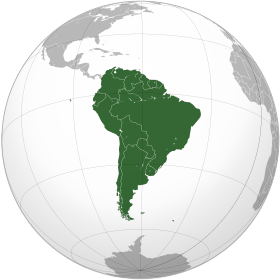 South America on a hemisphere map | |
| Territory | 17,840,000 km² |
| Population | 387,489,196 (2011) people |
| Density | 21.4 people / km² |
| Names of residents | South American, American |
| Includes | 12 states |
| Dependent states | 3 |
| Languages | languages used in South America |
| Time Zones | UTC-2 to UTC-5 |
| Largest cities |  Sao Paulo (11.1 million) Sao Paulo (11.1 million)
Fortaleza (2.4 million) |


The composition of South America also includes various islands , most of which belong to the countries of the continent. Islands in the Caribbean are North America . The countries of South America that border the Caribbean - including Colombia , Venezuela , Guyana , Suriname , French Guiana and Panama - are known as Caribbean South America .
The continent’s area is 17.84 million km² (4th place among continents; only slightly larger than Russia in area ), population 387,489,196 (2011) people (4th place among continents).
Name Origin
The word "America" in the name of this continent was first used by Martin Waldsemueller , having put on his map the Latin version of the name Amerigo Vespucci , who, in turn, first suggested that the lands discovered by Christopher Columbus are not related to India , but are the New World , formerly Europeans unknown.
History
The history of the continent can be divided into three stages. The first is the period of the formation, flourishing and decline of autochthonous civilizations ( Incas , etc.). The second is the era of the European conquest ( Conquista ) and colonialism of 1500 - 1800 , when most of the continent was dependent on two European countries ( Spain and Portugal ). Despite the relatively short duration, it was during this period that languages and cultures, economies, and also the beginnings of statehood of most modern Latin American states took shape. The history of the countries of the Guiana coast should be considered separately. Guyana , Suriname and, to a lesser extent, French Guiana , are markedly different from most of the Spanish and Portuguese-speaking countries of the continent.
Pre-Classical Period
There are two versions of the possible human settlement of South America. According to the first, settlement came from Asia, from the territory of modern Russia, through the Bering Strait and North America, however, not all existing archaeological finds fit into this theory , in connection with which the theory is advanced [by whom? ] on the possibility of the existence of "pre-Siberian" South American natives.
The first human agricultural experiments in South America date back to 6500 BC. e., when in the Amazon began to cultivate bananas , potatoes and hot red pepper [1] .
Discovery of South America
In an effort to open the sea route to India, Christopher Columbus crossed the Atlantic Ocean in 1492 and discovered the Greater Antilles . The first expedition was followed by a second, then a third. The route of his third expedition was laid much south of the lands already known to him and discovered the island of Trinidad , having drawn a ship between the island and the unknown coast. The Spaniards were surprised that the water along it was almost fresh. The admiral wrote in his diary: "... such a powerful river could exist only on the mainland, and in the south there is still the mainland."
Spanish Expeditions XV — XVI
Following Columbus, numerous Spanish expeditions set off for South America in search of new lands and new wealth - gold and jewelry.
Francisco Aurellana Expedition
At the end of December 1541, the Francisco Orellana flotilla, consisting of a brigantine and four canoes, began to descend to the ocean along the Napo River. After more than a month of sailing, they got into the river "wide as the sea", that is, into the Amazon. On the way to the east, the Spaniards met the Indian villages, saw numerous tributaries. The huge left tributary, the waters of which were “black as ink”, they called the Rio Negra - “the black river”. Only in August 1542 did they reach the mouth of the river.
Geographical Research
In the study of the nature of the continent, the role of the German naturalist and geographer Alexander Humboldt , who traveled to Central and South America in 1799-1804, is significant [2] . A deeper study of individual territories of the mainland began in the XIX century. In 1821-1828, a Russian expedition led by Grigory Ivanovich Langsdorf explored the interior of Brazil . Valuable information about the geological structure, climate, plants and animals of the Amazonian lowlands was collected by the English traveler Henry Bates during an expedition of 1848-1859.
Geography
The continent is 7350 km from north to south and 5180 km from west to east.
Extreme Points
- North - Cape Gallinas
- South (mainland) - Cape Froward
- South (island) - Diego Ramirez
- Western - Cape Pariñas
- East - Cape Cabo Branco
Relief
By the nature of the relief, South America can be divided into the Mountain West and the Plain East.
The average height of the mainland is 580 meters above sea level. Along the entire western edge stretches the Andes mountain system. The Guiana Plateau rises in the north of the mainland, in the east - the Brazilian Plateau , between which lies the Amazonian lowland . To the east of the Andes, in the foothill troughs are lowlands.
Geologically, quite recently, the Andes were an arena of active volcanic activity, which continues in the modern era in several areas.
Mountain West
Atacama Desert
El Nino
Plain East
Lowland plains - Orinok, Amazon and La Platskaya - occupy significant areas on the mainland. The almost flat surface of these plains is favorable for the formation of large river systems of the Amazon , Orinoco and Parana with wide and deep river valleys. A large area of the mainland is occupied by the Guiana and Brazilian plateaus. Often they consist of several plateaus.
Brazilian Plateau
Pampa
Patagonia
Geology
After the disintegration of the Ponthein Pangea, the territory of South America in the Cretaceous was merged with Africa, Australia and Antarctica as part of the Gondwana continent. At the end of the Cretaceous, Gondwana fell apart, and South America was an island until the end of the Tertiary. There was a special fauna dominated by notungulates . After the formation of the isthmus with North America, the influx of new fauna led to the almost complete extinction of the local fauna.
Climate
There are 6 climatic zones in South America: Subequatorial belt (2 times), Equatorial belt , Tropical zone , Subtropical zone and Temperate zone .
In most of South America, the climate is subequatorial and tropical, with well-defined dry and wet seasons; in the Amazonian lowlands - equatorial, constantly humid, in the south of the mainland - subtropical and temperate. On the plains of the northern part of South America, right up to the South Tropic, the temperature is 20-28 ° С all year round, and to the south in January (summer) it drops to 10 ° С. In July, that is, in winter, monthly average temperatures fall on the Brazilian plateau to 10-16 ° C, on the plateau of Patagonia - to 0 ° C and below. In the Andes, temperature decreases markedly with height; in the highlands it does not exceed 10 ° C, and in winter frosts are frequent here.
The most windward slopes of the Andes are most moistened in Colombia and the southern regions of Chile - 5-10 thousand mm of precipitation per year.
Glaciers are found in the southern Andes and on individual volcanic peaks to the north.
South America is the wettest continent of the Earth .
Hydrography
River system
The most important river systems in South America are the Amazon , Orinoco and Parana , whose total basin is 9,583,000 km² (South America's area is 17,850,568 km²).
In South America, there is the highest waterfall in the world - Angel . On the mainland is the most powerful waterfall - Iguazu .
- Amazon
- Parana
- Paraguay
- Uruguay
- Orinoco
Lakes
Most of the lakes in South America are located in the Andes , the largest of which and the world's highest shipping lake is Titicaca on the border of Bolivia and Peru. The largest in area is Lake Maracaibo in Venezuela, it is also one of the oldest on the planet.
- Titicaca
- Maracaibo
- Patus
Political Division
| Countries and Territories | Square (km²) | Population (as of July 1, 2008 ) | Population density (per person / km²) |
|---|---|---|---|
| Argentina | 2 766 890 | 40 677 348 | 14.3 |
| Bolivia | 1,098,580 | 8 857 870 | 8.1 |
| Brazil | 8 514 877 | 191 908 598 | 22.0 |
| Venezuela | 912,050 | 26,414,815 | 27.8 |
| Guyana | 214 970 | 770 794 | 3.6 |
| Colombia | 1,138,910 | 45 013 674 | 37.7 |
| Paraguay | 406,750 | 6 347 884 | 15.6 |
| Peru | 1,285,220 | 27 925 628 | 21.7 |
| Suriname | 163,270 | 438 144 | 2.7 |
| Uruguay | 176 220 | 3 477 778 | 19,4 |
| Falkland Islands ( United Kingdom disputed by Argentina ) | 12 173 | 2967 | 0.24 |
| Guiana ( France ) | 91,000 | 209,000 | 2.1 |
| Chile | 756,950 | 16 454 143 | 21.1 |
| Ecuador | 283,560 | 13 927 650 | 47.1 |
| South Georgia and the South Sandwich Islands ( UK ) | 3093 | 20 | 0 |
| Total | 17 824 513 | 382 426 293 | 21.5 |
South Georgia and the South Sandwich Islands do not have a resident population [ specify ] . The islands belong to the UK, belong to the overseas self-governing territory of the Falkland Islands.
Policy
In the political arena, the beginning of the 21st century in South America was marked by the arrival of left-wing forces; socialist leaders were elected in countries such as Chile , Uruguay , Brazil , Argentina , Ecuador , Bolivia , Paraguay and Venezuela . Against this background, the development of a market economy and international cooperation is noticeable everywhere in South America, for example, MERCOSUR organizations and the Andean community were created , the purpose of which is the free movement of citizens, economic development, the removal of customs duties and a common defense policy.
Since 2004, the Union of South American Nations , also known as UNASUR, is an organization that unites almost all the countries of South America, created according to the model of the European Union . An advisory South American Defense Council has been created within the framework of the union , it is planned to create a common parliament [3] , as well as create a single market and eliminate customs tariffs between the participating countries.
Demographics
Ethnic groups
At the ethnic level, the population of South America can be divided into three types: Indians , whites and blacks . In countries such as Colombia, Ecuador, Paraguay and Venezuela, mestizos (descendants of Spanish marriages and the native population) predominate demographically. Only in two countries (Peru and Bolivia) do Indians form the majority. Brazil, Colombia and Venezuela have a large population of African descent.
In states such as Argentina, Uruguay, Chile and Brazil, the majority of the population is of European descent, of which in the first two, the majority of the population are descendants of immigrants from Spain and Italy. In the south and southeast of Brazil, descendants of the Portuguese, Germans, Italians and Spaniards live.
Chile received a wave of emigration from Spain, Germany, England, France, Italy, Austria, Switzerland, Scandinavia, Greece and Croatia during the 18th and early 20th centuries. In this country, according to various sources, from 1,600,000 (10% of the population) to 4,500,000 (27%) come from the Basque Country . 1848 was the year of mass immigration of Germans (also Austrians and Swiss) and, in part, of the French, mainly to the southern regions of the country, hitherto completely unpopulated, but rich in nature and minerals. This German immigration continued after the first and second world wars in such a way that today about 500,000 Chileans are of German origin. In addition, about 5% of the Chilean population are descendants of immigrant Christian immigrants from the Middle East (Palestinians, Syrians, Lebanese, Armenians). Also about 3% of the population of Chile is genetic [ clarify ] croats. The descendants of the Greeks are about 100,000 people, most of them live in Santiago and Antofagasta . About 5% of the population is of French descent. From 600,000 to 800,000 - Italian.
The Germans immigrated to Brazil, mainly during the 19th and 20th centuries in connection with the political and social events in their homeland. Today, about 10% of Brazilians (18 million) are of German origin. In addition, Brazil is the country of Latin America, where the largest number of ethnic Ukrainians live (1 million).
Ethnic minorities in South America are also represented by Arabs and Japanese in Brazil, Chinese in Peru and Indians in Guyana.
Languages
The most common languages of South America are Portuguese and Spanish . Portuguese is spoken by Brazil , whose population is about 50% of the population of this continent. Spanish is the official language of most countries on this continent. Other languages are also spoken in South America: they speak Dutch in Suriname , English in Guyana, and French in French Guiana.
You can often hear the native languages of the Indians : Quechua ( Ecuador , Bolivia and Peru ), Guarani ( Paraguay and Bolivia ), Aymara ( Bolivia and Peru ) and Araucan language (south of Chile and Argentina). All of them (except the last) have official status in the countries of their language range.
Since a large proportion of the population of South America are immigrants from Europe, many of them still retain their language, the most common of them are Italian and German in countries such as Argentina, Brazil, Uruguay, Venezuela and Chile.
The most popular studied foreign languages in South America are English, French, German and Italian.
| tongue | number of carriers | |
|---|---|---|
| Spanish | 233,600 108 | |
| Portuguese | 191 480 630 | |
| English | 800,000 | |
| Dutch | 510,000 | |
| French | 230,000 |
Economics
In the post-crisis years 2010-2011, the economies of Latin America showed serious growth rates that are ahead of the global average: in 2010, growth was 6%, and the forecast for 2011 speaks of 4.7% [4] . Due to historically high inflation in almost all countries of South America, interest rates remain high, they are usually twice as high as in the United States. For example, the interest rate is about 22% in Venezuela and 23% in Suriname. An exception is Chile , which pursues a free-market economic policy with the establishment of a military dictatorship in 1973 and has been actively increasing social spending since the restoration of democratic rule in the early 1990s. This has led to economic stability and low interest rates.
South America relies on the export of goods and natural resources. Brazil (the seventh largest economy in the world and the second largest in America) leads in the total export of $ 137.8 billion US dollars, followed by Chile $ 58.12 billion and Argentina with 46.46 billion US dollars [5] .
The economic gap between rich and poor in most South American countries is considered larger than in most other continents. In Venezuela, Paraguay, Bolivia, and many other countries in South America, the richest 20% own more than 60% of the country's wealth, while the poorest 20% own less than 5%. Such a wide gap can be seen in many large South American cities, where temporary shacks and slums are located next to skyscrapers and luxury apartments .
| Country | GDP (nominal) in 2009 [6] | GDP in 2009 [7] | GDP per capita in 2009 [7] | HDI in 2007 [8] | |
|---|---|---|---|---|---|
| Argentina | 326 474 | 572 860 | 14 413 | ▲ | |
| Bolivia | 17 413 | 43 424 | 4330 | ▲ | 0.729 |
| Brazil | 1 572 590 | 1 981 642 | 10 325 | ▲ | 0.813 |
| Chile | 169 573 | 243 044 | 14 510 | ▲ | 0.878 |
| Colombia | 269 654 | 400 300 | 8215 | ▲ | 0.807 |
| Ecuador | 52 572 | 106 993 | 7685 | ▲ | 0.806 |
| Falkland Islands | ? | 75 | 25 000 | N / a | |
| Guiana ( France ) | 3524 [9] | N / a | 2300 (nominal, 2007) [9] | N / a | |
| Guyana | 1130 | 3082 | 4035 | ▲ | 0.729 |
| Paraguay | 16 006 | 29 403 | 4778 | ▲ | 0.761 |
| Peru | 127 598 | 245 883 | 8580 | ▲ | 0.806 |
| Suriname | 2984 | 4436 | 8323 | ▲ | 0.769 |
| Uruguay | 32 262 | 42 543 | 13 294 | ▲ | 0.865 |
| Venezuela | 319 443 | 335 200 | 12 785 | ▲ | 0.844 |
Tourism
Tourism is becoming an increasingly important source of income for many countries in South America [10] [11] . Historic sites, architectural and natural wonders, a diverse assortment of food and culture, picturesque cities, and stunning landscapes attract millions of tourists each year to South America. Some of the most visited places in the region: Machu Picchu , Rio de Janeiro , Salvador , Natal , Buenos Aires , Sao Paulo , Cuzco , Cartagena , Amazon rainforest, Angel Falls, Galapagos Islands , Margarita Island , Lake Titicaca and Patagonia region [12] .
Culture
The culture of South Americans was influenced by historical ties with Europe, especially with Spain and Portugal , as well as popular culture from the United States of America.
South American countries have a rich tradition of music. The most famous genres are cumbia from Colombia, samba , bossa nova from Brazil, and tango from Argentina and Uruguay. Also well-known is the non-profit folk genre of the Nueva Cansion , a musical direction that was founded in Argentina and Chile, and quickly spread to the rest of Latin America. People on the Peruvian coast created great duets and trios on the guitar and cajon in a mixed style of South American rhythms, such as the Marinera in Lima , the Tondero in Piura , the Creole waltz or the Peruvian waltz were popular in the 19th century, soulful Arequipan Yaravi and at the beginning of the 20th century the Paraguayan Guarania. At the end of the 20th century, Spanish rock appeared under the influence of British and American pop rock. Brazil was characterized by Portuguese pop rock.
Литература Южной Америки стала популярной во всем мире, особенно во время Латиноамериканского Бума в 1960-х и 1970-х годах, и после появление таких авторов, как Марио Варгас Льоса , Габриэль Гарсиа Маркес , Пабло Неруда , Хорхе Луис Борхес .
Из-за широких этнических связей, южноамериканская кухня взяла многое у африканских, американских индейцев, азиатских и европейских народов. Например, кухня в Баия , Бразилии, хорошо известна своими западно-африканскими корнями. Аргентинцы, чилийцы, уругвайцы, бразильцы и венесуэльцы регулярно потребляют вина, в то же время Аргентина наряду с Парагваем, Уругваем, и люди, живущие в южной части Чили и Бразилии предпочитают мате или парагвайскую версию этого напитка — терере , который отличается от других тем, что он подаётся холодным. Писко — дистиллированный ликёр из винограда, производится в Перу и Чили, однако, есть постоянные споры между этими странами в отношении его происхождения. Перуанская кухня смешивает в себе элементы китайской, японской, испанской, африканской и кухни народов Анд .
Sport
| Диего Марадона ( Аргентина ) и Пеле ( Бразилия ) — футболисты века, согласно определению ФИФА . | |
Спорт играет важную роль в Южной Америке. Наиболее популярный вид спорта — футбол, на профессиональном уровне представленный Конфедерацией Южноамериканского футбола ( КОНМЕБОЛ ), который входит в состав ФИФА и организует турниры, главными из которых являются Кубок Америки (международный турнир) и Кубок Либертадорес (состязание между клубами). В Уругвае, стране Южной Америки прошёл и первый чемпионат мира по футболу в 1930 году , и за всю историю соревнований страны Южной Америки побеждали 9 раз из 19 (Бразилия 5 раз, Аргентина и Уругвай по 2 раза).
Другими популярными видами спорта являются баскетбол , плавание и волейбол . В некоторых странах существуют национальные виды спорта, такие как пато в Аргентине, техо в Колумбии и родео в Чили.
Что касается других спортивных направлений, можно выделить, например, популярность регби, поло и хоккея в Аргентине, автоспорта в Бразилии и велосипедного спорта в Колумбии. Аргентина, Чили и Бразилия становились чемпионами турниров Большого шлема по теннису .
See also
- Latin America
- North America
Notes
- ↑ История древней Центральной и Южной Америки (недоступная ссылка) . Дата обращения 23 февраля 2010. Архивировано 13 июля 2011 года.
- ↑ ЭНЦИКЛОПЕДИЯ КРУГОСВЕТ: Александр Гумбольдт
- ↑ Би-би-си | В мире | В Южной Америке появится региональный парламент
- ↑ BuenoLatina. Латинская Америка: Cepal прогнозирует рост экономики в 2011 году на 4,7 %
- ↑ CIA - The World Factbook - Rank Order - Exports . Cia.gov (9 апреля 2009). Дата обращения 18 апреля 2009.
- ↑ Source
- ↑ 1 2 Source
- ↑ Human Development Report 2009. Human development index trends: Table G (недоступная ссылка) . The United Nations. Дата обращения 5 октября 2009. Архивировано 16 ноября 2009 года.
- ↑ 1 2 (фр.) INSEE -CEROM. Les comptes économiques de la Guyane en 2006 : premiers résultats (недоступная ссылка) . Дата обращения 14 января 2008. Архивировано 16 февраля 2008 года.
- ↑ Bigtravelweb (недоступная ссылка) . Bigtravelweb (13 октября 2008). Дата обращения 18 апреля 2009. Архивировано 15 апреля 2009 года.
- ↑ Latin American tourism growth (недоступная ссылка) . Дата обращения 1 марта 2010. Архивировано 25 марта 2009 года.
- ↑ Top attractions (недоступная ссылка) . Gosouthamerica.about.com (4 декабря 2007). Дата обращения 18 апреля 2009. Архивировано 14 марта 2009 года.
Links
- Средний класс в Южной Америке
- Скромницкий А. , Талах В. Энциклопедия доколумбовой Америки. Часть 1. Южная Америка. Том 2. Источники XVI-XVII веков по истории Южной Америки: Хроники. Документы. . www.kuprienko.info (А. Скромницкий) (11 февраля 2012). Дата обращения 11 марта 2012. Архивировано 26 мая 2012 года.