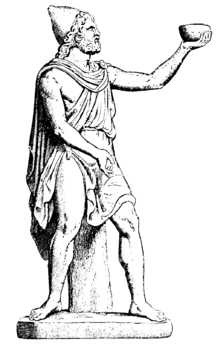

Exomis , exomide ( other Greek ἐξωμίς , from exo - outside, omos - shoulder) - in ancient Greece , a section of coarse fabric (skin, skin), laid by folds on the left shoulder, about 2.30 × 1.40 m in size [1] [2] .
The ekzomis was fastened at the waist with a belt, and on the left shoulder with a tie , belt or agraph . The size and texture of the fabric reflected the condition of the wearer and the purpose of the clothes: rough fabric without folds with an uneven or tattered hem - the clothes of a slave; a larger fabric with simple folds - a free man, a warrior. The exomis could be covered with a cloak, a piece of skin or skin. As a rule, an exomis above the knees was sometimes used as a loincloth [1] [2] [3] .
Due to the fact that exomis left both hands free, it was the main clothing of peasants and slaves [1] .
See also
- Chiton
- Peplos
- Gimatiy
Notes
- ↑ 1 2 3 Plekhanova E.O. Dictionary of costume, textile and jewelry . - Izhevsk: Publishing House "Udmurt University", 2013.
- ↑ 1 2 Mertsalova M.N. Costume of different times and peoples. Volume 1. - Moscow: Academy of Fashion JSC, 1993. - S. 74, 541. - ISBN 5-900136-01-9 .
- ↑ Zakharzhevskaya R.V. Costume History: From Antiquity to the Present . - RIPOL classic. - M, 2008 .-- S. 45-46. - 288 p. - ISBN 5-7905-1398-0 .