Slovenia ( Slovenian. Slovenija ), the official name is the Republic of Slovenia ( Slovenian. Republika Slovenija ) - a state in southern Europe . Territory - 20,236 km², population - 2,005,692 people (2009). Takes 144th place in the world in terms of populationand 150th on the territory .
| Republic of Slovenia | |||||
|---|---|---|---|---|---|
| Slovene. Republika Slovenija | |||||
| |||||
| Anthem : "Zdravljica" | |||||
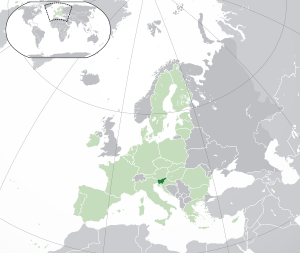 Location of Slovenia (dark green): - in Europe (light green and dark gray) - in the European Union (light green) | |||||
| Independence date | June 25, 1991 (from the SFRY ) | ||||
| Official language | Slovenian (official), in places of compact residence of national minorities also Italian and Hungarian [1] | ||||
| Capital | Ljubljana | ||||
| Largest cities | Ljubljana , Maribor , Celje , Kranj , Velenje | ||||
| Form of government | parliamentary republic [2] | ||||
| The president | Borut Pahor | ||||
| Prime Minister | Marjan Sharets | ||||
| Gos. religion | secular state | ||||
| Territory | 150th in the world | ||||
| • Total | 20,273 km² | ||||
| •% water surface. | 0.7 | ||||
| Population | |||||
| • Rating (01/01/2017) | ↗ 2 066 880 people ( 144th ) | ||||
| • density | 101.8 people / km² | ||||
| GDP ( PPP ) | |||||
| • Total (2019) | $ 80.375 billion [3] ( 96th ) | ||||
| • Per capita | $ 38,841 [3] | ||||
| GDP (nominal) | |||||
| • Total (2019) | $ 56.920 billion [3] ( 85th ) | ||||
| • Per capita | $ 27,506 [3] | ||||
| HDI (2018) | ▲ 0.896 [4] ( very high ; 25th place ) | ||||
| Names of residents | Slovenes, Slovenian, Slovenian [5] | ||||
| Currency | euro [6] | ||||
| Internet domain | .si | ||||
| ISO code | |||||
| IOC Code | |||||
| Telephone code | +386 | ||||
| Time Zones | CET ( UTC + 1 , summer UTC + 2 ) | ||||
| Car traffic | |||||

The capital is Ljubljana . The official language is Slovenian .
Unitary , parliamentary republic . In August 2018, Marjan Sharets took over as prime minister .
Administrative division: 210 communities, including 11 cities.
Located in the pre-alpine part of the Balkan Peninsula . It is washed by the waters of the Adriatic Sea . In the west it borders with Italy , in the north - with Austria , in the east - with Hungary , in the east and south - with Croatia .
An industrial country with a dynamically developing economy. The volume of GDP in 2011 amounted to 58.979 billion US dollars (about 29 179 US dollars per capita). The monetary unit is the euro .
The independence of the country was proclaimed on June 25, 1991 . On March 29, 2004, Slovenia joined NATO , and on May 1, 2004 joined the European Union .
Content
Etymology
The name Slovenija comes from the ethnonym " Slovene " - the pre-Slavic form of the ethnonym " Slavs ", that is, means "Slovenian land" [8] . The etymology of the ethnonym "Slavs" , according to a number of linguists, remains unclear, although there are a number of hypotheses on this subject [9] .
The name of modern Slovenia comes from the ( Slovenian. Slovenski narodnoosvobodilni svet ), created in 1944 during the national liberation movement of Yugoslavia against German occupation. The official name of the state in 1945-1946 was “Federal Slovenia” ( Slovenian. Federalna Slovenija ), while it was one of the countries that made up the SFRY . February 20, 1946 “Federal Slovenia” was renamed the “People’s Republic of Slovenia” ( Slovenian. Ljudska republika Slovenija ), which, in turn, was renamed April 9, 1963 the “Socialist Republic of Slovenia” ( Slovenian. Socialistična republika Slovenija ) [ 10] . On March 8, 1990, Slovenia removed the prefix "Socialist" from its name, becoming the "Republic of Slovenia", and on June 25, 1991 gained independence.
History
Slavic ancestors of modern Slovenes settled in the country in the VI century BC. e. In the 7th century, they formed Carantania , which became one of the first Slavic states. In 745, in exchange for military assistance , Quarantania recognized the protectorate on the part of the Franks , while maintaining formal independence until its collapse in 1180 . The influence of the Franks contributed to the Christianization of the Slovenes.
Around the year 1000, Brižinski spomeniki , the first written document in Slovenian, was written . In the XIV century, the territory of modern Slovenia fell under the rule of the Habsburgs and later became part of Austria-Hungary . Slovenia was divided into three provinces: Kranjska , Horishka and Staersk .
Moving trade routes and the Thirty Years War in the 17th century contributed to the economic decline of Slovenia, but in the 18th century, economic development intensified again: the production of various goods increased, agricultural production increased by about 60%. A national educational movement has unfolded. This period was called the Slovenian Renaissance .
In 1809 - 1813 most of Slovenia was part of the Illyrian provinces . In the XIX century , especially during the Revolution of 1848-1849. in Austria and after it, in the Austrian Primorye , the Slovenian national movement develops (center - Krajna ).
In 1918, Austria-Hungary collapsed. Italy , following the results of the First World War, captured all of Slovene Primorye , including it in the Venice-Giulia region . The rest of the Slovenian lands entered the newly formed Kingdom of Serbs, Croats and Slovenes , which in 1929 was renamed the Kingdom of Yugoslavia .
In 1941, after the attack of the Axis powers on Yugoslavia, Italy annexed the territory to Ljubljana , and Germany the rest of the territory with the city of Maribor .
The Kingdom of Yugoslavia disintegrated during World War II , and Slovenia became part of the Socialist Federal Republic of Yugoslavia as the Socialist Republic of Slovenia , which was announced on November 29, 1945. From Italy to Slovenia the lands of Obalna-Crashka and Horishka were annexed.
According to the results of the referendum held on December 23, 1990, 88.4% of Slovenes supported the declaration of independence of Slovenia from the SFRY.
The war in Slovenia (one of the military conflicts of the war that began with the collapse of Yugoslavia ) lasted ten days. During 72 combat contacts, the losses of the Yugoslav army amounted to 45 people killed, 146 wounded, while 4,693 military personnel and 252 federal services were taken prisoner. The losses of the Slovenian self-defense forces amounted to 19 killed (9 combatants , the rest - civilians) and 182 wounded. Also killed 12 citizens of foreign countries, mostly drivers in the service of international transport companies. 31 tanks (including burned and damaged ones), 22 transport armored vehicles , 172 vehicles and 6 aircraft were disabled.
On December 23, 1991, the Constitution of the Republic of Slovenia was adopted. In 2004, the country joined the European Union .
Administrative Division
The country is divided into 210 communities ( občina ), 11 of which have the status of a city, the capital is divided into district communities ( Četrtna skupnost ).
The representative body of the city is the city council ( mestni svet ), elected by the population, the executive - упupan .
The representative body of the community is the community council ( občinski svet ), elected by the population, the executive - упupan .
The representative body of the community is the council of the community ( Svet Četrtne skupnosti ), elected by the population, the executive body is the chairman of the council of the community ( predsednik sveta ).
Political structure
The head of Slovenia is the president , elected every 5 years. Executive power is vested in the president and cabinet. The latter is appointed by parliament .
The parliament consists of two chambers: the National Assembly (državni zbor) and the State Council (državni svet). 90 deputies are elected to the State Assembly: 88 of them - according to the proportional system, and 2 seats - according to the majority system for the Slovenian-Italian and Hungarian communities. The State Council acts as the upper house . It has 40 deputies, elected for a five-year term, representing important economic, structural and national groups of society. Parliament is elected every 5 years. The main parties in the parliament are the Slovenian Democratic Party and the Liberal Democracy of Slovenia .
Leading Parties
Below is a list of leading political parties in Slovenia represented in the country's parliament.
| Title | Year | Leader | Ideology | Intern. | HS | EP | |
|---|---|---|---|---|---|---|---|
| Slovenian Democratic Party Slovene. Slovenska demokratska stranka, SDS | 1989 | Janez Jansha | Right center , liberal conservatism , social conservatism , Slovenian nationalism | CDI , MDS , EPP | 25 | 3 | |
Slovene. Lista Marjana Šarca, LMŠ | 2014 | Marjan Sharets | Centrism , social liberalism , populism | ALDE | 13 | 0 | |
| Social Democrats Slovene. Socialni demokrati, SD | 1993 | Left Center , Social Democracy | SI , PES | eleven | one | ||
Slovene. Stranka modernega centra, SMC | 2014 | Miro Cerar | Centrism , social liberalism , pro-Europeanism | ALDE | 9 | 0 | |
| Left Slovene. Levica | 2017 | Joseph Bucher | Leftists , democratic socialism , eco-socialism , anti-capitalism , secularism , Euroscepticism | PEL | 9 | 0 | |
| New Slovenia - Christian Democracy Slovene. Nova Slovenija - Krščanski demokrati, N.Si | 2000 | Christian democracy social conservatism pro-europeanism | CDI EPP | 7 | one | ||
Slovene. Stranka Alenke Bratušek, SAB | 2008 | Alenka Bratushek | Centrism , social liberalism , liberal democracy , pro-Europeanism | ALDE | 5 | 0 | |
Slovene. Demokratična stranka upokojencev Slovenije, DeSUS | 1991 | Centrism , the protection of senior citizens, social liberalism , pro-Europeanism | ALDE | 5 | one | ||
| Slovenian National Party Slovene. Slovenska nacionalna stranka, SNS | 1991 | Right Center , Slovenian Nationalism , Populism , Euroscepticism | - | four | 0 | ||
Unions
The largest trade union center is the Union of Free Trade Unions of Slovenia ( Zveza svobodnih sindikatov Slovenije ), with 300,000 members and 4 seats in the Council of State.
Legal system
The body of constitutional oversight is the Constitutional Court ( Ustavno sodišče ), the highest court is the Supreme Court ( Vrhovno sodišče ), the courts of appeal are the highest courts ( Višje sodišče ), the courts of first instance are the land courts ( Okrajno sodiščei ) and , the supreme body of prosecutorial oversight is the Supreme State Prosecutor's Office ( Vrhovno državno tožilstvo ), the highest oversight body is the financial court ( Računsko sodišče ).
Slovenian Armed Forces
The number of personnel of the ground forces is 9,550. The combat personnel are (for 2002): - 7 infantry brigades, each of which has 3 infantry battalions: 1 fully equipped and 2 personnel battalions; - 1 brigade of special purpose; - 1 airborne brigade; - 1 anti-tank battalion; - 2 separate mechanized battalions; - 1 engineering company; - 1 unit of protection against WMD; - 1 regiment of logistics; - 1 anti-aircraft missile brigade.
Geographic data
Slovenia is located in the Alpine-Danube region of Central Europe. Four main geographical regions are distinguished: in the north-west are the Alps ( Julian , Kamensko-Savinsky , the Karavanke and Pohorje ranges , which occupy 42% of the territory), in the northeast are the Pannonian (Middle Danube) lowlands (28%), and in the south are the Dinar Highlands (21%), including the Karst plateau, which gave the name to this type of relief , in the west - the Mediterranean coast ( Adriatic Sea , 9%). Area 20 273 km². Land area: 20,151 km². The area of water: 122 km². The highest point is the peak of Mount Triglav (2864 m) [11] , the lowest - the coast of the Adriatic Sea - 0 m.
Large rivers: Sava (221 km), Drava - right tributaries of the Danube . Lakes are mountain-glacial ( Bleysko , Bohinsko ) and karst ( Tserknitsa , drying out, the largest in the country, maximum 26 km²). About a thousand karst caves ( Postojnska Yam , Shkotsyansky caves ). Many waterfalls, the largest Chedca (130 m). The climate in most of the north is temperate continental, with an average January temperature of 0 ... −2 ° C, July 19 ... 21 ° C. Precipitation is 800-1200 mm, in the mountains in places over 3000 mm / year. More than half of the territory is occupied by beech , oak , coniferous forests , in the mountains - alpine meadows , in the coastal area - maquis , on the Karst plateau - steppe vegetation.
Economics
Slovenia has a developed economy. Of all the Slavic countries, and countries with the former communist planned economy, Slovenia has the highest nominal GDP per capita and the second highest PPP GDP after the Czech Republic per capita . The minimum wage for 2018 is 842.79 euros (gross) and 638 euros (net) . [12] [13] The average wage for 2018 is 1,671 euros (gross) and 1,083 euros (net). [14] The minimum wage for 2019 is 886.00 euros (gross) and 667 euros (net) [15] [16] [17] [18]
Advantages : stability. Manufacturing is competitive. Strong export. The prospect of trade growth through EU membership. The Revoz car factory is very productive (Renault Clio). Unior dd is one of the largest and most important Slovenian importers, including for the German automobile industry. Competitive port in Koper . Of all countries in Eastern Europe, the minimum amount of debt (however, the amount of public debt and state guarantees is impressive is 19.7 billion euros as of December 31, 2012 [19] ). In 2001, a trade agreement with Bosnia.
Weaknesses : the economy is partially liberalized, which holds back foreign investors. Privatization (including the banking sector) is slow.
The official currency of Slovenia is the euro (previously the national currency of Slovenia was the tolar ).
Slovenia was the first of the countries to join the EU in 2004 , which launched a single European currency. The average gross salary in Slovenia for September 2007 was 1260 euros, the average net salary (after taxes and insurance contributions) was 820 euros. The minimum wage in 2007 was 522 euros.
In June 2005, the Government of the Republic of Slovenia adopted the Development Strategy of Slovenia, which includes:
- Exceeding the average level of EU economic development, as well as increasing employment in line with the goals of the Lisbon Strategy in the next ten years;
- Improving the quality of life and well-being of each person, as measured by indicators of human development, healthcare, social risks and social cohesion;
- Ensuring the principle of sustainability as the main quality criterion in all areas of development, including the goal of sustainable population growth;
- Development of the country's image in the world through the development of its characteristic pattern, cultural identity and active participation in international processes.
The large oil company Petrol is completely state-owned, and in accordance with a special decision of the government, it cannot be privatized.
There is one nuclear power plant in the Slovenian energy sector - the Krsko NPP . The unemployment rate is 7%, the gross product per inhabitant is 27,000 US dollars, the country has only 950,000 employees.
In 2009, the global economic downturn led to a decline in exports and industrial production - by more than 6%, and the unemployment rate exceeded 9%.
Bank of Slovenia is the central issuing and controlling authority. There is a Bank Association, which includes about 30 commercial banks in Slovenia.
Population
Annual growth (2012) + 0.16%, Birth rate - 10.66%, Mortality - 9.35%, E.p (+1.31), Balance of migration (+0.31) (Data for 2012)
The total fertility rate is 1,592 births per woman. (2012)
Total life expectancy: Men - 76.96 years; Women 82.89 years. (2012)
Ethnic composition: out of the total population according to the 2002 census, 1 964 036 people.
- Slovenes 1,631,363 (83.1%)
- Serbs 38 964 (2.0%)
- Croats 35 642 (1.8%)
- Bosnyak 21 542 (1.1%)
- Hungarians 6,243 (0.3%)
- Albanians 6,186 (0.3%)
- Macedonians 3 972 (0.2%)
- Montenegrins 2 667 (0.1%)
- Italians 2,258 (0.1%)
- Unspecified and unknown 174,913 (8.9%)
As of January 1, 2013, 2,058,821 residents were registered in Slovenia. Slovenia ranks 145th in the world in terms of population. The average age of the population is 41.7 years. (men - 40, women - 43).
The average population density is 101.66 people per km². About half of the residents live in cities, the rest in rural areas.
The official language is Slovenian . Italian has the status of an official language in some settlements of the municipalities of Izola , Koper and Piran , Hungarian in five communities of Prekmurje (Dobrovnik, Lendava, Moravske Toplice, Khodosh and Shalovtsi) [20] . Gypsy also has an official, albeit lower status . [21]
Religion
According to the 2002 census, Catholics make up 57.8% of the population, Muslims - 2.4%, Orthodox - 2.3%, Protestants - 0.8% (Union of Baptist Churches of Slovenia, Union of Pentecostal Churches of Slovenia , Adventists ).
Culture
The Slovenian language is a South Slavic language with writing based on the Latin alphabet . It has common roots with the Croatian and Serbian languages , but differs significantly from them. At the same time, it has some features close to the Western Slavic languages, as well as the North Russian dialect of the Russian language. Slovenian is one of the few Slavic languages that has preserved the dual number and supine . Currently, 49 dialects of the Slovenian language have been preserved.
In royal Yugoslavia, Slovenia was distinguished by almost universal literacy. Thus, according to the 1921 census, only 8.9% of the population were illiterate in the Slovenian Dravian Banovina of Yugoslavia [22] . In the same 1921, in Belgrade , the illiteracy rate was 14.1% of the population, and 51.5% in Yugoslavia as a whole [23] .
Slovenia's most famous writer is Franz Prešern (1800–1849), whose lyric poems set new standards for Slovenian literature and helped to awaken national identity. Since the Second World War, many Slovenian folk traditions have been lost, but there are attempts to revive the national culture, for example, the trio “ Trutamora Slovenica ” performs Slovenian folk music in the early 90's. the international competition of accordionists was won by Alessandra Minaccia , who performed Slovenian tunes. In the 1970s the musical style industrial came to the country, which by the beginning of the 1980s. covered the whole of Slovenia (a vivid example is the Laibach group from Ljubljana , Laibach is the German version of the name of the Slovenian capital). Postmodernism in painting and sculpture has been advanced since the 1980s. Neue Slowenische Kunst and five unidentified artists working under the pseudonym IRWIN. Many significant buildings and squares in Slovenia were created by the architect Jože Plečnik (1872-1957).
In 1919, the first university was opened - Ljubljana . After that, universities were founded in Maribor (1978), Koper (2001) and New Goritsa (2006).
Slovenian cuisine . According to data published by MSN , the best Slovenian dish is Cranje sausage [24] . At the official level, it is recognized as a “masterpiece of national importance” [25] . Traditionally widespread use of fish. Many dishes were borrowed from neighboring countries: Austria has a curl (strudel) and Danube zrezek (Viennese schnitzel). Gnocchi (potato dumplings), ryota and ravioli-like girkrof are local Italian dishes. Golash and paprikash (stewed chicken or beef) were borrowed from Hungarian cuisine. Laminated pie with meat or cheese “Burek” (a word of Turkish origin), meat and apple pie are also widespread. There are many types of dumplings , of which strukrules (cheese dumplings) are the most popular. Traditional dishes are best served at the guesthouse - local restaurants. An example of a traditional Slovenian dish is “beef juha” (goveja juha, a soup made of rich beef broth with long noodles (rezanci - resantsi), sometimes with parmesan cheese, as well as “gobah juha” (gobova juha, porcini mushroom soup). Slovenia produces good white and red wine, and also produces strong drinks, such as šnops, brandy called žganje, and beer brands popular in Slovenia - Laško (Lasko), Union .
Holidays
The Law on Public Holidays and Public Holidays in the Republic of Slovenia provides for the following public holidays and public holidays:
- January 1 and 2 - New Year
- February 8 - Preshern Day , Slovenian cultural holiday
- April 1 and 2 - Sunday and Monday of Easter (dates for 2018)
- April 27 - Day of the uprising against occupation
- May 1 and 2 - Labor Day
- June 25 - National Day
- August 15 - Assumption of the Virgin
- October 31 - Reformation Day
- November 1 - Memorial Day
- December 25 - Christmas
- December 26 - Independence Day
See also
- Socialist Republic of Slovenia
- Slovenian Railways
Notes
- ↑ Katunin D.A. Status of languages in the modern legislation of Slovenia and the Slovenian language in the legislative acts of neighboring countries. Article One // Language and Culture. - 2008. - No. 3. - S. 25.
- ↑ World Atlas: The most detailed information / Project leaders: A. N. Bushnev, A. P. Pritvorov. - Moscow: AST, 2017 .-- S. 22. - 96 p. - ISBN 978-5-17-10261-4.
- ↑ 1 2 3 4 [https: //www.imf.org/external/pubs/ft/weo/2018/02/weodata/weorept.aspx? Pr.x = 67 & pr.y = 11 & sy = 2019 & ey = 2019 & scsm = 1 & ssd = 1 & sort = country & ds =. & Br = 1 & c = 961 & s = NGDPD% 2CPPPGDP% 2CNGDPDPC% 2CPPPPC & grp = 0 & a = Report for Selected Countries and Subjects] . IMF (October 20, 2019).
- ↑ Human Development Indices and Indicators . United Nations Development Program (2018). - Human Development Report on the UN Development Program website. Date of appeal September 14, 2018.
- ↑ Gorodetskaya I. L., Levashov E. A. Slovenia // Russian names of inhabitants: Dictionary-Directory. - M .: AST , 2003 .-- S. 266. - 363 p. - 5,000 copies. - ISBN 5-17-016914-0 .
- ↑ Until 2007 - Slovenian tolar .
- ↑ http://chartsbin.com/view/edr
- ↑ Pospelov, 2002 , p. 388.
- ↑ Niederlé L. Slavic antiquities. / Translation from Czech T. Kovaleva and M. Khazanova. Foreword prof. P.N. Tretyakova. Edited by A. L. Mongait. - M .: Publishing house of foreign literature, 1956. - S. 42.
- ↑ Kopač, Janez. Ustava Socialistične republike Slovenije z dne 9. aprila 1963 (Slovenian) // Arhivi. - 2001. - T. XXIV , No. 1 . - S. 1 .
- ↑ Triglav (inaccessible link) . Date of treatment December 6, 2012. Archived December 7, 2012.
- ↑ [1]
- ↑ [2]
- ↑ Average monthly earnings, Slovenia, March 2018
- ↑ Minimalna plača bo omejena tudi navzgor
- ↑ DZ: Poslanci potrdili novelo zakona o minimalni plači - RTVSLO.si
- ↑ Vsak dan prvi - 24ur.com
- ↑ Poslanci podprli novelo zakona o minimalni plači | Žurnal24
- ↑ Knyazev Yu. Slovenia in the grip of the economic crisis // Free Thought. - 2013. - No. 3 (1639). - S. 77
- ↑ Katunin D.A. Status of languages in the modern legislation of Slovenia and the Slovenian language in the legislative acts of neighboring countries. Article One // Language and Culture. - 2008. - No. 3. - S. 25 - 27
- ↑ Katunin D.A. Status of languages in the modern legislation of Slovenia and the Slovenian language in the legislative acts of neighboring countries. Article One // Language and Culture. - 2008. - No. 3. - P. 25
- ↑ Biro L. Regionalism and Centralism between the two wars (on the example of Yugoslavia). A look from Hungary // Slavic world in the third millennium. - 2013. - No. 8-1. - S. 223
- ↑ Biro L. Regionalism and Centralism between the two wars (on the example of Yugoslavia). A look from Hungary // Slavic world in the third millennium. - 2013. - No. 8-1. - S. 223-224
- ↑ Top dishes from 50 countries on MSN
- ↑ Resolution of the Prime Minister of Slovenia No. 2012-3330-0144
Literature
- Pospelov E. M. Geographical names of the world. Toponymic dictionary / resp. ed. R. A. Ageeva. - 2nd ed., Stereotype. - M .: Russian dictionaries, Astrel, AST, 2002. - 512 p. - 3,000 copies. - ISBN 5-17-001389-2 .
Links
- - official site of Slovenia
- Sights of Slovenia - 360 ° panoramas of cities, castles, caves, parks, etc.
- The withdrawal of Slovenia from Yugoslavia (1991)
- Wikimedia Commons: Atlas: Slovenia
- Slovenia in the Open Directory Project link directory (dmoz)