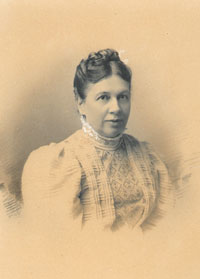
Countess Sofya Tolstaya (nee Bers , August 22 ( September 3 ) 1844 [1] - November 4, 1919 ) - great-granddaughter of the first Minister of Education P.V. Zavadovsky , the wife of Leo Tolstoy .
| Sofya Andreevna Tolstaya | |
|---|---|
 | |
| Birth name | Sofya Andreevna Bers |
| Date of Birth | August 22 ( September 3 ) 1844 |
| Place of Birth | |
| Date of death | November 4, 1919 (aged 75) |
| Place of death | |
| A country | |
| Occupation | , , , , |
| Spouse | |
| Children | , , , , and |
Content
Biography
Sofya Andreyevna is the second daughter of the doctor of the Moscow Palace Office of the real state adviser Andrei Evstafievich Bers (1808-1868), who came from the father of German nobles [2] [3] , and Lyubov Aleksandrovna Islavina (1826-1886), who came from a merchant family. In his youth, his father served as a doctor at the Moscow lady, Varvara Petrovna Turgeneva, and had a child from her, Varvara Zhitova , who thus turned out to be half-sister Sophia Tolstoy and unified - Ivan Turgenev . Other children of the Bers spouses were daughters Elizaveta Andreevna Bers (1843–?) And Tatyana Andreevna Kuzminskaya (1846–1925) [4] and five sons: Oryol vice-governor Alexander Andreevich (1845–?), State councilors Pyotr Andreevich (1849-1910 ) and Stepan Andreyevich (1855—?), as well as Vladimir (1853—?) and Vyacheslav (1861—?) [5] .
Sophia was born in the country house , which her father rented, near the estate Pokrovskoye-Streshnevo . Until the marriage, Sophia Bersa spent every summer there.
Having received a good home education , Sofia in 1861 passed the exam for the title of home teacher at Moscow University , and stood out with a Russian essay submitted by Professor Tikhonravov on the topic “Music”. In August 1862, she and her family went to grandfather Isleniev Alexander Mikhailovich to the estate of his legal wife Sofya Alexandrovna (nee Zhdanova) in the village of Ivitsa, Odoyevsky district of the Tula province and on the way visited L.N. Tolstoy in Yasnaya Polyana . On September 16 of the same year, Tolstoy made an offer to Sofya Andreevna; a week later, on the 23rd, their wedding took place [6] , after which Tolstaya for nineteen years became a resident of the village, occasionally leaving for Moscow .
The first years of their married life were the happiest [7] . After marriage, Tolstoy wrote in his diary: “Incredible happiness ... It cannot be that this all ends only in life” [8] . A friend of Tolstoy, I.P. Borisov, in 1862 about spouses remarked:
“She is the charm of herself all good. She is sensibly intelligent, simple and uncomplicated - there must be a lot of character in her, that is, her will in her team. He is in love with her until the Sirians. No, the storm in his soul still hasn’t calmed down - it has abated with the honeymoon, and, probably, there will still be hurricanes and seas of angry noise. ”
These words were prophetic, in the 1880-1890s, as a result of a change in Tolstoy's views on life, a discord occurred in the family. Sofya Andreevna, who did not share her husband’s new ideas, his aspirations to give up property, to live his own, mainly physical labor, nevertheless perfectly understood what moral and human height he had risen. In the book “My Life,” Sofya Andreevna wrote:
“... He expected from me, poor, dear husband of mine, that spiritual unity that was almost impossible with my material life and concerns, from which it was impossible and nowhere to leave. "I would not have been able to share his spiritual life in words, but to bring it to life, to break it, dragging a whole large family with me, was unthinkable, and beyond its strength."
Sofya Andreevna was weighed down by constant pregnancies . Of the first thirty years of married life, she was pregnant for a total of 10 years. She breastfed eleven of her thirteen children [9] .
For many years, Sofya Andreevna remained a faithful assistant to her husband in his affairs: manuscript scribe, translator , secretary, publisher of his works.
The artist Leonid Pasternak , who was closely acquainted with the Tolstoy family, remarked about Sofya Andreevna: “... She was in many respects a large, outstanding person - in a pair Lev Nikolaevich ... Sofya Andreevna herself was a big personality.” Possessing a delicate literary instinct, she wrote novels, children's stories, and memoirs. Throughout her life, with small interruptions, Sofya Andreevna kept a diary, which is spoken of as a noticeable and peculiar phenomenon in Tolstoy's memoirs and literature. Her hobbies were music , painting , photography .
Sofya Andreyevna’s “material life and concerns” can be judged by her diaries. On December 16, 1887, she wrote:
“This chaos of countless worries, interrupting one another, often leads me into a crazy state, and I lose my balance. It’s easy to say, but at any given moment I’m worried about: students and sick children, the hygienic and, most important, spiritual condition of my husband, big children with their affairs, debts, children and service, sales and plans of the Samara name ..., new edition and part 13 with the forbidden Kreutzer Sonata , a petition for a section with Ovsyannikovsky priest, proofs of 13 volumes, Misha’s nightdresses, sheets and Andryusha’s boots; do not overdue payments at home, insurance, duties by name, passports of people, keep accounts, rewrite and so on. and so on. “And all this must certainly touch me directly.”
Knowing that her role in Leo Tolstoy’s life was assessed ambiguously, she wrote:
“... Let people be condescending to the one who, perhaps, it was too much for a young woman to carry a high purpose on weak shoulders - to be the wife of a genius and a great man.”
The departure and death of Tolstoy had a heavy effect on Sophia Andreevna, she was deeply unhappy, could not forget that before his death she did not see her husband in consciousness. On November 29, 1910, she wrote in The Diary:
"Unbearable melancholy, remorse, weakness, pity for suffering for the deceased husband ... I can’t live."
After Tolstoy’s death, Sofya Andreevna continued publishing, releasing her correspondence with her husband, and completed the publication of the collected works of the writer.
Sofya Andreevna spent the last years of her life in Yasnaya Polyana , where she died on November 4, 1919. She was buried at the Kochakovsky cemetery, not far from Yasnaya Polyana.
Children
From the marriage of Lev Nikolaevich with Sofia Andreevna, 13 children were born, five of whom died in childhood:
- Sergey (June 28, 1863 - December 23, 1947), composer, musicologist.
- Tatyana (October 4, 1864 - September 21, 1950), in 1917-1923. the keeper of the museum-estate "Yasnaya Polyana"; c. 1899 married to Mikhail Sergeyevich Sukhotin .
- Ilya (May 22, 1866 - December 11, 1933), writer, memoirist. In 1916 he left Russia and left for the USA.
- Leo (May 20, 1869 - October 18, 1945), writer, sculptor. In exile in France, Italy, then in Sweden.
- Maria (February 12, 1871 - November 23, 1906), from 1897 married to Prince Nikolai Leonidovich Obolensky (1872-1934).
- Peter (June 13, 1872 - November 9, 1873).
- Nicholas (April 22, 1874 - February 20, 1875).
- Barbara (November 1875 - November 1875, lived for two hours).
- Andrei (December 6, 1877 - February 24, 1916), official of special assignments under the Tula governor.
- Michael (December 20, 1879 - October 19, 1944). In 1920 he emigrated, lived in Turkey, Yugoslavia, France and Morocco.
- Alexey (October 31, 1881 - January 18, 1886).
- Alexandra (June 18, 1884 - September 26, 1979), father's assistant.
- Ivan (March 31, 1888 - February 23, 1895).
Bibliography
The names of some heroes of the novel “ War and Peace ”, including Natasha Rostova , and the description of the Rostov family scenes, L. Tolstoy took from the unpublished novel by Sofia Andreevna “Natasha”, written before the wedding in the summer of 1862 [10] .
Tale
- "Whose fault? (Concerning the “Kreutzer Sonata” of Leo Tolstoy) ” (1985);
- "Song without Words".
Collections
- A collection of short stories for children "Skeleton Pupae" (1910).
Films
- In the sensational film by Yakov Protazanov “The departure of the great old man ” (1912), the role of Sofia Andreevna was played by an American actress who used the Russian pseudonym Olga Petrova . The film was banned for showing in Russia at the request of the Tolstoy family.
- In the film by Sergei Gerasimov “ Leo Tolstoy ” (1984), Sofya Andreevna Tolstoy was played by Tamara Makarova .
- British actress Helen Mirren played the role of Sophia Andreevna in the biopic of “ The Last Sunday ” in 2009, and Leo Tolstoy in the film was played by Christopher Plummer . Both actors for their roles received nominations for the Academy Award " Academy Award "
- In the dramatic film “ The Story of a Single Purpose ” (2017), the role of Sofya Andreevna was performed by actress Irina Gorbacheva .
Literature
- Basinsky P.V. Leo Tolstoy: Escape from Paradise / Ch. ed. E. Shubina. - M .: Publishing house AST, 2018 .-- 636 p. - (Literary biographies of Pavel Basinsky). - ISBN 978-5-17-067699-9 .
- Pashchenko M.V. Tolstaya Sofya Andreevna (encyclopedic article). - Russian writers. 1800-1917. [one]
Notes
- ↑ Genealogy book of the nobility of the Moscow province / ed. L. M. Savyolova. - M.: Publishing. Moscow nobility, [1914]. - [Nobility granted and served: A – I]. - S. 123.
- ↑ Safonova O. Yu. Rod Bersov in Russia. - M., 1999. - ISBN 5-89673-011-X .
- ↑ Anne Edwards. Sonya. The Life of Countess Tolstoy . New York: Simon & Schuster, 1981. p. 33
- ↑ Some fat scholars consider these sisters to be partial prototypes of Natasha Rostova and Vera Berg in War and Peace
- ↑ Genealogy book of the nobility of the Moscow province / ed. L. M. Savyolova. - M.: Publishing. Moscow nobility, [1914]. - [Nobility granted and served: A – I]. - S. 128
- ↑ Basinsky, 2018 , p. 167.
- ↑ Basinsky, 2018 , p. 200-202.
- ↑ Tolstoy L.N. Complete works: In 90 vols. - M.: Goslitizdat, 1952.- T. 48.- S. 46.
- ↑ Basinsky, 2018 , p. 214.
- ↑ Basinsky, 2018 , p. 164-167.
Links
- Definition of the Holy Synod, February 20-22, 1901 No. 557, with a message to the faithful children of the Orthodox Greek-Russian Church on Count Leo Tolstoy "Church Gazette." SPb., 1901.
- Countess S. A. Tolstoy's letter to Metropolitan Anthony (Vadkovsky) of St. Petersburg and Ladoga, “Additions to the Church Sheets”. SPb., 1901.
- Response of Metropolitan Anthony to Countess S. A. Tolstoy to her letter regarding the notification of the Holy Synod about the fall of Count L. N. Tolstoy from the Orthodox Church in St. Petersburg, 1912.
- Gorky M. About S. A. Tolstoy