The Washo language (yours, washo) is an Indian isolate language. Distributed on the border of the states of California and Nevada along the dry riverbed of the Truckee and Carson rivers among the Washo tribe, especially around Lake Tahoe. According to the 2000 census, there were 252 native speakers of the washo language, but in fact it can be only a few dozen [1] ). There are official washo language support programs.
| Washo | |
|---|---|
| Self name | Wá: šiw ʔítlu |
| Countries | USA |
| Regions | Nevada , Washo County |
| Total number of speakers | 252 (as of 2000) |
| Status | dysfunctional |
| Classification | |
| Category | Languages of North America |
| |
| Writing | unwritten |
| Language Codes | |
| GOST 7.75–97 | your 132 |
| ISO 639-1 | - |
| ISO 639-2 | was |
| ISO 639-3 | was |
| WALS | |
| Atlas of the World's Languages in Danger | |
| Ethnologue | |
| ELCat | |
| IETF | |
| Glottolog | |
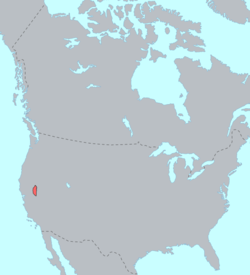
Among native speakers, there were 64 children and adolescents under the age of 17 years, of which 4 had limited knowledge of English. [one]
The Washo tribe belongs to the culture of the Great Basin and is the only one that does not belong to the Num languages in this region. The language has borrowings from neighboring Yuto-Astekian, Maiduan and Miwok languages, for this reason it is included in two language unions at once - the Great Basin and the Californian.
Content
- 1 Regional Options
- 2 Genetic relationships
- 3 Phonetics
- 4 Grammar
- 5 Links
- 6 notes
- 7 Literature
Regional Options
Washo is divided into two groups of dialects: northern and southern. The difference between the dialects is small and does not impede mutual understanding.
Genetic relationships
Washo is not related by kinship to neighboring languages - Northern Pute ( Num languages of the Uto-Astek family ), Maidu ( Maidan family ) and Miwok ( Utian family ). No reliable links with other languages have been established. It is often included in a hypothetical Hokan macro-family , but even this assumption, in the opinion of the father of the Hokan hypothesis A. Kroeber , can be true if there is a very distant relationship with other Hokan languages. For the first time, the opinion of kinship with the Khokan languages was expressed by J.P. Harrington, who suggested a kinship between Washo and the Chumash languages . Harrington’s opinion was supported without discussion by other proponents of the Hokan hypothesis. In 1988, Terrence Kaufman published a work with a new review of the Hokan hypothesis, where he includes Washo in the Hokan languages, but excludes the Chumash languages. Due to the controversial existence of the Hokan macro-family, the Washo language is usually regarded as an isolate.
Phonetics
Washo has a regressive harmony of vowels or umlaut. The vowel harmonization mechanism is different in the northern and southern dialect groups.
Grammar
In the washo language, verb reduplication was used to convey repeatability of an action or plural.
The word order is SOV .
Both verbs and nouns used both suffixes and prefixes. Verb conjugation paradigms are rich, there have been many times.
Links
Notes
- ↑ 1 2 Language Map Data Center Archived June 2, 2013.
Literature
- Campbell, Lyle. (1997). American Indian languages: The historical linguistics of Native America . New York: Oxford University Press. ISBN 0-19-509427-1 .
- Goddard, Ives (Ed.). (1996). Languages . Handbook of North American Indians (WC Sturtevant, General Ed.) (Vol. 17). Washington, DC: Smithsonian Institution. ISBN 0-16-048774-9 .
- Gordon, Raymond G., Jr. (Ed.). (2005). Ethnologue: Languages of the world (15th ed.). Dallas, TX: SIL International. ISBN 1-55671-159-X . (Online version: http://www.ethnologue.com ).
- Jacobsen, William H. 1996. Beginning Washo . Occasional Papers 5: Nevada State Museum.
- Mithun, Marianne. (1999). The languages of Native North America . Cambridge: Cambridge University Press. ISBN 0-521-23228-7 (hbk); ISBN 0-521-29875-X .
- Sturtevant, William C. (Ed.). (1978-present). Handbook of North American Indians (Vol. 1-20). Washington, DC: Smithsonian Institution. (Vols. 1-3, 16, 18-20 not yet published).