Ulysses is a modernist novel by Irish writer James Joyce . Ulysses is a complex polystylistic work. This novel, which is recognized as the pinnacle of modernist literature [1] , despite its plot simplicity, contains a huge number of historical, philosophical, literary and cultural allusions .
| Ulysses | |
|---|---|
| Oulysses | |
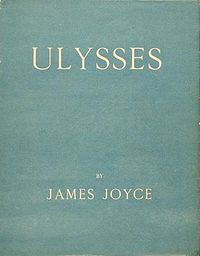 Cover of the first edition of 1922 | |
| Genre | modernist romance |
| Author | James joyce |
| Original language | English |
| Date of writing | 1914-1921 |
| Date of first publication | 1918-1920 |
| Publishing house | Sylvia Beach |
| Previous | |
| Following | |
The novel tells the story of one day of the Dublin inhabitant of Jewish origin Leopold Bloom (currently this date, June 16, 1904 , the fans of the novel celebrates as " Bloom 's Day "). This day Bloom spends in the publishing house, on the streets and in a cafe in Dublin, at the funeral of his friend, on the bay, in the maternity hospital, where he meets Stephen Dedalus, a young teacher at a local school, in the brothel and, finally, in his own house, where he leads late at night to the pretty drunk Daedalus, who has lost his shelter. The main intrigue of the novel is the betrayal of Bloom's wife, whom Bloom knows, but does not take any measures against her.
The canvas of the novel and its compositional construction have explicit and implicit analogies with Homer's poem Odyssey . In the work “similar” characters are also derived: largely autobiographical Stephen Daedalus ( Telemachus storyline), Leopold Bloom ( Odysseus , the Latin form of this name Ulysses served as the name of the novel), Molly Bloom ( Penelope ). One of the main themes of the novel is the father-son theme, where Bloom is symbolically the first, and Stephen is the second. The novel reflects literary styles and genres of various eras, the stylistic features of writers whom Joyce parodies or imitates.
Content
- 1 idea of creation
- 2 Structure
- 2.1 Gilbert Scheme
- 3 Gallery
- 4 Editions in Russian
- 5 censorship
- 6 Perception of the novel
- 7 notes
- 8 References
Creation Idea
Joyce met the character of Odyssey (Ulysses) in Charles Lam’s English adaptation of The Odyssey for Children, The Adventures of Ulysses, which probably fixed the Latin version of the name in the writer’s memory. In school, he wrote an essay about this character called "My Favorite Hero." Joyce told Frank Badgen that he considered Ulysses the only multifaceted character in literature. He planned to name “Ulysses in Dublin” his collection of short stories, which he later called “ Dubliners, ” but in the end this idea turned into the idea of a large novel that was started in 1914.
Structure
James Joyce divided Ulysses into 18 chapters, or "episodes." At first glance, the book may seem unstructured and chaotic, and on this occasion, Joyce once said that he “put so many puzzles and puzzles into it that professors will argue for many centuries about what I had in mind”, what the novel will do “ immortal ” [2] . Joyce composed two schemes of the novel. The first diagram was drawn up for his friend Carlo Linati in 1920, the second for Valerie Larbo in 1921. Initially, Joyce was against the widespread publication of these schemes, but in 1931, with his permission to protect against pornography charges, the second scheme was published by Stuart Gilbert in the James Ulysses book "Ulysses" [3] [4] .
Each episode of Ulysses has its own theme, technique and connection between its characters and the characters of Odyssey. The original text did not have the names of the episodes; they come only from the schemes of Linati and Gilbert . In his letters, Joyce called the episodes their Homer titles. Some episode titles have characteristic connections, for example, “Nausicaa” and “Telemachis” are taken from Victor Berar ’s two-volume book “Phoenicians and Odyssey”, which the author got acquainted with in 1918 at the Central Library of Zurich .
Gilbert's scheme
| No. | Chapter | Scene | Time | Organ | Color | Symbol | Art | Technics |
|---|---|---|---|---|---|---|---|---|
| one | Telemachus | Tower | 8 | - | White / gold | Heir | Theology | Narration (youthful) |
| 2 | Nestor | School | 10 | - | Brown | Horse | Story | Catechism (personal) |
| 3 | Proteus | Coast | eleven | - | Green | Tide | Philology | Monologue (male) |
| four | Calypso | House | 8 | Bud | Orange | Nymph | Economy | Narration (mature) |
| 5 | Lotofagi | Bath | 10 | Genitals | - | Eucharist | Botany / Chemistry | Narcissism |
| 6 | Hades | Cemetery | eleven | Heart | White / black | Caretaker | Religion | Incubism |
| 7 | Eol | Newspaper | 12 | Lungs | Red | Editor | Rhetoric | Enthymeme |
| 8 | Lestrigons | Lunch | 13 | Esophagus | - | Constable | Architecture | Peristalsis |
| 9 | Scylla and Charybdis | Library | fourteen | Brain | - | Stratford | Literature | Dialectics |
| 10 | Wandering cliffs | Streets | fifteen | Blood | - | Citizens | Mechanics | Labyrinth |
| eleven | Sirens | Concert hall | 16 | An ear | - | Bartender | Music | Fuga per canonem |
| 12 | Cyclops | Tavern | 17 | Muscle | - | Fenian | Policy | Gigantism |
| 13 | Nausicaa | Cliffs | twenty | Eye nose | Gray / blue | Virginity | Painting | Tumescence / Detumescence |
| fourteen | Bulls of the Sun | Hospital | 22 | The belly | White | Mother | The medicine | Embryo |
| fifteen | Circe | Brothel | midnight | Locomotion | - | Prostitution | Magic | Hallucination |
| 16 | Eumeus | Shelter | one | Nerves | - | Sailors | Navigation | Narration (senile) |
| 17 | Ithaca | House | 2 | Skeleton | - | Comets | The science | Catechism (impersonal) |
| eighteen | Penelope | Bed | ∞ | Flesh | - | Earth | - | Monologue (female) |
Gallery
James Joyce's Room at the James Joyce Tower Museum
View from the shore of Sandymount to the Dublin Bay and Cape Houth
Pub Davy Byrne (Dublin), where Bloom ate a gorgonzola sandwich and drank Burgundy wine
National Library of Ireland
Ulysses, 1922 edition
A plaque on the house number 12 in the Rue de l'Odeon ( Paris ) [5]
Editions in Russian
- 1920s:
- 1925 - episode 18 [6] in the translation of V. Zhitomirsky was published in the almanac of “Novelties of the West”;
- 1929 - excerpts from episodes 4 and 8 are published in Literaturnaya Gazeta translated by S. Alimov and M. Levidov.
- 1930s:
- 1934-1935 - episodes 4-6 were published in the journal Zvezda translated by V. I. Stenich ;
- 1935-1936 - episodes 1-10 were published in the journal International Literature in the translation of the First Translation Association at hand. I.A. Kashkina .
- 1980s:
- 1982 - excerpts from the novel translated by A. Livergant ;
- 1985 - extracts from the novel translated by I. Pomerantsev ;
- 1986 - extracts from the novel translated by I. Shamir ;
- 1989 - the first full publication in the translation of V. Khinkis , S. Khoruzhego , comments by E. Genieva , in the journal " Foreign Literature ".
- 1993 - the first book edition of the Russian translation: Joyce D. Ulysses / Per. from English B. Khinkis and S. Khoruzhego; commentary. S. Khoruzhego. - M .: Republic, 1993 .-- 671 p. ISBN 5-250-02181-6
- Joyce D. Favorites. In 2 volumes. - Volume 1: Ulysses. - M .: Terra, 1997 .-- 672 p.
- Joyce D. Ulysses. - St. Petersburg: Symposium, 2000 .-- 832 p. ISBN 5-89091-098-1
- Joyce D. Ulysses. - St. Petersburg: Crystal, 2001 .-- 1152 p.
- Joyce James "Odyssey" / Per. from English S. Makhova , - M .: LLC "SFK Invest", 2007. - 696 p. ISBN 978-5-91439-003-4 (vol. II)
- Joyce J. Ulysses. - St. Petersburg: ABC classic, 2006 .-- 992 p. ISBN 5-352-01300-6
- Ulysses: novel / James Joyce; Per. from English S. Khoruzhego. - M .: Eksmo, 2013 .-- 928 p. ISBN 978-5-699-43288-2
Censorship
The novel was created over seven years, published in parts in the American magazine from March 1918 to December 1920, and was published entirely in Paris by Sylvia Beach on February 2, 1922. [7] During its first publication in the journal, the episode "Nausicaa" was the subject of legal charges of pornography. In 1919, fragments of the novel appeared in the London literary magazine , but the novel was completely banned in the UK until the 1930s. But Joyce firmly decided that the book should be published on his fortieth anniversary, February 2, 1922, and that morning, Joyce's publisher in Paris, Silvia Beach, received the first three copies of the novel from the typographer.
The prosecution in the United States began immediately after the publication of an excerpt from a book in one of the issues of Little Review, which describes how the protagonist masturbates. The historian of law, , argued that only a few readers could really recognize in a text filled with metaphors that someone was experiencing an orgasm. Irene Gummel continued this assertion, suggesting that Little Review’s allegations of pornography were triggered by more explicit poems by Baroness Elsa Freytag-Loringofen , which appeared simultaneously with the episodes of Ulysses. , which protested against the contents of the book, was trying to take measures that would prevent the book from being distributed in the United States. During the in 1921, the magazine was declared pornographic, and as a result, Ulysses was actually banned in the United States. Throughout the 1920s, the U.S. Department of Posts burned copies of the novel.
In 1933, the publishing house and lawyer organized the import of the French publication, and when unloading the vessel, one copy was confiscated by customs, which was then protested. On December 6, 1933, in the United States case against a book called Ulysses, Federal District Judge ruled that the book was not obscene and therefore could not be pornographic, as called the “landmark” decision . The Second Circuit Court of Appeals upheld this decision in 1934. Then the United States became the first English-speaking country where the book began to be in the public domain. In Ireland, Ulysses was not banned, but despite this, the novel was not published there.
Perception of the novel
I never really liked Ulysses, most of the novel consists of examples of how you should not write a novel. - Aldous Huxley [8] . |
In a review of The magazine, TS S. Eliot said of Ulysses: “I consider this book to be the most significant expression found by our generation; this is a book to which we are all indebted and from which no one can escape. ” He also claimed that Joyce was not to blame for the fact that people subsequently did not understand him: “The next generation is responsible for its soul; "a brilliant person is responsible to his peers, and not to a group of illiterate and untrained dudes."
The book also has critics. Virginia Woolf stated that "Ulysses was an unforgettable catastrophe - immeasurable in courage, terrible in destructiveness." The Marxist Karl Radek called Ulysses “a pile of manure, in which worms swarm, filmed by a cinema machine through a microscope” [9] . One newspaper expert stated that it had a “secret sinful sewage system ... directing his unimaginable thoughts, images and pornographic words” into a single stream, and concluded a “disgusting blasphemy” that “depreciates and perverts and dishonors the wonderful gift of imagination and wit and the lordship of the tongue. ” Similar opinions on the proper role of literature were expressed by the dissenting judge of the court of appeal in the American case, who found that the book was not pornographic: assuming that Joyce was subject to “pornographic or lustful thoughts” and “there was no Christ against him,” the judge said that literature should serve the needs of people with “moral principles,” be “majestic and lasting,” and “encourage, facilitate, purify, or ennoble the life of people.”
| “What is so amazing in Ulysses is that nothing is hidden behind a thousand curtains; that he does not appeal to either reason or society, but as cold as the moon, he looks at them from outer space, gives the tragedies of development, existence and decomposition to go their own way ” |
| - Carl Jung [10] |
“Ulysses” was called “a prominent landmark in modernist literature”, an essay in which the complexities of life are portrayed with “unprecedented and incomparable linguistic and stylistic virtuosity”. This style was recognized as the best example of the stream of consciousness in modern fiction, the author of which went deeper and further in the internal monologue than any other novelist. This technique has become famous for its honest presentation of the flow of thoughts, feelings, mental perception and mood changes. The critic Edmund Wilson noted that Ulysses is trying to portray "as accurately and as directly as possible in words what it looks like (or rather what it seems to us like) our participation in life from moment to moment." Stuart Gilbert said that “the characters of Ulysses are not fictitious,” that “these people are what they should be; they act, as we see, according to a certain lex aeterna , an unshakable condition for their very existence. ” Through these characters, Joyce "seeks a harmonious and integral interpretation of life."
Joyce uses metaphors, symbols, ambiguous expressions and hidden hints that gradually intertwine and form a network connecting the entire work. This system of connections gives the novel a wider, more universal meaning, where Dublin appears in the novel as a symbol of the whole world , Bloom - a modern Ulysses, a symbol of a man as such, his wife embodies the image of all women, one summer day - of all times on Earth . Eliot described this system as a “mythical method”: “a way to control, organize, give form and meaning to the vast panorama of futility and anarchy that modern history is.”
It is known that the prototype of the Bull of Mulligan was a former friend of Joyce Oliver Gogarty [11] [12] .
The novel was included in the list of 100 best books of all time according to the Norwegian Book Club, which conducted a survey of 100 writers around the world to compile the list [13] .
Notes
- ↑ Ulysses was called the "quintessence of the entire modernist movement." Beebe, Maurice (Fall 1972). "Ulysses and the era of modernism." James Joyce Quarterly (University of Tulsa) 10 (1): p. 176.
- ↑ The bookies' Booker ... , The Observer (November 5, 2000). Date of treatment February 16, 2002.
- ↑ Ulysses: the Gilbert schema
- ↑ Joyce, James. Ulysses. - New York: Everyman's Library, 1997 .-- P. 23. Introduction. - ISBN 978-1-85715-100-8 .
- ↑ “In 1922, Mademoiselle Sylvia Beach published the James Ulysses Ulysses in this house.” Originally, it housed the Shakespeare & Co. bookstore.
- ↑ Genius E. Yu. Rereading Joyce / Joyce J. Favorites. - M., 2000. - S. 7-18
- ↑ The first edition of Ulysses sold for a record amount
- ↑ Aldous Huxley's Rules of Life | Esquire.ru Magazine
- ↑ First All-Union Congress of Soviet Writers. Verbatim report. - M .: State Publishing House of Fiction, 1934. - 718 p. - ISBN 5265009167 .
- ↑ Jung C. Ulysses: Monologue ( Wirklichkeit der Seele ). - Nimbus . T. 2, No. 1, June-August 1953.
- ↑ Joyce D. Ulysses . // gumer.info. Date of treatment August 2, 2012. Archived on August 5, 2012.
- ↑ Yana Dashkovskaya. Literary revenge . // h.ua (July 9, 2007). Date of treatment August 1, 2012. Archived on August 5, 2012.
- ↑ Dette er Verdensbiblioteket . Norsk Bokklubben (2016). Дата обращения 25 июня 2016.
Links
- www.james-joyce.ru // «Улисс» Джойса (русский перевод и оригинал)
- Улисс в библиотеке Максима Мошкова (англ.)
- Джеймс Джойс. Улисс. — СПб: Симпозиум , 2004. — 830 с. — ISBN 5-89091-098-1 . .