The Crimean People’s (Democratic) Republic ( Crimea. Qırım Halq Cumhuriyeti, Kırym Halk Jumhurieti , قريم خلق جمهوريت государ ) is a state entity that claimed to restore the state sovereignty of the Crimean Tatars in the territory of the Crimea on November 19 , in the territory of Crimea. It ceased to exist in January 1918 after a defeat in an armed clash with supporters of the Soviets .
| Historical state | |||
| Crimean People's Republic | |||
|---|---|---|---|
| Qırım Halq Cumhuriyeti قريم خلق جمهوريتى | |||
| |||
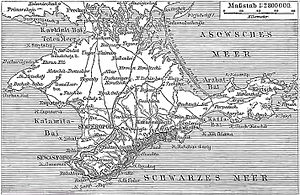 Crimea map | |||
←   → →November 1917 - February 1918 | |||
| Capital | Bakhchisaray | ||
| Languages) | Crimean Tatar | ||
| Religion | secular state | ||
| Square | 26,860 km ² | ||
| Population | 749 800 people | ||
| Form of government | parliamentary republic | ||
| Official language | |||
| Prime Minister | |||
| • | Noman Celebigihan | ||
| • | Jafer Seydamet | ||

History
After the February Revolution, the Muslim Executive Committee and the convening of the Kurultai
The February Revolution of 1917 , among other things, led to the activation and organizational design of the national democratic movements of the national suburbs of Russia.
In March 1917, the All-Crimean Muslim Congress was held in Simferopol , at which the 1,500 delegate corps elected a permanent body - the Muslim Executive Committee (Musispol) of 50 people [1] .
The former teacher, a soldier Seitzhelil Khattatov , was elected Chairman of the Musical Executive Committee . Key posts were occupied by Celebi Chelebiev (Noman Chelebidzhikhan) (interim commissar of the clerical government and at the same time Tauride Mufti) and Jafer Seydamet (commissar of the Vacuf Commission), Ali Bodaninsky , manager of affairs (serkyatib) [1] [2] .
The Musical Executive Committee began to actively manage the internal life of the Crimean Tatars: changes were being prepared in the field of education, newspapers were published, steps were taken to create Crimean Tatar military units, links were established with other national movements in the Russian Empire [3] .
The first decision of the Muslim Committee was the decision on public education, and only secondarily did it take care of creating armed support - Muslim volunteer units. The Tatar battalion was recognized as the legitimate revolutionary unit by the All-Russian Provisional Government, which even strengthened it by transferring the spare part of the Cavalry Tatar Regiment to Simferopol [1] .
Formation of the authorities of the Crimean People's Republic and confrontation with the Bolsheviks
On October 1-2, 1917 (according to the old style), at a congress of representatives of Crimean Tatar organizations convened by the Executive Committee, it was decided that in the current political situation, the issue of the future fate of Crimea should be decided by the Kurultay of the Crimean Tatars. On November 20, 1917, the Council of People's Representatives was elected (it was boycotted by the Bolsheviks), in which the Crimean Tatars and Ukrainians got 3 places each, and the Russians (which were much more than the Crimean Tatars and Ukrainians) only 2 places [4] . Kurultay opened on November 26 in the Khan's Palace ( Bakhchisaray ). He took over all the powers of the Muslim Executive Committee, proclaimed the re-establishment of Crimean statehood on the principle of a people's republic / Constitutional monarchy, and then declared himself the parliament of the Crimean state. It should be noted that the new formation had very limited military forces, with unknown stability and its power over the entire territory of Crimea was declarative in nature.
The congress elected the leadership of Kurultay. The chairman was A. S. Aivazov , members of the presidium - J. Ablaev and Ablyakim Ilmiy, secretaries - S. Taracci and A. Bodaninsky [5] .
The Board of Directors ( Directory ), the National Government, was appointed with forty votes to twenty. N. Celebidzhikhan was elected Chairman and Director of Justice; J. Seidamet was appointed director of foreign and military affairs, S.J. director of finance and waqfs. Hattatov ; Director for Religious Affairs - A. Shukri; Director of Public Education - A. Ozenbashly [5] .
Noman Celebigihan led the government. On December 13, 1917, Kurultay approved the “Crimean Tatar Basic Laws” and the creation of the Crimean People’s (Democratic) Republic [6] . The Directory of five Crimean Tatars became the leader of the new republic [7] .
- Figures of the Crimean People's Republic
Seitzhelil Khattatov (1874-1938)
Celebi Celebiev (Noman Celebidzhikhan) (1885-1918)
Jafer Seydamet, left (1889-1960)
Matvey Aleksandrovich (Suleiman) Sulkevich (1865-1920)
Asan Sabri Ayvazov (1878-1938)
The Crimean government relied on the armed forces of the "Crimean Revolutionary Headquarters", formed in November 1917 by the Musical Executive Committee. Other peoples of the multinational Crimea also expressed a desire for the formation of the Crimean military forces. From the very beginning of the process of creating the Tatar national units, the Ukrainian Regiment named after the hetman Doroshenko entered into friendly relations with the Simferopol Muslim soldiers' committee. There was a proposal from the Greeks and Russians to form the 3rd Crimean Horse Regiment from Crimean natives of all nationalities except the Tatars. Already in January 1918 the division of this regiment was created. Volunteers of a regiment of horses brought with them. At the beginning of 1918, a Greek battalion, a Jewish detachment, an Armenian and a Polish company were also formed. The French military also served in the Crimean forces, namely aviators under the command of Colonel Montero.
The Muslim corps of General M.A. Sulkevich was never transferred to the Crimea, remaining until the end of its existence on the Romanian front in the conditions of the complete failure of the army, the battles against the Bolsheviks and the Romanian occupation. After the advance of the Austro-Hungarian army in March 1918, the corps was disarmed by the Austrians near Tiraspol. Sulkevich himself, with part of the corps' soldiers, Crimean Tatars, could only come to Crimea in April 1918, when parts of the German army had already settled there [8] .
Military clash with the forces of the Sevastopol Council and defeat
Trying to take control of the entire peninsula, on January 11 (24), 1918, the government sent troops subordinate to it to Sevastopol , which during the battles of January 12 (25) - 13 (26) with the Reds were defeated. After that, on January 14 (27), with the support of the Sevastopol detachment of Red Guards and sailors of the Black Sea Fleet, the Tatar formations were knocked out of Simferopol . D. Seydamet left the Crimea, N. Celebidzhikhan was arrested and placed in a Sevastopol prison , and on February 23 of the same year in Sevastopol he was killed without trial by sailors, and his body was thrown into the Black Sea [9] .
See also
- Soviet Socialist Republic of Tauris
- Crimean regional government
- The second Crimean regional government
- Millie Firka
- Crimean Khanate
Notes
- ↑ 1 2 3 Vozgrin V. E. The historical fate of the Crimean Tatars
- ↑ Aivazov A.S. History of the national movement in Crimea
- ↑ Chubarov E. Kurultay of the Crimean Tatar people: the origins and convocation of the national congress. Official website of the Mejlis of the Crimean Tatar people
- ↑ Soldatenko V.F. Russia - Crimea - Ukraine. Relationship experience during the years of the revolution and the Civil War. - M.: Political Encyclopedia , 2018. - P. 24-25.
- ↑ 1 2 Selim ALI. The first Kurultay of the Crimean Tatar people . Ana Yurt (2012 - 2018).
- ↑ Soldatenko V.F. Russia - Crimea - Ukraine. Relationship experience during the years of the revolution and the Civil War. - M.: Political Encyclopedia , 2018 .-- P. 25.
- ↑ Soldatenko V.F. Russia - Crimea - Ukraine. Relationship experience during the years of the revolution and the Civil War. - M.: Political Encyclopedia , 2018 .-- P. 25.
- ↑ Papakin A. Tatar military units in Crimea (November 1917 - January 1918) // Military Crimea. - 2010. - No. 15. - S. 22-24.
- ↑ Zarubin, A. G., Zarubin, V. G. Without winners. From the history of the Civil War in Crimea. - 1st. - Simferopol: Antikva, 2008 .-- 728 p. - 800 copies. - ISBN 978-966-2930-47-4 .
Literature
- Government of Ukraine in the twentieth century. K .: Naukova Dumka. 2001.608 p.
- Papakin A. Tatar military units in the Crimea (November 1917 - January 1918) // Military Crimea. - 2010. - No. 15. - S. 22-24.