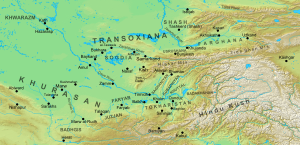
Shash or Chach is an ancient historical region in Central Asia, roughly the right bank of the Syr Darya along the valleys of the Chirchik and Angren rivers (modern Tashkent region and the adjacent territories of Kazakhstan ). And also the name of the city itself - mentioned by Abu Reikhan al-Biruni from the 11th century as Tashkent .
Content
- 1 History
- 2 Rulers
- 3 notes
- 4 Literature
- 5 See also
History
Shash is a region of ancient agricultural culture. Even in the inscription of the Sasanian king Shapur I from 262 AD e. Chach region is mentioned.
It is reliably known from the II-I centuries BC, as the possession of the Kangyuy with their first capital ( Kanka ). [1] [2] [3] [4] [5] In the earliest Chinese sources it appears as Shi, Zheshi and Yuani, in the early Middle Ages - Chach, Shash and Jach. [6] There are various names of the area - Shash-tepa, Chach-tepa.
The Silk Road from the Middle East to China passed through Shash. Chinese sources [7] knew Shash under the name Shi ( Chinese. 石 國 ) on the Yaosha River ( Chinese. 藥 殺 ). The circumference of the city was 10 li (about 5 km). The ruler of Shasha was a prince named Ne ( Chinese. К ). To the southeast of the palace was a courtyard where a golden throne stood. There, on the 6th day of the first month, an urn with the ashes of the deceased parents of the reigning prince was set up on the lunar calendar and nobles went around her, throwing flowers and fruits. After this, the prince granted the nobles sacrificial meat and they feasted, and the prince and his wife left. Residents grow millet and wheat, raised horses, were known as good warriors. At first they got along with the Turks, but after their relationship deteriorated and Shash was conquered by the Shegui Khan (actually his grandfather Kara-Churin-Turk ) and became the possession of the Turkic princes. In 609, an embassy arrived in China from Shash.
In Arabic-language historical documents, the name "Shash" is found after the Arabs conquered Central Asia . In the years 712 - 713, Shash, as well as his allies Sogd , Ustrushan and Ferghana, were defeated by the Arabs. With the advent of the Samanid state, Shash becomes one of its largest areas.
Since the XI century, it is known as Tashkent , which supposedly means "Stone City" (from Uzbek. Tosh "stone"). Since “shi” can also mean “stone” in Chinese ( Chinese ex.. , Pinyin : shí ), then after the region was settled by Turkic tribes, these names could be transformed into a consonant word with the same semantic meaning in Turkic languages - “Tash” (“stone”) [8] .
During the Mongol-Tatar conquest of Central Asia, the dynasty of Shasha rulers managed to survive, the capital of Shasha, Binkent , which from the 11th century began to be called Tashkent, survived. This city at times belonged to the khans of the Chagatai ulus . Since 1370, Tashkent became part of the Timurid Empire. Various states that arose in the Tashkent region in a number of medieval documents continued to be called Shash later, and from the 16th century. Tashkent.
Rulers
Shash (Chach) (c. 600 - 775)
Table. Shash (n. Tashkent).
- Tudong (Yubizhe) (c. 730 - 49) *
- Ram (approx. 750 - 70).
- 775 (fact. 749) the Arab conquest [9] .
Notes
- ↑ UNESCO, Kanka
- ↑ [Filanovich M.I. Tashkent. The origin and development of the city and urban culture. T., 1983. S. 26; Shaniyazov Sh. K. On the historical toponymy of Tashkent. // ONU, No. 7, 1983. P. 36-37]
- ↑ CITY OF THE HOLY FARN, ANCIENT CAPITAL OF THE TASHKENT STATE Archival copy of July 29, 2009 on the Wayback Machine
- ↑ Letters about Tashkent :: City of noble stone
- ↑ The earliest known information about Tashkent is found in ancient Chinese chronicles of the II century BC. e., in which the Tashkent oasis and its central city , which was part of the Kangyu state, are referred to under the name Yueni. In the transcription of some ancient Chinese sources it is referred to as Shash. In the inscription on the Kaaba of Zoroaster (262 CE) of the Persian king Shapur I, the Tashkent oasis is mentioned under the name Chach. (inaccessible link) . Date of treatment May 1, 2007. Archived March 14, 2007.
- ↑ In the 19th century, it was believed that the first reliable information about Tashkent, referred to under the name Chach, was known from the 7th century, when it was mentioned in the notes of the Chinese traveler Xuanzang . Tashkent // Brockhaus and Efron Encyclopedic Dictionary : in 86 volumes (82 volumes and 4 additional). - SPb. , 1890-1907.
- ↑ Bei Shi (Book of the Northern Dynasties). Juan 97.; N. Ya. Bichurin "Collection of information ...", 1950 p.272.
- ↑ Max Fasmer. Etymological dictionary of the Russian language. Translation from German and additions by corresponding member of the USSR Academy of Sciences O. N. Trubachev. Edited and foreword by prof. B.A. Larina. Second edition, stereotyped. In four volumes. M .: "Progress", 1986.
- ↑ Rulers of the World. V. Erlichman. 2009.
Literature
- "Ancient Tashkent", Tashkent 1973
- Bartold V.V. “Tashkent”, Works, vol. 3, Moscow 1965.
- Bei Shi (Book of the Northern Dynasties). Juan 97.; N. Ya. Bichurin "Collection of information ...", 1950 p.272.
See also
- Shashtepa
- Minguryuk
- Kanka