Nasikabatrachus sahyadrensis (lat.) Is a frog species , the only one in the genus Nasikabatrachus of the monotypic family Nasikabatrachidae [1] . It lives in the mountains of the Western Ghats in India . This frog received the Latin name Nasikabatrachus due to its pointed nose (nasika in Sanskrit means "nose").
| Nasikabatrachus sahyadrensis |
 |
| Scientific classification |
|---|
| No rank : | Bilateral symmetrical |
| Squad: | Tailless Amphibians |
| Family: | Nasikabatrachidae Biju & Bossuyt, 2003 |
| Gender: | Nasikabatrachus Biju & Bossuyt, 2003 |
| View: | Nasikabatrachus sahyadrensis |
|
| International scientific name |
|---|
Nasikabatrachus sahyadrensis Biju et Bossuyt, 2003 |
| Area |
|---|

|
| Security status |
|---|
Endangered speciesIUCN 3.1 Endangered : 58051 |
|
Content
The species was discovered and classified only in 2003 . This frog is a living fossil , lives only on the territory of about 14 km² . Related species live only in the Seychelles in more than 3 thousand kilometers to the west. [2] Although one of the discoverers, Professor Biju, refers the species to a separate family.
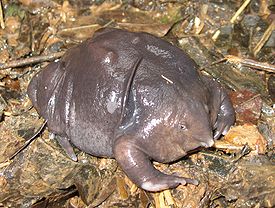
Squat, slightly rounded body. The extremities are turned outward, as in other species of frogs. It has a small head and a specific pointed muzzle. The motionless frog outwardly resembles a piece of a jelly-like mass of purple or violet . The length of the purple frog is 5–9 cm. [3] The specimen from which the species was described was 7 cm long from the tip of the muzzle to the tailbone . Adults are usually dyed purple.
Nasikabatrachus sahyadrensis spends most of the time underground, going to the surface for two weeks a year during the monsoon with the aim of mating . The reclusive way of life led to the fact that biologists for a long time did not know about the existence of this species. To search for food, the purple frog does not come to the surface, it feeds underground, mainly termites . [four]
In 2008, Chan Li Pen, one of the leading Scienceray sites , included Nasikabatrachus sahyadrensis in his list of the 20 most strange or ugly animals on the planet [5] [6] .