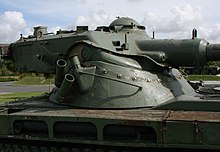
The swinging tower is a type of tank tower in which the gun is fixedly mounted in the upper half of the tower, swinging on the pins relative to the turning lower half. Such a tower has a number of specific advantages and disadvantages over the towers of the traditional scheme. The swinging tower was developed in France in 1946 by AMX as part of the AMX-12t project. This project remained on paper, but later the tower was finalized and successfully used on the light tank AMX-13 of the same manufacturer, launched into production in 1951 . Development in this direction was carried out in the 1950s in France and the United States, but as a result, the flaws of the swinging tower against the background of growing requirements for tanks outweighed its advantages, and the designs based on it did not go beyond the stage of projects and prototypes. The only exception was the Austrian light tank SK-105 Cuirassier equipped with a modified AMX-13 turret, whose production began in 1971 .
Content
Swing Tower Design
In contrast to the tower of the traditional design , which is an integral rotary structure in which the vertical guidance tool is placed in a movable installation on the pins , passing through the embrasure , the swinging tower consists of two parts - the lower turning and the upper swinging relative to it, in which the gun is placed. The main advantage of the swinging tower over the towers of the traditional scheme is the immobility of the upper part of the tower relative to the gun, which allows you to use the simplest loading mechanism in it [1] . In different countries, two different approaches have been taken to realize this advantage. In France , the loader shop was moved to the rear of the turret, which reduced the tower’s reserve volume and further simplified the loading mechanism. On the other hand, the location of the store isolated from the crew allowed it to be recharged only outside the tank, which in combat conditions required the withdrawal of the tank from the firing zone. [2] In the USA, a different approach was chosen, aimed only at using the high rate of fire provided by the automatic loader. At the same time, the store moved to the bottom of the swinging part of the tower, where it remained possible to reload it by the crew from inside the tank, for which a separate loader was left in the crew. [3] [4]
In addition, the design of the swinging tower has a number of both advantages and disadvantages. So, moving the gun outside the shoulder of the tower allows you to reduce the diameter of the latter, as a rule, determined by the space to ensure the rollback of the gun at any elevation angles, and therefore the reserve volume. [2] Although the overall height of the swinging tower is approximately the same as that of a traditional design, its advantage was to minimize the height of the part of the tower above the gun, since there was no need to provide space for lifting the breech of the gun when declining the barrel. As a result, the tank’s defense was significantly increased at the “in the trench” position, when only that part of the tank that was at the level of the gun barrel and above it was open for enemy fire [4] .
However, the large size of the moving part in the swinging tower created a number of problems. One of them was the additional area, and accordingly the weight of the reservation needed to provide protection at any elevation angles of the gun, in comparison with the towers of the traditional design, where this role is played by a relatively small mask of the gun [4] . The aft recess of the turret swinging with the gun also limited the maximum elevation angle of the gun, resting against the roof of the rear of the hull. [2] In addition, the relatively large gap between the upper and lower parts of the tower made it difficult to seal to overcome deep fords , or to protect against weapons of mass destruction , which became an important requirement for tanks in many countries in the 1950s and 1960s . An equally serious drawback over time was the extreme difficulty of stabilizing the gun in the vertical plane, due to the large mass of the moving part. [five]
Swing Tower Development History
France
For the first time, a concept similar to a swinging turret was applied to the Type 201 prototype armored car developed by Panar in 1937-1940 . In contrast to the post-war swinging towers, the parts of which were pivotally connected to each other, the Type 201 tower consisted of two parts rotatable relative to the vertical axis, the upper of which was mounted on the bottom at a slight angle. Thus, when turning the upper part relative to the lower, the elevation angle of the gun fixed in the upper part changed [6] .
With the surrender of France in 1940, work in this direction was stopped and resumed only after the end of World War II . The first tank equipped with a swinging turret, model FL10, was the light tank AMX-13 created in 1946-1949 .
The use of a swinging tower, combined with the general compactness of the layout , allowed the 15-ton tank, which was intended to be a mobile anti-tank weapon, to carry a long-barreled 75-mm cannon, which was a modified version of the German KwK 42 mounted on the Panther tank .
AMX-13 was mass-produced in France from 1951 to 1965 , and subsequently produced under license in Argentina from 1968 to 1985 , a total of about 7,700 tanks and vehicles based on them were produced [7] . Since the mid -1960s , when improving the armor of tanks made the 75-mm gun AMX-13, firing only with caliber armor-piercing shells , obsolete, tanks began to install 90-mm, and later 105-mm low-pulse guns firing cumulative shells .
The swinging turret was also used on the AMX 50 heavy tank , developed in the second half of the 1940s . Several prototype tanks of the tank were built, armed with 90 mm, 100 mm and 120 mm guns mounted in swinging towers, but the AMX-50 was not launched into mass production. Both the high price of the tank and the US supply of M47 tanks played a role in this, significantly reducing the severity of the problem of rearmament of their tank units for France [8] . With the beginning of the development by France in the late 1950s of the main battle tank AMX-30 , it was decided to return to the traditional tower structure [4] .
The swinging towers were also installed on the Batignolles Chatillon 25t , Lorraine 40t , Somua SM tanks, as well as on the EBR75 armored car developed by Panar. Unlike tanks, the FL11 turret mounted on the EBR75 had no aft niche and automatic loader and was armed with a 75 mm gun with a shorter barrel length. Like the AMX-13, the EBR75 was subsequently re-equipped with a low-pulse 90 mm gun mounted in a standard FL11 turret. On some of the vehicles that were later installed, the FL10 towers from AMX-13 with 75 mm cannons [9] .
USA
In the United States, work on swinging towers began after the French in 1950 transferred the second prototype AMX-13 for study [4] . The interest in this concept in the United States was primarily due to the desire to install an automatic loader on the tank, which provided a significantly higher rate of fire than with manual loading. Attempts to create an automatic loader for a turret of a traditional design, undertaken in the early 1950s , were unsuccessful - the need to ensure the supply of shots to a gun movable relative to the machine caused complication of the mechanism, and as a result, its unreliability, therefore, designed for the light tank T41 and medium T42 automatic loaders were found to be unsatisfactory [10] [11] . It was decided to turn to the French experience, and since 1951, the development of a number of projects using the swinging tower was started: the light tank T71, the medium T54E1, T69 and T77 heavy T57 and T58. In contrast to the scheme adopted at AMX-13, in the United States the autoloader store was moved under the gun, which allowed it to be reloaded from inside the tank.
Of all the projects developed in the USA that used the swinging tower concept, medium tanks reached the greatest development. The first of these was the T69 armed with a 90 mm cannon, using the chassis of the prototype T42. The prototype T69 was completed in early 1955 and from June of that year to April 1956 was subjected to lengthy tests, which revealed the unreliable operation of the automatic loader [12] . Shortly after the start of work on the T69, the development of another medium tank with a swinging turret of a similar design, this time on the chassis of the M48 tank and armed with a 105-mm cannon, received the designation T54E1 ; In total, two prototypes of the T54E1 were ordered, of which at least one was completed and tested, however, this tank did not go beyond the prototype stage [13] [4] . The development of another tank tank project, similar to the T54E1, but armed with a 120 mm cannon, was launched in 1952-1953 under the designation T77. As with the T54E1, two prototypes of the T77 were ordered, but work on this project was discontinued by 1957, even before the start of testing the prototypes. [14]
In addition to medium tanks, some projects of light and heavy tanks were equipped with swinging towers. In 1952 - 1955 , in the process of developing a light tank to replace the M41, various firms presented numerous concept projects, some of which used a swinging tower, but not one of them even reached the prototype stage [15] . A similar fate befell the projects that used the T43 chassis of the T57 and T58 heavy tanks with swinging turrets with 120-mm and 155-mm guns, respectively. Although the construction of their prototypes was started by the mid-1950s, all work on them was stopped in 1957, even before the completion of the assembly of prototypes [16] . After the negative results shown by the completed prototypes of medium tanks during testing, the military’s interest in the concept of a swinging tower fell significantly, and all work in this direction was stopped in 1957-1958 [17] .
Other countries
In the 1950s , the swing turret concept was studied for some time in Sweden , but in the end, Swedish designers, in search of a way to maximize the benefits provided by the fixed-mounted gun setup, came to an even more radical “swing tank” concept, which was launched in production in the mid -1960s Strv.103 [18] . Instead of installing the gun in the upper part of the tower, swinging with it, it was decided to install the gun motionless in the tank body, using for vertical aiming the inclination of the entire body provided by an adjustable suspension . This solved some of the problems inherent in the AMX-13 - for example, the autoloader’s store was not in the tight aft niche of the tower, but in a relatively spacious building, in addition, the problem of additional reservation and sealing of the gap between the parts of the tower, along with the gap itself, disappeared. On the other hand, stabilization of the gun with this scheme became completely impossible, to which was added the impossibility of horizontal aiming of the gun without turning the entire tank. As a result, although the concept of a turretless tank was still being developed in Sweden in the 1970s , these works were subsequently discontinued in favor of more traditional designs [19]
Swing Tower Machines
- Steyr SK 105 "Cuirassier" (German: SK-105 Kürassier) - Austrian light tank of the 1970s.
- Engin leger de combatSteyr SK 105 Cuirassier
See also
- Armored vehicles with an external location of the main armament
Notes
- ↑ RM Ogorkiewicz. Technology of Tanks. - Culsdon: Jane's Information Group, 1991 .-- S. 390 .-- 500 p. - ISBN 0-71060-595-1 .
- ↑ 1 2 3 Spasibukhov, Dmitrienko, 1999 , p. 18.
- ↑ Hunnicutt, 1984 , p. 48.
- ↑ 1 2 3 4 5 6 RM Ogorkiewicz. Technology of Tanks. - Culsdon: Jane's Information Group, 1991 .-- S. 391. - 500 p. - ISBN 0-71060-595-1 .
- ↑ Malginov, 2001 , p. four.
- ↑ RM Ogorkiewicz. Panhard Armored Cars. - Windsor: Profile Publications, 1972. - S. 2-5. - 20 s. - (AFV Weapons No. 39).
- ↑ V. Malginov. Light tanks of foreign countries 1945-2000 / M. Baryatinsky. - Moscow: Model designer, 2002. - P. 26. - 32 p. - (Armored Collection No. 6 (45) / 2002). - 4000 copies.
- ↑ RM Ogorkiewicz. AMX-30 Battle Tank. - Windsor: Profile Publications, 1973. - S. 2-3. - 20 s. - (AFV Weapons No. 63).
- ↑ RM Ogorkiewicz. Panhard Armored Cars. - Windsor: Profile Publications, 1972. - S. 5-8. - 20 s. - (AFV Weapons No. 39).
- ↑ Hunnicutt, 1995 , p. 43.
- ↑ Hunnicutt, 1984 , p. 47.
- ↑ Hunnicutt, 1984 , p. 47-51.
- ↑ Hunnicutt, 1984 , p. 127.
- ↑ Hunnicutt, 1984 , p. 145.
- ↑ Hunnicutt, 1995 , p. 56–66.
- ↑ Hunnicutt, 1988 , p. 150-160.
- ↑ Hunnicutt, 1984 , p. 51.
- ↑ RM Ogorkiewicz. S-tank. - Windsor: Profile Publications, 1971. - 20 p. - (AFV Weapons No. 28).
- ↑ RM Ogorkiewicz. Technology of Tanks. - Coulsdon: Jane's Information Group, 1991 .-- S. 57. - 500 p. - ISBN 0-71060-595-1 .
Literature
- Yu. Spasibukhov, D. Dmitrienko. AMX-13 - a hell of a dozen for the French army // Tankaster. - M .: Technique - youth, 1999. - No. 4 .
- V. Malginov. Austrian light tank "Cuirassier" // Tankmaster. - M .: Technique - Youth, 2001. - No. 5 .
- RM Ogorkiewicz. Technology of Tanks. - Culsdon: Jane's Information Group, 1991 .-- S. 390 .-- 500 p. - ISBN 0-71060-595-1 .
- RM Ogorkiewicz. AMX-30 Battle Tank. - Windsor: Profile Publications, 1973. - S. 2-3. - 20 s. - (AFV Weapons No. 63).
- RM Ogorkiewicz. S-tank. - Windsor: Profile Publications, 1971. - 20 p. - (AFV Weapons No. 28).
- RP Hunnicutt. Patton: A History of American Main Battle Tank Volume I. - Novato, California: Presidio Press, 1984. - 464 p. - ISBN 0-89141-230-1 .
- RP Hunnicutt. Firepower: A History of American Heavy Tank. - Novato, California: Presidio Press, 1988 .-- 224 p. - ISBN 0-89141-304-9 .
- RP Hunnicutt. Sheridan: A History of American Light Tank Volume 2. - Novato, California: Presidio Press, 1995 .-- 340 p. - ISBN 0-89141-570-X .