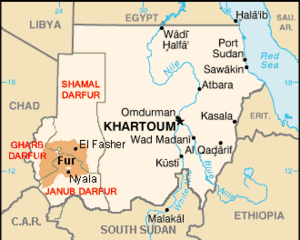
The Fur Language (self-named bèle fòòr or fòraŋ bèle , arab. فوراوي , pronounced Fûrâwî), sometimes linguists call it konjar after the name of the former ruling clan, the language of the Uri people living in the Sudanese Darfur region . It refers to the Fursk branch of the Nilo-Saharan macro family . The number of carriers - about 750 thousand. [1]
| Fur | |
|---|---|
| Self name | bèle fòr |
| Country | Sudan , Chad |
| Regions | Darfur |
| Official status | not |
| Regulatory Organization | not |
| Total number of speakers | 746,000 |
| Classification | |
| Category | Languages of Eurasia |
Nilo-Sahara macrofamily
| |
| Writing | Latin |
| Language codes | |
| ISO 639-1 | - |
| ISO 639-2 | - |
| ISO 639-3 | fvr |
| WALS | |
| Ethnologue | |
| Ietf | |
| Glottolog | |
Content
Phonology
Consonants
In the language of trucks there are the following consonants:
- Bilabial: fbmw
- Dental / alveolar: tdsnlr
- Palatal: j ñ y
- Velor: kg (h) ŋ
All the above characters have the same meaning as in the MFA , except for the following:
- j = [ɟ] ,
- ñ = [ɲ]
- y = [j] .
z is found only as the allophone of sound y . In borrowed words, Arabic consonants are sometimes found. Sound / h / is very rare.
Vowels
The following vowels are available: aeiou . There are disagreements between linguists whether vowels with an advanced language root (+ ATR), namely [ɛ], [ɔ], [ɪ], [ʊ] , phonetic variants or separate phonemes. Sound / f / is a free variation for a series of sounds ranging from [p] to [f] ; for the same reason, in a number of sources the language is called pɔɔr .
There are two main tones, L (low) and H (high); L, H, Medium, HL and LH are phonetically different.
It is interesting to note that metathesis is a widespread and regular occurrence in the language of trucks; if a consonant pronominal prefix joins a verb beginning in a consonant, then either the first consonant of the verb is omitted, or it changes places with the next vowel. Examples: lem- "lick"> -elm- ; ba- "drink"> -ab- ; tuum- "build"> -utum- . There are a number of other rules of phonetic assimilation.
Morphology
Plural
The plural of a noun and (optional) an adjective can be formed by the suffix -a ( -глаa after the vowels): áldi "story"> àldiŋa "stories", tò "type of antelope" tòŋà "antelope of this type"; bàin "old"> bàinà "old". This suffix also denotes an inanimate 3rd person plural. verbs: lìiŋ “he bathes”> lìiŋa “they (inanimate) bathe”, kaliŋa “they (animate) bathe”.
Adjectives ending in a vowel can take the plural suffixes -là or -ŋa : lulla “cold”> lullalà or lullaŋà “cold”. A similar suffix (as a result of metathesis and assimilation, which turned into -òl / -ùl / -àl ) is used to denote the plural number of verbs in a number of tenses.
Some nouns such as CVV accept the plural suffix H -ta ; ròò "river"> ròota "rivers"; rèi “field”> rèito “fields”.
At least two nouns accept the plural suffix. h. -i: koor "spear"> koori "spear", dote "mouse"> kuuti "mouse".
Nouns with a prefix of the singular d- (> n- before the nose) accept the plural suffix k- ; they make up about 20% of all nouns. In some cases (most often it concerns the names of parts of the body) L (low tone) is added to it. Example: dilo “ear”> kilo “ears”; nuŋi "eye"> kuŋi "eyes"; dagi "tooth"> kàgi "teeth"; dòrmi "nose"> kòrmì "noses".
- In some cases, the singular has the suffix -ŋ , which is absent in the plural: daulaŋ “shoe”> kaula “shoes”, dìroŋ “egg”> kìrò “eggs”.
- Sometimes an additional plural suffix is added from those listed above: nunùm “barn”> kunùmà “barns”, nuum “snake”> kuumi “snakes”, dìwwo “new”> kìwwolà “new”
- Sometimes the suffix is added - (n) ta : dèwèr “porcupine”> kèwèrtà “porcupines”; dàwì "tail"> kàwìntò "tails".
- One noun, as well as demonstrative and interrogative pronouns “which” form a plural. by adding the prefix k- with a low (L) tone: uu "cow"> kùù "cows"; ei "which?"> kèì "which?".
- There are a number of cases of syntactic plural without singular forms, mainly for the names of liquids that have the suffix k- L (low tone) - a ; kèwà “blood”, kòrò “water”, kònà “name, song”.
Nouns
A locative can be expressed by the suffix -le or a change in the final tone of a noun, eg: tòŋ “house”> toŋ “house, in the house”; loo "place", kàrrà "far"> loo kàrrà-le "in a faraway place".
The genitive is expressed by the suffix -iŋ ( i is omitted after the vowel). If the type of relationship is possessive, then the definition (the name of the owner) takes the first place, in other cases the last. Example: nuum “snake”> nuumiŋ tàb голова “snake head”; jùtà "forest"> kàrabà jùtăŋ "animals of the forest".
Pronouns
Independent subject
| I | ka | we | ki |
| You | ji | You | bi |
| He she it | ie | They | ami |
The object pronouns are the same, but they have a low tone, and -ŋò is added to the plural forms.
Subject prefixes
| I | - (leads to metathesis) | we | k- |
| You | j- | You | b- |
| He she it | - (vowel increase; * i -) | They (animate) They are (inanimate) | k- (+ suffix pl.) (* i-) (+ suffix pl. h.) |
Example for the verb bu- "tired":
| I'm tired | ùmô | We are tired | kùmô |
| Are you tired | jùmô | You're tired | bùmô |
| He is tired / she is tired | buô | They are tired | kùmul |
gi , which conveys the "object pronouns of the participant", conveys the objects of the first or second person in the dialogue, depending on the context.
Possessive pronouns
All the above forms are in the singular. The prefix k- is added to form the plural:
| my | duiŋ | our | daìŋ |
| your | diiŋ | your | dièŋ |
| his her | deeŋ | their | dièŋ |
Verbs
The verbal system of the Fur language is rather complicated; verbs have a number of paradigms of conjugation. There are three times: present, perfect and future. There is also a subjunctive mood. In past tense species differ.
Among suffixes, mention should be made of -iŋ (intransitive / recoverable; example lii "he washes"> liiŋ "he washes") and hemination of the middle consonant with the addition of -à / ò (intensive; example jabi "drop"> jappiò / jabbiò "throw down" .)
Denial is accomplished by adding the circumfix a- ... -bà ; a-bai-bà "he does not drink."
Adjectives
Most of the adjectives are disyllable, with geminata as the second consonant. Examples: àppa "big", fùkka "red", lecka "sweet." Some have 3 syllables: dàkkure "hard."
Adverbs can be formed from adjectives by adding the suffix -ndì or -n , for example: kùlle “fast”> kùllendì or kùlèn “fast”.
Abstract nouns can form from adjectives by adding the suffix -iŋ and lowering all the tones, as well as losing the final vowel of the adjective, for example: dìrro “heavy”> dìrrìŋ “heaviness”.
Writing
The Latin alphabet [2] is used to record the language of trucks: A a, A̱ a̱, B b, D d, E e, G g, H h, I i, Ɨ ɨ, J j, K k, L l, M m, N n, Ny ny, Ŋ ŋ, O o, P p, R r, S s, T t, U u, ʉ, W w, Y y, Z z . A high tone is indicated by an acute sign (ˊ), an ascending tone is indicated by a nut (ˇ), a descending tone is indicated by a circumflex (ˆ), a low tone is not indicated in the letter.
Literature
- AC Beaton. A Grammar of the Fur Language . Linguistic Monograph Series, No. 1. Khartoum: Sudan Research Unit, Faculty of Arts, University of Khartoum 1968 (1937).
- Angelika Jacobi, A Fur Grammar . Buske Verlag: Hamburg 1989.
- Constance Kutsch-Lojenga & Christine Waag, "The Sounds and Tones of Fur", in Sudanese Languages No. 9 Entebbe: SIL-Sudan 2004.
Notes
- ↑ Fur on Ethnologue
- ↑ Constance Kutsch Lojenga, Christine Waag. The Sounds and Tones of Fur // Occasional papers in the study of the Sudanese languages. - 2004. - № 9. - P. 1-25.