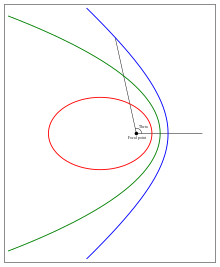
Eccentricity of the orbit (indicated by " ”Or“ ε ”) is the numerical characteristic of the orbit of a celestial body (or spacecraft ), which characterizes the“ compression ”of the orbit. In the general case, the orbit of a celestial body is a conical section (i.e. an ellipse , parabola , hyperbola or straight line ), and the eccentricity of the orbit is the eccentricity of the corresponding curve . The orbits of many bodies in the solar system are ellipses .

Content
Orbit eccentricity calculation
In appearance, the orbits can be divided into five groups:
- - circle
- - ellipse
- - parabola
- - hyperbole
- - direct (degenerate case)
For elliptical orbits, the eccentricity is calculated by the formula:
- where - minor axis, - semi-major axis of the ellipse.
For hyperbolic orbits, the eccentricity is calculated by the formula:
- where - imaginary axis, - the actual semi-axis of the hyperbola.
Some orbit eccentricities
The table below shows the orbit eccentricities for some celestial bodies (sorted by the major semi-axis of the orbit, except for 1I / Oumuamua, which has a hyperbolic orbit, and except for satellites that are grayed out).
| Heavenly body | Orbital eccentricity | |
|---|---|---|
| Mercury | 0.205 [1] | |
| Venus | 0.007 [1] | |
| Land | 0.017 [1] | |
| Moon | 0,05490 [2] | |
| (3200) Chaise | 0.8898 [3] | |
| Mars | 0,094 [1] | |
| Jupiter | 0,049 [1] | |
| And about | 0.004 [4] | |
| Europe | 0.009 [4] | |
| Ganymede | 0.002 [4] | |
| Callisto | 0.007 [4] | |
| Saturn | 0,057 [1] | |
| Titanium | 0,029 [4] | |
| Comet Halley | 0.967 [5] | |
| Uranus | 0,046 [1] | |
| Neptune | 0.011 [1] | |
| Nereid | 0.7512 [4] | |
| Pluto | 0.244 [1] | |
| Haumea | 0.1902 [6] | |
| Makemake | 0.1549 [7] | |
| Eris | 0.4415 [8] | |
| Sedna | 0.85245 [9] | |
| 1I / Oumuamua | 1,1995 [10] | |
Eccentricity is invariant under plane motions and similarity transformations [11] .
See also
- Elements of the orbit
Notes
- ↑ 1 2 3 4 5 6 7 8 9 Planetary Fact Sheet
- ↑ Clabon Walter Allen, Arthur N. Cox. Allen's Astrophysical Quantities . - Springer, 2000. - P. 308. - ISBN 0-387-98746-0 .
- ↑ 3200 Phaethon (1983 TB) . Jet Propulsion Laboratory (2015-10-22 last obs). Date of treatment October 23, 2015.
- ↑ 1 2 3 4 5 6 Clabon Walter Allen, Arthur N. Cox. Allen's Astrophysical Quantities . - Springer, 2000 .-- P. 305-306. - ISBN 0-387-98746-0 .
- ↑ JPL Small-Body Database Browser: 1P / Halley . Jet Propulsion Laboratory (11 January 1994 last obs). Date of treatment October 23, 2015. Archived on August 20, 2011.
- ↑ Jet Propulsion Laboratory Small-Body Database Browser: 136108 Haumea (2003 EL 61 ) . Jet Propulsion Laboratory (2015-07-26 last obs). Date of treatment October 23, 2015.
- ↑ JPL Small-Body Database Browser: 136472 Makemake ( 2005 FY 9 ) . Jet Propulsion Laboratory (2015-07-26 last obs). Date of treatment October 23, 2015.
- ↑ JPL Small-Body Database Browser: 136199 Eris (2003 UB313) unspecified . Jet Propulsion Laboratory (October 26, 2014 last obs). Date of treatment October 23, 2015.
- ↑ JPL Small-Body Database Browser: 90377 Sedna (2003 VB12) . Jet Propulsion Laboratory (2014-11-17 last obs). Date of treatment October 23, 2015.
- ↑ JPL Small-Body Database Browser: 'Oumuamua (A / 2017 U1) . Jet Propulsion Laboratory (2017-11-17 last obs). Date of treatment November 22, 2017.
- ↑ Akopyan A.V., Zaslavsky A.A. Geometric properties of second-order curves - M.: MCCNMO , 2007. - 136 p.