
Brandenburg Museum ( Brandenburg Brand Museum , Merkisches Museum , German Märkisches Museum ) - a museum of the history and culture of the land of Berlin . It houses the Berlin City Museum Fund . The museum is located on Am Kölnischen Park ( German: Am Köllnischen Park ) in Mitte County , in the immediate vicinity of Spree .


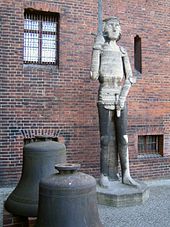
The history of the museum dates back to the times when the once provincial residence city began to turn into a large industrial center. The population of Berlin in 1850-1870 doubled and amounted to 800 thousand people. The city needed professional governing bodies and a new town hall. In 1861, the first stone was laid in the foundation of the new building of the town hall, the future Red Town Hall . Its tower towered above the City Palace , which testified to the growth of self-awareness of the urban bourgeoisie . At a time when the appearance of the city was changing rapidly, interest in the history of the city, in what was already lost and what was disappearing before our eyes, appeared in bourgeois circles. An association of Berlin history buffs has appeared in Berlin, which included the first photographers of the city who captured the changing city for history. These photographs they later provided to the museum.
The particularly valuable and ancient part of the archives of the city administration from the cellars and storage was transferred to the first museum of Berlin, independent of the royal house, called the “Brandenburg Provincial Museum” and housed in the Podewils Palace .
For some time the museum wandered around temporary shelters, until in 1904 the museum building was built under the leadership of the new chief architect of the city, Ludwig Hoffmann . As conceived by Hoffman, the museum building should speak for itself, so Hoffman created a complex of structures that are very different from each other, including elements of various historical eras and create an appropriate historical atmosphere. The buildings are grouped around two courtyards, above which there is a tower with a four-gable roof, a copy of the main tower of the Episcopal Palace in Witstock .
The interiors of the museum were also designed to create an appropriate mood among visitors. The impression of antiquity on the first floor of the museum, which housed the prehistoric department, was given by low ceilings and roughly machined walls. Tools and household items of the Stone Age were placed in simply decorated shop windows. The collection of medieval altars and sculptures was housed in a " chapel ", the arches of which were created according to medieval models. In a bright room on the third floor in elegant glass cases, Rococo porcelain and a collection of snuffboxes for storing snuff were arranged. In total, the museum had about 50 exhibition halls.
In the Third Reich, the Brandenburg Museum participated in Gleichschaltung politics. At auctions where sales of Jewish property were held, the museum acquired valuable artistic values. Confiscated from the Jewish population in 1938, items and products from precious metals were partly settled in the museum funds. At the beginning of World War II, the museum was closed, and its funds were taken out for storage, most of which was lost as a result. In the last days of the war, the museum building was badly damaged.
After the war, the museum ended up in the Soviet occupation sector of Berlin, the future capital of the GDR . The first post-war exhibition of the museum opened in 1946 . In the new GDR state, the Brandenburg Museum was entrusted with the task of supporting the construction of socialism on the basis of a Marxist-Leninist worldview .
After the construction of the Berlin Wall in West Berlin in 1961, after a long debate, its Berlin Museum opened in the baroque building of the former Berlin Court of Appeal on Lindenstrasse . After the reunification of Germany in 1995, the Berlin City Museum Fund housed 16 city institutions under the roof of the Brandenburg Museum.
Bibliography
- Nikolaus Bernau / Kai Michel: Das Märkische Museum , Berlin Edition in der Quintessenz Verlags-GmbH, Berlin, 1999. ISBN 3-8148-0021-4
Links
- Media files related to the Brandenburg Museum in Wikimedia Commons
- Brandenburg Museum on the site of the Foundation for Berlin City Museums
- Brandenburg Museum on the official website of Berlin