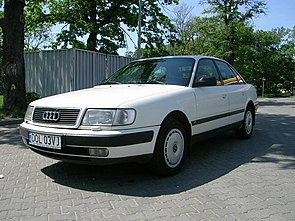
The Audi 100 is the name of a family of business class cars produced in Germany by Audi from 1968 to 1994. All generations of the model had a certain technical continuity among themselves and retained the basic principles laid down from the very appearance of the model - first of all, a front-wheel drive layout with a longitudinal engine. The Audi 100 C3 was sold in the USA under the name Audi 5000 until 1988.
| Audi 100 | |
|---|---|
 | |
| Total information | |
| Manufacturer | Audi |
| Years of production | 1968 - 1994 |
| Assembly |  Ingolstadt , Neckarzulm Ingolstadt , Neckarzulm |
| Class | Business |
| Design | |
| Body type | 4 ‑ dv Sedan (5-seater.) 2 ‑ dv coupe (4-seater) (C1) 5 ‑ dv hatchback (5-seater) (C2) |
| Platform | Volkswagen C |
| Layout | front-wheel, front-wheel front-wheel, all-wheel drive [1] |
| Wheel formula | 4 × 2 4 × 4 ( quattro ) |
| On the market | |
| Segment | E-segment |
The Audi 200 was a more expensive version of the Audi 100, featuring a higher level of basic equipment, improved exterior and interior trim, equipped with only five-cylinder engines, including turbocharged engines.
Content
Typ C1 / F104
| Audi 100 (C1) | |
|---|---|
| Total information | |
| Manufacturer | Audi AG |
| Years of production | 1968 - 1976 , 827,474 copies were released, including 30,687 coupes |
| Design | |
| Engine | |
| 1.6 l I4 - 1.9 l I4 (80-115 hp.) | |
| Specifications | |
| Mass and Dimensional | |
| Length | 4590 mm |
| Width | 1729 mm |
| Height | 1421 mm |
| Wheelbase | 2675 mm |
| On the market | |
The origin of the first Audi 100 has become a legend in Germany.
When Volkswagen bought Auto Union from Daimler-Benz in 1965, it was motivated by the large lack of production capacity for its Beetle ( Beetle ), a model that sold faster than it was made. Then, almost new, the Auto Union plant in Ingolstadt, built when the company was still owned and operated by Daimler-Benz, was quickly adapted for the production of the Beetle: the head of Volkswagen, Heinrich Nordhoff, remembering the poor sales of DKW F102 and, at the same time, on A new Audi F103 was entering the market, which was still to establish itself in the market and gave instructions that no further new Auto Union models (including Audi ) would be developed.
However, Volkswagen did not only acquire production equipment located in Ingolstadt when it bought Auto Union from Daimler-Benz. Among the employees inherited by Volkswagen, was engineer Ludwig Kraus (Ludwig Kraus). Kraus did not share Nordhoff's conviction that the demand for the Beetle would always be high, and it was Kraus who developed the secret of the Audi 100, directly contradicting the instructions of the Volkswagen board. Nordhoff found out about the project when he was presented with a production-ready prototype. For the first time the car body was developed on the computer [2] . He changed his mind and gave a green light, and very timely. The Audi 100 claimed commercial success, but it was also the first in a series of cars based on Audi's water-cooled front-engine design. This allowed the Volkswagen group to survive and thrive in the European and American markets, which began to lose interest in rear-engined and air-cooled models.
The Audi 100 was shown to the press on November 26, 1968. This name originally meant the engine capacity of 100 liters. with. . The Audi 100 was the company's largest car since the revival of the Audi Volkswagen brand in 1965. The C1 platform spawned several options: Audi 100 2- and 4-door sedans and Audi 100 Coupé S , in the fastback coupe style. In 1973, a prototype was developed with Porsche components for testing the Porsche 928 which received a 5.4-liter V8 with a capacity of 350 liters. with. and possessed advanced exterior body elements, under the name Audi 100 Coupé S V3 . Audi introduced the 4-door sedan in November 1968 , the 2-door sedan in October 1969 and the 100 Coupé S in the fall of 1970 . The car could have one of the following 4-cylinder engines : the base (1.8 liter 80 hp.), 100 S (1.8 liter 90 hp.) And 100 LS (1.8 liter 100 hp. ), the coupe had an engine capacity of 1.9 liters and a capacity of 115 liters. with. Since April 1970, the 100LS can be ordered with a 3-speed automatic transmission , supplied by Volkswagen.
Since 1972, the version with the engine 80 l. with. and 90 l. with. were replaced by a new engine designed for low-octane gasoline, a volume of 1.8 liters, developing capacity of 85 liters. with. At the same time, the 100 GL engine was introduced, with a volume of 1.9 liters, previously used only in the Coupé S. In September 1973, the Audi 100 was slightly updated: the grille was reduced and the rear lights were changed. Rear torsion bar was replaced by coil springs.
Since 1975, the base model has received the name 100 L and a 4-cylinder 1.6-liter engine (coming from the Audi 80). Even before the advent of all-wheel drive quattro, Audi conducted experiments on the introduction of all-wheel drive on the Audi 100 C1, but the development of this technology was postponed.
Lineup
- Audi 100 (1760 cm³, carburetor, 80 hp, later 85 hp.)
- Audi 100 S (1760 cm³, carburetor, 90 hp. Pp.)
- Audi 100 LS (1760 cm³, carburetor, 85 or 100 hp.)
- Audi 100 GL (1871 cm³, carburetor, 112 hp.)
- Audi 100 Coupé S (1871 cm³, carburetor, 115 hp, later 112 hp.)
- Audi 100 L from 1974 model year (1577 cm ³, carburetor, 85 hp.)
- Audi 100 from January 1976 (1577 cm³, carburetor, 85 hp.)
- Audi 100 LS from January 1976 (1577 cm³, carburetor, 85 hp.)
- Audi 100 I from 1968 to 1976
Audi 100 LS C1
2-door with vinyl roofUpdated 1973
Audi 100 and 200 C2
| Audi 100 and 200 (C2) | |
|---|---|
| Total information | |
| Manufacturer | Audi AG |
| Years of production | 1976 - 1982 , 988,581 copies issued. 100: 887 647 100 Avant: 49 652 200: 51,282 |
| Other designations | Audi 5000 |
| Design | |
| Engine | |
| 1.6 l I4 2.0 l I4 1.9 l I5 2.1 l I5 Turbo 2.1 l I5 2.0 l I5 diesel 2.0 l I5 turbo diesel | |
| Transmission | |
| 5-speed manual 3-speed automatic | |
| Specifications | |
| Mass and Dimensional | |
| Length | 4695 mm 4607 mm (Avant) |
| Width | 1768 mm |
| Height | 1390 mm |
| On the market | |
The Audi 100 C2 was released in 1976 with a new design and a rare 5-cylinder engine (the first gasoline-powered 5-cylinder engine in the world - Mercedes-Benz , shown in 1974 with a 3-liter 5-cylinder diesel engine in the Mercedes-Benz C111 ) . Originally it was an engine with an effective capacity of 100 liters. with. (74 kW), offering "6-cylinder power and 4-cylinder economy", later updated to 136 liters. with. (100 kW). The design of the model was inspired by the contours of the car NSU Ro 80 .
The coupe was discontinued, but the 5-door hatchback, the Audi 100 Avant, was released in August 1977 as part of this generation. 2- and 4-door sedans were still produced. Audi 200 C2 in the back of Avant was not produced. In 1978, at the Paris Motor Show, Audi introduced the Audi 100 with a 5-cylinder diesel engine. In 1979, Audi released the Audi 200 - a car, in fact, representing the Audi 100, but in a more expensive basic configuration.
In 1980, the car design was slightly updated. The size of the lanterns was increased, and the interior was redone. In 1981, a model CS version appears (with a front spoiler and light alloy wheels), in the same year a new 5-cylinder engine with a volume of 1.9 liters appears. Due to the predisposition to corrosion, now, this car is becoming increasingly rare.
The Audi 100 prototype with a rotary-piston engine (with a capacity of approximately 180 hp) was rejected in 1977 after extensive and successful testing - the profitability of such motorization was controversial.
Gallery
Audi 200 Turbocharged
since 1979 top model in the Audi programAudi 100 Avant
Specifications
The following engines were available:
| Specifications of the car Audi 100 C2 1976-1982 | |||||||
|---|---|---|---|---|---|---|---|
| Engine: | 1.6 | 2.0 (s) | 1.9 (s) | 2.1 (5S) | 2.1 (5E) | 2.0 (5D) | 2.0 Turbodiesel |
| Design | 4-cylinder inline (four-cycle cycle) | 5-cylinder inline (four-cycle cycle) | |||||
| Designation | YV | WA | Wh | WB | WC | CN | DE |
| Diameter x Stroke | 79.5 × 80 mm | 86.5 × 84.4 mm | 79.5 × 77.4 mm | 79.5 × 86.4 mm | 88 × 69.8 mm | ||
| Volume | 1588 cm³ | 1984 cm³ | 1921 cm³ | 2144 cm³ | 1986 cm³ | ||
| Power at rpm | 85 l. with. (63 kW) 4800-5300 | 115 l. with. (85 kW) 5400 | 100 liters with. (74 kW) 5600 | 115 l. with. (85 kW) 4400 | 136 l. with. (100 kW) 5700 | 70 l. with. (51 kW) 5200 | 87 l. with. (64 kW) 4400 |
| Max. torque at rpm | 124 N · m / 3200 | 127 N · m / 3200 | 132 N · m / 2800 | 166 N · m / 4000 | 185 N · m / 4200 | 123 N · m / 3000 | 130 N · m / 2500 |
| Compression | 8.2, later 8.0: 1 | 9.8: 1 | 7.6: 1 | 8.8: 1 | 9.8: 1 | 22.0: 1 | |
| Mix preparation | Zenith 2B2 carburetor | Zenith 2B3 carburetor | Carburetor Keihin 28-32 | Zenith 2B3 carburetor | Bosch K-Jetronic Injector | Bosch-Diesel Injector | Bosch-Diesel Turbocharged Injector |
| Valve mechanism | Top-mounted camshaft, disc pushers | ||||||
| Cooling | Liquid cooling with plate radiator | ||||||
| Front suspension | Independent wheel suspension in suspension strut chassis | ||||||
| Rear suspension | Bridge with torsion bar suspension on trailing arms with trailing arms of independent suspension and Panhard bar, coil springs | ||||||
| Control | Rack and pinion steering | ||||||
| Body | Sheet steel | ||||||
| Track width | 1470 mm | ||||||
| Wheelbase | 2677 mm | ||||||
| Length | 4587 (Avant) -4680 mm | ||||||
| Weight | 1150-1210 kg | ||||||
| Max. speed | 156-160 km / h | 175-179 km / h | 170 km / h | 172-177 km / h | 185-190 km / h | 150-155 km / h | 155-160 km / h |
| From 0 to 100 km / h | 20-26 s | 18-18,5 seconds | 17-20 s | 15-17.5 seconds | 14-16.5 seconds | 18.5 seconds | 23.5-32 s |
| Fuel consumption (l / 100 km) | 8.9-9.5 | 9.6-10.2 | 9.4 | 10.6-11.1 | 10.5-11.1 | 8-9.5 | 8.5-10.0 |
| Years of release | 08.1976-07.1982 | 08.1976-07.1978 | 08.1980-07.1982 | 04.1978-07.1982 | 05.1977-07.1982 | 10.1978-07.1982 | 08.1981-07.1982 |
A total of about 850000 Audi 100/200 C2 [3] were manufactured, of which 133512 were sold in the USA [4]
Delivery Options
This generation of the Audi 100 was offered as a 2-door and 4-door sedan , as well as a 5-door station wagon (Audi 100 Avant). Since February 1977, the 2-door version was rarely ordered, so subsequent models in this version were not supplied.
1976 - 1977
- Audi 100; Basic equipment (YV) * **
- Audi 100 L; Extended Equipment (YV) **
- Audi 100 GL; The best grade (YV)
1976 - 1978
- Audi 100 "S"; Basic equipment (WA) * ***
- Audi 100 LS; Extended Equipment (WA)
- Audi 100 GLS; The best grade (WA)
1977 - 1978
- Audi 100; Basic equipment (YV) * **
- Audi 100 L (5E); Extended equipment (YV, WC) **
- Audi 100 GL (5E); The best grade (YV, WC)
1978 - 1981
- Audi 100 (5E, 5S); Basic equipment (YV, WC, WB) * **
- Audi 100 L (5E, 5S, 5D); Extended equipment (YV, WC, WB, CN) **
- Audi 100 GL (5E, 5S, 5D); The best grade (YV, WC, WB, CN)
- Audi 100 CD (5E, 5S, 5D); Luxury equipment (WC, WB, CN) *
1980 - 1981
- Audi 100 E; Complete set corresponds to Audi 100 L, more economic consumption of gasoline, (YV) *
1981 - 1982
- Audi 100 ° C (5E, 5S, 5D, 5); Budget option, (YV, WC, WB, CN, WH) * **
- Audi 100 CL (5E, 5S, 5D, 5, Turbodiesel); Standard equipment, (YV, WC, WB, CN, WH, DE) **
- Audi 100 GL (5E, 5S, 5D, 5, Turbodiesel); Extended equipment, (YV, WC, WB, CN, WH, DE)
- Audi 100 CD (5E, 5S, 5D, 5); Luxury equipment, (WC, WB, CN, WH)
- Audi 100 CS (5E, 5S, 5D); Sports equipment (YV, WC, WB, CN) *
- Audi 100 E; Complete set corresponds to Audi 100 CL, (YV) more economic consumption of gasoline *
(*) The Avant version was not shipped;
(**) A 2-door version is also available;
(***) It was offered as “Audi 100”, however, a more logical name would be “Audi 100 S”;
Audi 5000 C2
In the North American market, the car was sold (1978-1983) under the brand name Audi 5000. All versions sold in America had a 5-cylinder engine, this was reflected in the name - "5000". Initially, a 108 l engine was available. with., equipped with a catalyst. The color palette of bodies is less bright than in Europe, and the equipment corresponds to the European version of the GL, which was very poor for the then American market. Audi 5000 S has a richer equipment, including air conditioning. Avant models and 2-door sedans were never offered as an Audi 5000. In 1979, the Audi 5000 and Audi 5000 S came out with a 5-cylinder diesel engine, but it could not be sold in California because it did not meet the standards for toxic substances in exhaust gases installed in this state.
Until the 1980 model year, the Audi 5000 had twin round headlights. In 1980, the tail lights are increasing, double round front headlights change to a rectangular shape, as in European models, in addition to the dashboard.
The Audi 5000 was quite successful in the United States, with a total of 133,512 copies sold [4] . This car can be seen in the Steven Spielberg ET movie, as well as in the Magnum series.
- Audi 5000, 2144 cm³, 108 l. with.
- Audi 5000 S, 2144 cm³, 108 l. with.
- Audi 5000 Diesel, 1986 cm³, 70 l. with.
- Audi 5000 S Diesel, 1986 cm³, 70 l. with.
- Audi 5000 S Turbo, 2144 cm³, 133 liters. with.
- Audi 5000 Turbo Diesel, 1986 cm³, 87 l. with.
Audi 100 and 200 C3
| Audi 100 and 200 (C3) | |
|---|---|
| Total information | |
| Manufacturer | Audi AG |
| Years of production | 1982 - 1991 , released 1,078,443 copies.: 100: 852,243 100 Avant: 122 852 200: 97 195 200 Avant: 6153 |
| Design | |
| Engine | |
| 1.8 liters I4 1.9 l I5 2.0 l I5 2.1 l I5 2.2 l I5 2.3 l I5 2.0 l I5 turbo diesel 2.4 liter I5 diesel 2.5 l I5 diesel / turbo diesel | |
| Transmission | |
| 5-speed manual 4-speed automatic | |
| Specifications | |
| Mass and Dimensional | |
| Length | 4793 mm (RoW) 4895 mm (US) |
| Width | 1814 mm |
| Height | 1420 mm 1415 mm (S) |
| Weight | 1080–1500 kg |
| On the market | |
| Other | |
| Volume of the tank | 80 l |
Having won with a slight advantage Ford Sierra in the rank of Car of the Year in Europe in 1983, the Audi 100 had outstanding aerodynamics , reaching a drag coefficient of 0.30 for the base model. Improved streamlining resulted in greater fuel economy, and buyers around the world began to realize this. As a result, cost-effectiveness and streamlining have become an excellent marketing tool for Audi in the 1980s, as well as an outstanding step forward compared with the angular outlines of the C2, along with other technical solutions, including the procon-ten security system.
Audi was able to arrive at a modern round shape, first seen in this sector from the Citroën CX in 1975. Audi, in turn, influenced the Ford Taurus , an American 1986 sedan. Such a rounded look became the norm in the 1990s. The trend has also begun to use hubcaps on wheels that are flush with the tire, a black band running across both doors, and black frames, around the glass, eventually adopted by a number of cars from the Honda Accord in 1984 to cars built on the Chrysler K platform .
Audi on the C3 introduced such innovation as flush windows, which are a key area of aerodynamic drag, this innovation was accepted by almost all manufacturers.
The Audi 100 also had a revolutionary diesel engine — one of the first direct-injection turbo diesel engines (TDI). The engine was launched on the market in 1990, had a volume of 2.5 liters. and power of 120 liters. with., while having low fuel consumption and had a large torque (more than 200 N · m) at low engine speeds [5] .
Since November 1984, all-wheel drive versions of the Audi 100 with the quattro system are available.
Since July 1986 (1987 model year), the Audi 100 after upgrading (Restayl) gained a fully galvanized body, the external difference in the so-called. recessed handles, previously from September 1985, upon the request of the first buyer, the body could optionally be galvanized, however this does not mean that all Audi 100s were galvanized since the 1986 model year. In addition, in the mid-1980s, the company experimented with aluminum alloy bodies, on the basis of which some prototypes of the Audi 100 were made. However, the transition to mass production occurred only in the later Audi A8 .
Now the Audi 100 C3 is very popular in the used car markets. This car is considered to be very reliable, and the body, thanks to the complete galvanization, serves for a very long time. C3 engines are considered reliable, more than 300,000 km mileage is not such a rarity.
In the late 1980s, the Audi V8 was announced. This car, in fact, was an Audi 200 quattro with an engine derived from two 4-cylinder Volkswagen Golf GTI engines assembled together. Although the design was the same as that of the Audi 200, on which it was based, with the exception of the roof and doors, the body panels were not disconnected. The Audi V8 was available with a 3.6 or 4.2 liter engine. It was the first quattro model that had an automatic 4-speed gearbox with a viscous clutch in the center differential in combination with the rear differential Torsen . Versions of quattro with manual transmission continued to be produced in parallel and had the traditional rear differential and center differential Torsen.
The cost of modification Audi 200 Turbo capacity of 165 liters. with. with a catalytic converter in 1986 in Germany was 52 880 DM. The surcharge for the more powerful 2.1 Turbo engine (182 hp) was 1700 DM.
Audi 5000 C3
In 1984, the C3 generation (1984-1991) comes to replace the C2 generation in the USA. From the middle of 1986 (1987 model year) the car will have a basic fully galvanized body. The model received a new front and rear bumper, the shape of the headlights has been changed to rectangular. New aerodynamic shape of the car had a great influence on the design of American cars of the late 1980s.
In the USA, the name Audi 5000 was removed after Audi gained negative fame in the mid-1980s about the “unintended acceleration” incident. The problem became even more aggravated after the publication of the 60 minutes news program [6] [7] of the CBS television company. The essence of the problem was as follows: buyers complained that the Audi 5000 with the automatic transmission had allegedly sometimes been set in motion on its own, with some cases leading to a fatal accident. The National Highway Traffic Safety Administration (NTHSA) concluded that most cases of unintended acceleration, including those reported in the “60 minutes” message, were caused by driver errors, for example due to gas-brake pedaling. CBS has released a partial rebuttal, but Audi’s image has been damaged in the United States for many years. Some multi-tiered parking places even blocked entry for the Audi 5000. At the same time, the National Highway Traffic Safety Administration reported the lowest mortality rate for the Audi 5000. In the American hip-hop , the slogan “I'm Audi 5000” or “I'm 5000! ”( Ice Cube , Eminem ), whose approximate meaning was“ moving fast. ”
Due to a ruined reputation in the USA, the Audi 5000 has been becoming the Audi 100 and the Audi 200 again since 1989, depending on the engine configuration . Audi sales in the United States were able to return to previous levels only after 15 years.
Audi 5000 '' S / Turbo '' was in the top ten in 1984 and 1985, according to the version of "Car and Driver". Audi '' CS Turbo quattro '' was on the same list from 1986 to 1988.
In 1991, the Audi 5000/100 C3 was replaced by the Audi 100 C4.
Engine Options
The following engines were available:
| Engine capacity, l. | Configuration | Power, l. with. | Specifications | Interior code | Years of release |
|---|---|---|---|---|---|
| Audi 100 | |||||
| 1.8 | I4 | 75 | carburetor | DR | 1982-1987 |
| 1.8 | 90 | carburetor, later injection and single injection | DS PH PH SH 4B | 1983-1990 | |
| 1.9 | I5 | 100 | carburetor | Wh | 1982-1984 |
| 2.0 | 115 | injector | KP, RT | 1984-1990 | |
| 2.1 | 136 | WC | 1982-1988 | ||
| 2.2 | 115 | injection, with catalyst | KZ | 1984-1987 | |
| 165 | injection, turbocharging | MC | 1986-1990 | ||
| 2.3 | 138 | injector | HX | 1984-1986 | |
| 136 | injector | Nf | 1986-1990 | ||
| 2.0 | 70 | diesel | CN | 08.1980-07.1989 | |
| 87 | turbo diesel | DE | 1983-1987 | ||
| 100 | NC | 1987-1990 | |||
| 2.4 | 82 | diesel | 3D | 1989-1990 | |
| 2.5 | 120 | TDI | 1T | 1990 | |
| Audi 200 | |||||
| 2.1 | I5 | 136 | injector | WC | 1983-1984 |
| 141 | injection, turbocharged, with catalyst | 1984-1985 | |||
| 182 | injection, turbocharging | KG | 1983-1986 | ||
| 2.2 | 138 | injector | KU | 1984-1985 | |
| 165 | injection, turbocharged, with catalyst | MC | 1985-1991 | ||
| 200 | injection, turbocharging | 1B | 1988-1989 | ||
| 200 | injection, turbocharging, option 1B for automatic transmission | 2b | 1988-1989 | ||
| 220 | 20-valve, turbocharged, for Audi 200 Quattro 20V | 3B | 1989-1991 | ||
| Audi 5000/100/200 (North American market) | |||||
| 2.1 | I5 | 100 | 1984 | ||
| 140 | turbocharging | 1984-1985 | |||
| 2.2 | 115 | 1985 | |||
| 110 | 1986-1987½ | ||||
| 158 | turbocharging | 1986-1987½ | |||
| 162 | 1987½-1991 | ||||
| 220 | 1991 | ||||
Delivery Options
- Audi 100 CC (1982-1987) standard
- Audi 100 CD (1982-1987) comfortable
- Audi 100 CS (1982-1987) sports
- Audi 100 Turbo (1986–1990)
- Audi 100 quattro (1985–1990)
- Audi 100 Turbo quatro (1986–1990)
- Audi 100 1.8 (1988–1990)
- Audi 100 2.0 (1988–1990)
- Audi 100 2.3 (1988–1990)
- Audi 100 2.0 D Turbo (1988–1990)
- Audi 100 2.4 D (1988–1990)
- Audi 100 2.5 TDI (1990)
- Audi 100 Sport (1988–1990)
- Audi 100 Busines (1990)
- Audi 200 (1984–1990)
- Audi 200 quattro (1985–1990)
- Audi 200 Turbo (1985–1990)
- Audi 200 Exclusiv (1986-1987)
- Audi 200 quattro 20V (1989–1991)
| Production volumes [8] | |
|---|---|
| Audi 100 | 852243 copies |
| Audi 100 Avant | 122852 copies |
| Audi 200 | 97195 copies |
| Audi 200 Avant | 6153 copies |
| Total | 1078443 copies |
Gallery
Audi 100 C3 Audi 100 C3 Avant
back viewAudi 5000 / Audi 100
(US version)
Audi 200 speed record
In 1986, a record speed was set among all-wheel drive cars. The Audi 200 quattro with a 650 horsepower five-cylinder engine developed a speed of more than 350 km / h on the NASCAR Talladega highway in the state of Alabama , USA [9] .
Type C4 / 4A
| Audi 100 (Typ C4 / 4A) | |
|---|---|
| Total information | |
| Manufacturer | Audi AG |
| Years of production | 1991 - 1994 , released about 628,000 |
| Other designations | Audi A6 (C4) |
| Design | |
| Engine | |
| Petrol: 2.0 liters I4 99 l. with. 2.0 l I4 114 l. with. 2.0 l I4 138 l. with. 2.3 l I5 133 liters with. 2.6 liters V6 150 liters. with. 2.8 liters V6 174 liters. with. Diesel: 2.4 l I5 80 l. with. 2.5 l I5 114 l. with. TDI 2.5 l I5 138 liters with. TDI | |
| Transmission | |
| 5- and 6-speed manual , 4-speed automatic | |
| Specifications | |
| Mass and Dimensional | |
| Length | 4790 mm |
| Width | 1800 mm |
| Height | 1440 mm 1438 mm (front wheel drive sedan) 1448 mm (front wheel drive sedan) |
| Wheelbase | 2687 mm (front wheel drive) 2692 mm (all-wheel drive) |
| Weight | 1080—1663 kg |
| On the market | |
| Other | |
| Volume of the tank | 80 l |
- See also: Audi A6 1st generation C4 (1994–1997)
Strongly reworked C3 - C4 was introduced in 1991. New model in production from December 1990 (sedan) and from August 1991 (wagon) to June 1994. Audi V8 on the C3 platform continued to be sold as a separate line. The main change in the C4 was a 2.8 liter V6 engine 90 °, SOHC , 12-valve. Later added 2.6 liters option V6, 60 °. In fact, these were the same engines that were offered in 1992 in the Audi 80 B4. The quattro permanent all-wheel drive option was available for the entire model range, the Audi 100 quattro was available with a 4-speed ZF automatic transmission .
Since the 1995 model year, Audi has omitted the number “100” from the model name and renamed the car to Audi A6 . In addition, the S6 comes in place of the S4 , but these models were independent of each other after Audi replaced the Audi 80 with the Audi A4 in 1995. The Audi V8 was eventually replaced by the Audi A8 in 1994. Simultaneously with the change of name in 1994, the Audi 100 undergoes a deep restyling: the bumper, fenders, front hood and rear optics change in the exterior, and the design of the seats and torpedoes changes in the interior. The restyling also took into account the technical weaknesses of the model. All-wheel-drive versions of the Quattro also received changes; if the Audi 100 uses the second-generation Quattro system , then the Audi A6 has been using the fourth-generation Quattro since 1995.
The current design of the Audi 100 / A6 was maintained until 1997, when it was replaced by a completely new Audi A6 design of the second generation. From 1990 to 1997, about 927,000 Audi 100 / A6 cars were produced.
Engine Options
The following engines were available:
| Model | Cm³ | Interior code | Number of cylinders | Power | Years of release |
|---|---|---|---|---|---|
| Gasoline engines | |||||
| 1.8 | 1781 | ADR | four | 125 l. with. (92 kW) | 1995-1997 |
| 2.0 | 1984 | AAE | four | 101 l. with. (74 kW) | 1990-1996 |
| 2.0 E | 1984 | AAD, ABK | four | 115 l. with. (85 kW) | 1990-1996 |
| 2.0 E 16V | 1984 | ACE | four | 140 l. with. (103 kW) | 1992-1997 |
| 2.2 Turbo (S4 / S6) | 2226 | Aan | five | 230 l. with. (169 kW) | 1991-1994 |
| 2.3 E | 2309 | AAR | five | 133 l. with. (98 kW) | 1990-1996 |
| 2.6 | 2598 | ABC | 6 | 150 l. with. (110 kW) | 1992-1997 |
| 2.8 | 2771 | Aah | 6 | 174 l. with. (128 kW) | 1990-1997 |
| 2.8 | 2771 | ACK | 6 | 193 l. with. (142 kW) | 1995-1997 |
| 4.2 (S4) | 4172 | ABH | eight | 280 l. with. (206 kW) | 1991–1993 |
| 4.2 (S6) | 4172 | AEC | eight | 290 l. with. (213 kW) | 1994–1997 |
| 4.2 (S6 Plus) | 4172 | Ahk | eight | 326 l. with. (240 kW) | 1991–1993 |
| Diesel engines | |||||
| 1.9 tdi | 1896 | 1Z | four | 90 l. with. (66 kW) | 1994-1996 |
| 1.9 tdi | 1896 | Ahu | four | 90 l. with. (66 kW) | 1995-1997 |
| 2.4 D | 2370 | Aas | five | 82 l. with. (60 kW) | 1991-1994 |
| 2.5 TDI | 2461 | ABP, AAT | five | 115 l. with. (85 kW) | 1991-1997 |
| 2.5 TDI | 2461 | Ael | five | 140 l. with. (103 kW) | 1994-1997 |
Supply Options
This generation of Audi 100 was offered as a sedan, as well as a station wagon (Audi 100 Avant).
- Audi 100 2.0 E 74 kW Sedan 1991
- Audi 100 2.0 E 85 kW Sedan 1992
- Audi 100 2.0 E 85 kW auto Sedan 1992
- Audi 100 2.3 E Sedan 1991
- Audi 100 2.3 E Quattro Sedan 1991
- Audi 100 2.3 E auto Sedan 1992
- Audi 100 2.5 TDI Sedan 1991
- Audi 100 2.5 TDI auto Sedan 1993
- Audi 100 2.6 E Sedan 1992
- Audi 100 2.6 E auto Sedan 1992
- Audi 100 2.6 E Quattro Sedan 1992
- Audi 100 2.6 E Quattro auto Sedan 1992
- Audi 100 2.8 E Sedan 1991
- Audi 100 2.8 E Quattro Sedan 1991
- Audi 100 2.8 E Quattro auto Sedan 1991
- Audi 100 2.8 E auto Sedan 1991
- Audi 100 Avant 2.0 E 74 kW Universal 1991
- Audi 100 Avant 2.0 E 85 kW Universal 1991
- Audi 100 Avant 2.0 E 85 kW auto Universal 1991
- Audi 100 Avant 2.2 S4 Turbo quattro (1991 −1994)
- Audi 100 Avant 2.3 E Wagon 1991
- Audi 100 Avant 2.3 E Quattro Universal 1991
- Audi 100 Avant 2.4 D Wagon 1991
- Audi 100 Avant 2.5 TDI Wagon 1991
- Audi 100 Avant 2.5 TDI auto Universal 1993
- Audi 100 Avant 2.6 E Wagon 1992
- Audi 100 Avant 2.6 E auto Wagon 1992
- Audi 100 Avant 2.6 E Quattro Universal 1992
- Audi 100 Avant 2.6 E Quattro auto Universal 1992
- Audi 100 Avant 2.8 E Universal 1991
- Audi 100 Avant 2.8 E auto Universal 1991
- Audi 100 Avant 2.8 E Quattro Wagon 1991
- Audi 100 Avant 2.8 E Quattro auto Universal 1991
- Audi 100 Avant 4.2 S4 V8 quattro (1994)
Audi 100 C4 Avant Audi 100 C4, rear view
Audi S4 speed record
In 2012, American Jeff Gerner set a world record among supercharged production cars. On its Audi S4 of 1992, it developed about 418 km / h on the Bonneville Salt Lake in Utah , USA . The car is equipped with a five-cylinder engine with a power of 1100 horsepower [10] .
Before that, the car set the speed record two more times. In 2009, he developed 358 km / h with an engine power of 730 liters. with.
In 2011, the car developed 389 km / h. The engine power at that time was already 1,100 liters. from [11]
Body Types
In addition to the C-codes of the platform (C1, C2, ...), Audi gave the designation to the bodies:
- Typ F104 : C1; Audi 100 (1968–1976)
- Typ 43 : C2; Audi 100 (1976-1982); Audi 200 (1979–1982)
- Typ 44 : C3; Audi 100 (1983–1991); Audi 200 (1983–1992)
- Typ 4A : C4; Audi 100 (1991–1994); Audi S4 (1992-1994); Audi A6 (1995–1997); Audi S6 (1995–1997)
Chinese manufacture
The Audi 100 C3 was also manufactured in Changchun , China , at the FAW factory (First Automobile Works, Chinese automaker) for several years in the 1990s. Since most of the specimens were intended for government use, all Chinese Audi 100s were front - wheel - drive sedans with a 2.0-liter 4-cylinder engine. or 5-cylinder, a volume of 2.3 liters.
In 1990, the Political Bureau of the Central Committee of the Chinese Communist Party approved a resolution limiting automotive imports and engine cylinder capacity of officials' cars. Moreover, the resolution prescribed that all the cars of the central committee of the party and the government were domestically produced. Since FAW-Audi 100 and 200 were among the most luxurious and advanced cars made in China in the early 1990s, they had a significant percentage of high-quality executive cars on the Chinese market for almost a decade until the C3 platform was replaced by Audi A6 in 1999
During negotiations between FAW and Volkswagen in the late 1980s, Volkswagen accepted the FAW proposal to combine the C3 platform with the previously introduced Chrysler engines in the new generation of Hongqi (Hongqi, Red Flag) car. The Hongqi CA2700 series, based on C3 technology, was released in the mid-1990s, at a time when most parts of the Audi 100 C3 could be made in China. The CA7200 was originally equipped with a 2.0 or 2.2 liter Chrysler 4-cylinder engine. In the 2000s, they came to replace the engines Nissan VQ20 [12] .
A small number of Audi 200 C3s (with 2.6-liter V6 turbo engines or 2.6-liter V6) and some early Audi 100 C4s (most with European designs, but with rear lights, like in American design) were also assembled in China .
Audi Duo
At the Geneva Motor Show in March 1990 [13] Audi introduced its first Audi Duo (or Audi 100 Avant Duo) experimental car, a hybrid based on the Audi 100 Avant quattro. When driving in the city, the Siemens electric motor with an effective power of 12.6 liters. with. rotated the rear wheels and was powered by a Ni-Cd battery in the trunk. On a country trip, the front wheels were driven by a 2.3-liter 5-cylinder engine with a capacity of 136 liters. with. Drive type could be selected by the driver. It is believed that only 10 cars were made. Their disadvantage was that due to the extra weight of the electric motor and a large battery, the car was less efficient when driving a conventional engine than a standard Audi 100 with the same engine.
At the end of 1991 [14] Audi announces a second-generation Audi Duo, also based on the Audi 100 Avant quattro. The cars were again equipped with a 28.6 liter 3-phase electric motor. s., driving the rear wheels. This time, however, the rear wheels were additionally set in motion through the Torsen differential from the main engine, which is a 4-cylinder 2.0-liter engine.
Notes
- ↑ ア ー カ イ ブ さ れ た コ ピ ー . The appeal date is June 19, 2008. Archived June 19, 2008. Audi of America Press Site 25 Years of Audi Quattro
- ↑ autobild.de Alle Infos: Audi 100 (German)
- ↑ Werner Oswald: Deutsche Autos 1945–1990 , vol. 4, ISBN 3-613-02131-5 , p. 263
- 2 1 2 Mike Covello, Standard Catalog of Imported Cars 1946-2002 . Krause Publications, Iola 2002, ISBN 0-87341-605-8 , p. 82-85.
- ↑ kolesa.ru "Product hundred: the history of the development and success of the Audi 100 C3"
- ↑ manhattan-institute.org "Civil Justice Memo, No. 18 January 1990 Manufacturing the Audi Scare" (Eng.)
- ↑ aim.org "Accuracy in Media The CBS" Cold Case "Files" (eng.)
- ↑ Oswald, op. cit., p. 263. Note: data are given for calendar years and may include data on production of C2; data for Audi 200 do not include 1991 .
- ↑ ableitet.no Audi 5000 CS Talladega Archival copy of April 11, 2018 on the Wayback Machine (eng.)
- 20 The fastest sedan in the world is the 20-year-old Audi .
- ↑ The worlds fastest Audi 242 mph Audi S4 (Eng.) .
- ↑ chinacartimes.com
- ↑ Eberhard Kittler: Deutsche Autos seit 1990 , Bd. 5 ("German Cars since 1990, vol. 5"). Motorbuch Verlag, Stuttgart 2001, ISBN 3-613-02052-1 , p.65
- ↑ Eberhard Kittler: Deutsche Autos seit 1990 , Bd. 5 ("German Cars since 1990, vol. 5"). Motorbuch Verlag, Stuttgart 2001, ISBN 3-613-02052-1 , p.71
Sources
- Covello, Mike, updated by Standard Catalog of Imported Cars: 1946-2002, Krause Publications, Iola, Wisconsin, USA, 2002.
- Werner Oswald: Deutsche Autos 1945–1990, vol. 4. Motorbuch Verlag, Stuttgart 2001, ISBN 3-613-02131-5 (German).