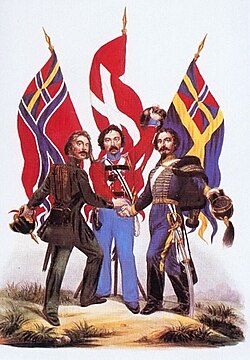
Scandinavism is a social movement in the Scandinavian countries - Sweden , Norway and Denmark , aimed at the political, economic and cultural unification of these countries.
Content
Meaning of the term
In a broad sense, "Scandinavism" refers to any currents of the era of capitalism (the period after the Napoleonic Wars ), which have unifying tendencies. In the narrow sense, it is only a movement in the 40-60s of the XIX century. Some historians, however, extend the effect of this concept also to the unifying phases during the Scandinavian Middle Ages. In non-Scandinavian literature, the term "Panscandinavism" is sometimes also used.
History
The first signs of Scandinavia as a public thought appeared back in the 1700s in the academic and literary circles of Denmark. Over the centuries, Danes, Norwegians and Swedes waged many wars against each other, but the Scandinavians believed that it was better to look at each other as brothers, recalling the experience of the Union of Kalmar and based on the geographic and economic situation of the countries.
During the Napoleonic Wars, Scandinavian politics alternated between federal plans and acts of war. Denmark supported Russia throughout the eighteenth century against the Swedish great power . The Swedish government of the capture of Norway was hatched by Charles XII, Gustav III and Gustav IV Adolf after the war of 1808-1809. as compensation for the loss of Finland. Under these conditions, it is not surprising that the forced separation of Norway from the union with Denmark and the forced association with Sweden in 1814 acted in an anti-Scandinavian direction. At the same time, the King of Denmark, Frederick VI and Napoleon I, in the course of choosing the heir to the Swedish throne in 1810, tried to approve their , pro-French or pro- Danish candidate , which could open up the further prospect of uniting Scandinavia around the Oldenbrug house or establishing the Bonaparte dynasty or its related branch.
For the first time, “Scandinavism” in the modern political sense appeared in Denmark in the 10–20s of the 19th century as ideological support for the struggle to expand the national market. The conductors of this theory at that time were primarily students, scientists, writers. Accordingly, this period (until 1848 ) was called "academic", or "literary Scandinavism."
After the 1849 revolution in Denmark, Scandinavism acquired an anti-German and partly great Danish character.
In Sweden, the ideas of "Scandinavism" were used primarily by the monarchy, hoping to unite all the Scandinavian countries under the auspices of the Swedish dynasty Bernadotov . "Dynastic Scandinavism" in the 1850s acquired a pronounced anti-Russian coloring. However, by the 1860s, in Denmark and Sweden, in spite of the fairly friendly relations of Kings Frederick VII and Charles XV , who were interested in consolidating and consolidating the position of cooperation, quite different views developed in understanding “Scandinavism”. If for the Danes “Scandinavism” was primarily military-political and ideological support against Prussian expansion, then for the Swedish government the ideological justification for the policy of expanding the country's borders. The Danish government was formed by the liberal party of Wenstre , especially the Minister of Foreign Affairs and the head of government in 1857-1863. Hall and members of his cabinet, Lehmann and Monrad , in the face of threats from Prussia were ready to consider union projects in the form of suzerainty, confederal or federal structure of those kingdoms, provided that Sweden undertakes to help protect and preserve Denmark's territorial integrity “before Eider” . The Swedish diplomat Earl Henning Hamilton, on behalf of the king, expressed his readiness to conclude an alliance agreement. In the conditions of the flare-up crisis around Schleswig-Holstein, Napoleon III tried to support the idea of the Scandinavian Union, but Charles XV could not move the office of De Gera- Gripenstedt, who focused on the country's internal affairs and was negatively reacted to military adventures. The state of the Swedish army, which was still being formed according to the territorial-police principle of the Indelt , and the upset finances after the parliamentary, municipal and church-administrative reforms did not allow the necessary military action to be carried out. Hamilton tried to secure the diplomatic support of the great powers of the guarantors of the London Protocol , but England and France did not commit themselves to supporting Denmark. This led to a government crisis, as a result of which Hamilton himself resigned. Sweden's actual refusal to help Denmark repel the attack of Prussia during the Danish war of 1864 dealt a serious blow to the ideology of "Scandinavism". The military defeat with the separation of the duchies in favor of Prussia generated in the Danish society indignation and bitterness directed at Sweden, which buried the practical possibility of the Scandinavian alliance. According to Danish historians Klausen and Moller, the Scandinavian project was hardly feasible when both Russia and the British government were strong opponents of creating what they perceived as excessive strengthening of Sweden.
Attempts to save "Scandinavism" both in the form of "economic" - by creating the Scandinavian monetary union of 1872-1914 - and of "constitutional Scandinavism" (due to the project of the Swedish public figure and scientist A. Hedin in 1865 on the creation of a confederation of Scandinavian countries) turned out to be unsuccessful. In the 2nd half of the 19th century, the politicians of the Scandinavian countries refused to implement the political goals of “Scandinavism”, since this prevented them from waging a competitive, economic struggle with each other.
In 1903-1918 , “Scandinavism” emerged as a trend by which the political elite of Sweden and Denmark tried to prevent the independence of Norway and Iceland. After the creation of the Nordic societies in the Scandinavian countries in 1919–1924, “Scandinavism” performed mostly cultural and educational tasks (the so-called “neo-Scandinavianism”). Trends in political, economic and cultural unity have grown since the 50s of the XX century after the creation of the Northern Council . Scandinavism shows the ability to modify, depending on the changing historical situation.
Literature
- Clausen J. "Skandinavismen, historisk fremstillet", Kobenhavn 1900.
- Moller E. "Skandinavisk straeben og svensk politik omkring 1860", Kobenhavn 1948.
- Lundh HL Skandinavismen i Sverige, Stockholm 1951.
Links
- Scandinavism // Encyclopedic Dictionary of Brockhaus and Efron : 86 volumes (82 volumes and 4 additional). - SPb. , 1890-1907. - T. XXX). - S. 174.
See also
- Pan-Germanism
- Pan-Turkism
- Pan-Africanism
- Panslavism