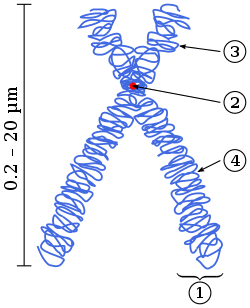
(1) Chromatide
(2) Centromere
(3) Short shoulder
(4) Long shoulder
Chromatide ( Greek chroma - color, paint and Greek. Eidos - type) is a structural element of the chromosome that forms in the interphase of the cell nucleus as a result of doubling of the chromosome .
Content
- 1 Description
- 2 Quantity
- 2.1 4N
- 2.2 2N
- 2.3 1N
- 3 See also
Description
Chromatid is any of the two copies of a DNA molecule that together make up the replicated chromosome and are joined by their centromeres . This term is used as long as the centromeres remain in contact. After chromosome separation during anaphase, mitosis or meiosis, the strands are called daughter chromosomes . In other words, chromatids are halves of replicated chromosomes .
Quantity
In humans, as a rule, there are 23 pairs of homologous chromosomes in each cell (N = 23). However, the number of chromatids will be a multiple of 23 and may be 4N, 2N or 1N. The number does not apply to the haploid or diploid set, it refers to the number of chromatids in each cell, as a multiple of the haploid set of chromosomes in the body .
4N
In a 4N chromatid cell, 23 pairs of chromosomes (46 chromosomes ) are present, and each chromosome has two chromatids. Thus, 92 chromatids are present in each (4N) cell.
2N
Immediately after mitosis , during which the cell divides in half, 23 pairs of chromosomes (46 chromosomes) appear. However, the chromosome has only one chromatid. Thus, a total of 46 chromatids (2xN).
On the other hand, a haploid cell with two chromatids for each chromosome also has 46 chromatids. However, this does not happen in humans.
1N
Immediately after meiosis, each cell, called a gamete , has only half the sum of chromosomes (23 chromosomes). In addition, each chromosome has only one chromatid. Thus, a total of 23 chromatids (1xN).
See also
- Chromosome
- Karyotype
- Sex chromosomes
- Chromatin
- Somatic cells
- Sister chromatid exchange