


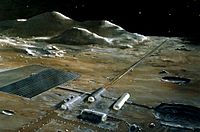
Colonization of the Moon is a hypothetical settlement of the Moon by man , which is the subject of predominantly fantastic works [1] . The existing plans for the construction of inhabited bases on the Moon are sometimes considered a preliminary stage of settlement, but the constant and autonomous stay of a person is an order of magnitude more difficult.

Fiction
The constant dwelling of man on another celestial body (outside the Earth) has long been a constant topic in science fiction .
Reality The slow development of space technology after the 1970s does not allow us to think that the colonization of space is an easily attainable and in all cases justified goal. Due to its proximity to the Earth (three days of flight) and a fairly well-studied landscape, the Moon has long been considered as a candidate for the place of creation of the human colony. But although Soviet and American moon exploration programs demonstrated the feasibility of flying to the moon (being very expensive projects at the same time), they also dampened the enthusiasm for creating a lunar colony. This was due to the fact that the analysis of dust samples delivered by astronauts showed a very low content of light elements in it. necessary to maintain life support.
Despite this, with the development of astronautics and the cost of space flights, the Moon appears to be the primary object for the base. For scientists, the lunar base is a unique place for scientific research in the field of planetology , astronomy , cosmology , space biology and other disciplines. Studying the lunar crust can give answers to the most important questions about the formation and further evolution of the solar system , the Earth-Moon system, and the appearance of life. The absence of atmosphere and lower gravity make it possible to build observatories on the lunar surface equipped with optical and radio telescopes capable of obtaining much more detailed and clear images of distant regions of the Universe than is possible on Earth, and it is much easier to maintain and upgrade such telescopes than orbital observatories.
The moon also has a variety of minerals, including metals valuable to industry - iron , aluminum , titanium ; In addition, in the surface layer of lunar soil, regolith , a rare helium-3 isotope is accumulated on Earth, which can be used as fuel for promising thermonuclear reactors . Currently, there are development of methods for industrial production of metals, oxygen and helium-3 from regolith; water ice deposits found.
The deep vacuum and the availability of cheap solar energy open new horizons for electronics , metallurgy , metalworking and materials science . In fact, the conditions for metal processing and the creation of microelectronic devices on Earth are less favorable due to the large amount of free oxygen in the atmosphere, which worsens the quality of casting and welding, making it impossible to obtain ultrapure alloys and microcircuit substrates in large volumes. It is also of interest to bring harmful and dangerous industries to the moon.
The moon, thanks to its impressive landscapes and exoticism, also looks like a very likely object for space tourism , which can attract a significant amount of funds for its development, contribute to the popularization of space travel, provide an influx of people for the development of the lunar surface. Space tourism will require certain infrastructure solutions [2] . The development of infrastructure, in turn, will contribute to the wider penetration of mankind on the moon.
There are plans to use lunar bases for military purposes to control near-Earth outer space and ensure supremacy in space [3] .
Director of the Space Research Institute of the Russian Academy of Sciences Lev Zelenyi believes that the circumpolar regions of the moon can be used to host a Russian or international scientific base [4] .
Helium 3 Plans for Moon Exploration
In January 2006, Nikolai Sevastyanov , the former president of the Energia Rocket and Space Corporation , officially announced [5] that the main goal of the Russian space program would be to produce helium-3 on the moon by processing lunar regolith . “We plan to create a permanent station on the moon by 2015 , and from 2020 industrial production of a rare isotope helium-3 on Earth’s satellite can begin.” The reusable Clipper ship will fly to the Moon, and the Interorbital tug “Ferry” will begin to help him in the construction of the Lunar Base. However, the data of the “official statement” remained on the conscience of N. N. Sevastyanov , since Russia does not recognize the existence of a lunar program like the American one. Other sources of funding are also not yet known.
The presence of helium-3 in lunar minerals, representatives of the US National Agency for Cosmonautics and Aeronautics ( NASA ) also consider a serious reason for the development of the satellite. At the same time, the first flight there NASA plans to carry out no earlier than 2018 . China and Japan also planned the creation of lunar bases, but this is likely to happen in the 2020s . Until now, the United States remains the only state whose representatives visited the moon - from 1969 to 1972, 6 American manned expeditions were sent there.
The creation of the station is not only a matter of science and state prestige, but also commercial gain. Helium-3 is a rare isotope, costing approximately $ 1,200 per liter of gas [6] , which is necessary in nuclear energy to trigger a thermonuclear reaction . On the moon, its amount is estimated at thousands of tons (according to minimum estimates - 500 thousand tons [7] ). The density of liquid helium-3 at a boiling point and normal pressure is 59 g / l, and in gaseous form it is about 1000 times less, therefore, 1 kilogram costs more than $ 20 million, and all helium - more than $ 10 quadrillion (about 500 current GDP USA).
Scientists [8] believe that helium-3 can be used in thermonuclear reactors . To provide energy to the entire population of the Earth during the year, according to scientists at the Institute of Geochemistry and Analytical Chemistry. V.I. Vernadsky RAS , approximately 30 tons of helium-3 are needed. The cost of its delivery to Earth will be ten times less than that of the electricity currently being generated at nuclear power plants .
When using helium-3, long-lived radioactive waste does not arise, and therefore the problem of their disposal, which is so acute when operating reactors in the division of heavy nuclei, disappears by itself.
However, there is serious criticism of these plans. The fact is that in order to ignite the thermonuclear reaction deuterium + helium-3, it is necessary to heat isotopes to a temperature of a billion degrees and solve the problem of keeping the plasma heated to this temperature. The current technological level makes it possible to retain plasma heated only to several hundred million degrees in the deuterium + tritium reaction , while almost all of the energy received during the thermonuclear reaction is spent on plasma confinement (see ITER ). Therefore, helium-3 reactors by many leading scientists, for example, academician Roald Sagdeev , who criticized Sevastyanov’s plans, are considered a matter of the distant future. More realistic from their point of view is the development of oxygen on the moon, metallurgy , the creation and launch of spacecraft, including satellites , interplanetary stations and manned spacecraft.
Water
On the surface [9] of the moon ( Deep Impact mission (SC) , Cassini (SC) , Chandrayan-1 ) and below its surface [10] [11] (mission LCROSS ), water in the form of ice was found in the vicinity of the poles, the amount of which is highly dependent from illumination by the Sun. The presence of water is very important for a potential lunar base.
Lunar Power Plants
Key technologies have, according to NASA, a technological readiness level of 7/10. The possibility of producing a large amount of electricity equal to 1 PW is being considered . WhereinThe cost of the lunar complex is estimated at approximately $ 200 trillion. In the same time the cost of producing a comparable amount of electricity by ground-based solar stations is $ 8,000 trillion, ground-based thermonuclear reactors is $ 3,300 trillion, and land-based coal stations are $ 1,500 trillion [12] .
Practical Steps
Lunar Bases in the First Lunar Race
| External Images | |
|---|---|
| Moon base projects | |
| A sketch of the process of erecting a lunar base according to a project developed by General Electric engineers [13] | |
During the first “lunar race” of the 1960s (as well as a little earlier and later), two space superpowers - the USA and the USSR - had plans for the construction of lunar bases, which were not implemented [14] [15] .
In the United States, advance projects of the Lunex Project and Project Horizon lunar military bases were being worked out, as well as technical proposals for Werner von Braun 's lunar base.
In the first half of the 1970s. at hand. Academician V.P. Barmin, Moscow and Leningrad scientists developed a project for a long-term lunar base, which, in particular, studied the possibility of embankment of inhabited structures with a directed explosion to protect against cosmic radiation (inventions by A.I. Melois using Alfred Nobel's technologies). In more detail, including models of expeditionary vehicles [16] and inhabited modules [17] , the design of the USSR ’s lunar base “Star” was developed, which was to be implemented in the 1970s and 1980s. as the development of the Soviet lunar program , curtailed after the loss of the USSR in the "moon race" with the United States.
Lunar Oasis
In October 1989, NASA staff at the 40th Congress of the International Aviation Federation, Michael Duke, head of the Solar System Research Division at the Lyndon Johnson Space Center in Houston, and John Niehoff of Science Applications International Corporation (SAIC) introduced project of the lunar station Lunar Oasis. Until now, this project has been considered highly developed and interesting in a number of basic decisions, both original and realistic. The ten-year Lunar Oasis project involved three stages, totaling 30 flights, half of which were manned (14 tons each); unmanned starts were estimated at 20 tons of cargo each.
The authors call the cost of the project equal to the four Apollo programs, which is approximately $ 550 billion in 2011 prices. Considering that the implementation time of the program was supposed to be very significant (10 years), the annual expenses for it would be about $ 50 billion. For comparison, we can point out that in 2011 the cost of maintaining American troops in Afghanistan reached $ 6.7 billion per month, or $ 80 billion a year. [18]
Lunar Bases in the 21st Century Lunar Race
At the beginning of the XXI century, the USA initiated a new “moon race”, in which, as in the “moon race for second place”, several more advanced space powers were announced. All these programs provide for the creation of bases on the moon.
NASA was developing the constellation space program, within the framework of which new space technology should be developed and the necessary infrastructure created to ensure flights of a new spacecraft to the ISS , as well as flights to the moon, the creation of a permanent base on the moon and, in the future, flights to Mars [19] . The task of mapping possible future landing sites and bases was solved including the Lunar Prospector station earlier. Manned flights to the moon were planned from 2019-2020. However, by decision of US President Barack Obama on February 1, 2010, funding for the program in 2011 was discontinued [20] .
In February 2010, NASA introduced a new project: “avatars” on the moon, which can be implemented in 1000 days. Its essence lies in organizing an expedition to the moon with the participation of robotic avatars (representing a telepresence device ) instead of people. In this case, the engineers involved in organizing the flight save themselves from the need to use important life support systems , and thanks to this, a less complex and expensive spacecraft is used . NASA experts suggest using high-tech telepresence suits (like a virtual reality suit ) to control avatar robots. The same suit can be “worn” by several specialists from different fields of science in turn. For example, in studying the features of the lunar surface, a geologist can control the “avatar”, and then a physicist can put on a telepresence costume [21] .
In May 2019, NASA administrator Jim Brydenstein announced the launch of the Artemis program [22] (named after the Greek goddess of the hunt , Apollo 's sister). The program is divided into two stages: The first stage includes landing on the Moon in 2024 and includes, but not limited to: a manned orbital flyby of the Moon Artemis-2 , the start of construction of the international near-moon station Gateway , a landing of the crew with the first woman on the moon in the mission of Artemis-3. The second stage of the program is flights to the moon and the creation of lunar infrastructure. For the summer of 2019, the program did not receive adequate funding. It is planned that manned flights will be carried out using LV SLS and Orion spacecraft .
The ambitious plan of the European Space Agency "Aurora" , provides ultimately after 2030 expeditions and bases on the moon. The first European lunar station Smart-1 for a year and seven months was engaged in mapping the surface of the moon, as well as building maps of various minerals.
China has repeatedly declared its plans for the exploration of the moon. On October 24, 2007, the first Chinese moon, Chang'e-1, was successfully launched from the Sichan Cosmodrome. His tasks included obtaining stereo images, with the help of which a volume map of the lunar surface would subsequently be made. In the future, China expects to establish an inhabited scientific base on the moon. According to the Chinese program, the development of the Earth’s natural satellite is scheduled for 2040–2060 [23] .
The Japan Space Research Agency planned to put into operation a manned station on the moon by 2030, five years later than previously anticipated. In 2007, the Kaguya space station, Japan began orbiting the moon. In March 2010, Japan decided to abandon the manned lunar program due to its excessive cost in favor of robotic settlements.
In 2008, India sent the first Chandrayan-1 AMS to the moon with the goal of three-dimensional topographic and radio sounding to map the surface chemical elements in search of metals, water and helium-3. The Indian Space Research Organization has presented plans for the early departure of the lunar rover and joint or independent manned flights to the moon in the distant future (after 2025–2030).
21st Century Russian Lunar Program
In 2007, Roscosmos announced a plan that included the landing of a man on the moon by 2025 and the deployment there of a permanent lunar base several years later [24] .
In 2014, it became known about the draft concept of the Russian lunar program, which proposed three stages [25] :
- Stage 1 of 2016–2025. It assumes sending to the moon the automatic interplanetary stations Luna-25 , Luna-26 , Luna-27 and Luna-28 . They will have to determine the composition and physicochemical properties of the lunar polar regolith with water ice and other volatile compounds. In addition, the task of the devices will be to select the most promising area in the area of the South Pole of the Moon for the future deployment of a test site and a lunar base there [26] .
- Stage 2 of 2028–2030. It includes manned expeditions to the orbit of the moon without landing on its surface [26] .
- Stage 3 of 2030–2040. It includes the landing of astronauts in the area of the potential location of the lunar polygon [14] and the deployment of the first infrastructure elements from lunar matter. In particular, it is proposed to start building elements of the lunar astronomical observatory, as well as objects for monitoring the Earth [26] .
By 2050, it is planned to build an inhabited base and a mining range [26] .
In 2015, there were reports that these plans were delayed for several years from the announced schedule, due to a decrease in funding [27] [28] .
European project
In April 2018, the European Space Agency announced the start of work on a project to create a permanent base on the lunar surface. The base creation project is designed for four stages, from 2020 to 2062 [29] .
- The first stage (2020–2030) is the mapping of the lunar surface and the development of the Krypton heavy launch vehicle , booster and lunar lunar modules [29] .
- The second stage (2030-2032) - determining the location of the future base, delivery of four astronauts and modules by Krypton to create the base itself, launching the space station into orbit [29] .
- The third stage (2032–2042) - delivery and installation of command and repair modules, a power plant for supplying the base and the lunar rover [29] .
- The fourth stage (2042–2062) is the creation of life support systems , a production base and an observatory, the launch of a permanent base by 2062 without the need for a person to stay on the moon [29] .
Problems
Radiation
The continued presence of man on the moon will require the solution of a number of problems. Thus, the Earth’s atmosphere and magnetic field delays most of the solar radiation. The atmosphere also burns many micrometeorites . On the Moon, without solving the radiation and meteorite [30] problems, it is impossible to create conditions for normal colonization. During solar flares, a stream of protons and other particles is created that can pose a threat to astronauts. However, these particles do not have too much penetrating power, and protection against them is a solvable problem. In addition, these particles have a low speed, which means that there is time to hide in anti-radiation shelters. Hard x-ray radiation is a much bigger problem. Calculations showed [31] that an astronaut after 100 hours on the surface of the moon with a probability of 10% will receive a dose that is hazardous to health ( 0.1 Gray ). In the case of a solar flare, a dangerous dose can be obtained within a few minutes.
Vyacheslav Shurshakov, head of the radiation safety department of manned space flights at the IMBP RAS, said in a media interview that radiation doses are acceptable during missions to the moon. According to published data on the lunar crews of the United States, a ten-day mission is equivalent to a flight in orbit of the Earth for 20 days: the total dose will be approximately 12 mSv. Based on today's knowledge of space radiation, the specialists at the Institute of Biomedical Chemistry, Russian Academy of Sciences, allow flights to the moon lasting from several weeks to two months [32] .
Moondust
A separate problem is moon dust [33] . Lunar dust consists of sharp particles (since there is no smoothing effect of erosion ), and also has an electrostatic charge. As a result, moon dust penetrates everywhere and, having an abrasive effect, reduces the life of the mechanisms (and getting into the lungs, it becomes a deadly threat to human health and can cause lung cancer [34] ).
Commercial component
Commercialization is also not obvious. The need for large quantities of helium-3 is not yet available. Science has not yet been able to achieve control over the thermonuclear reaction. The most promising project in this regard at the moment (mid-2019) is the large-scale international experimental reactor ITER , the construction of which is expected to be completed by 2025. After that, about 20 years of experiments will follow. The industrial use of fusion is expected no earlier than 2050 according to the most optimistic forecasts. In this regard, until this time, the extraction of helium-3 will not be of industrial interest. Space tourism can also not be called a driving force for the exploration of the Moon, since the investments required at this stage will not be able to pay off in a reasonable time due to tourism, as shown by the experience of space tourism on the ISS, the income from which does not cover a small fraction of the cost of maintaining the station.
This state of affairs leads to the fact that suggestions are made (see Robert Zubrin's "A Case for Mars") space exploration immediately begin with Mars .
Filmography
- “ Mining the Moon ” is a popular science film made by Discovery in 2011.
- “ Moon 2112 ” is a feature film about the lunar base, according to the plot, the base is controlled by one person, Helium-3 is being mined.
- Iron Sky is a feature film about political and social issues and the arms race through the prism of the commercialized mining industry Helium-3
See also
- Moon exploration
- List of people who visited the moon
- Horizon
- Lunex
- Terraforming
- Colonization of Mars
Notes
- ↑ Arthur Clark . Throw to the moon
- ↑ Lysenko M.P., Katterfeld G.N., Melua A.I. On the zonality of soils on the moon // Izv. All Geogr. Society - 1981. - T. 113 . - S. 438-441 .
- ↑ Academician B. Ye. Chertok “Cosmonautics in the 21st Century” (Inaccessible link) . Date of treatment February 22, 2009. Archived February 25, 2009.
- ↑ Lunar poles can become observatories - scientist . RIA Novosti (February 1, 2012). Date of treatment February 2, 2012. Archived May 31, 2012.
- ↑ By 2015, Russia will create a station on the moon , Kommersant.ru, 01/25/2006.
- ↑ Christina Reed (Discovery World). The Fallout of a Helium-3 Crisis (February 19, 2011). Archived on February 9, 2012.
- ↑ 3D News. Colonization of the solar system is canceled (March 4, 2007). Date of treatment May 26, 2007.
- ↑ Brought by the solar wind . Expert (November 19, 2007). Archived on February 9, 2012.
- ↑ Popular mechanics. Lunar sensation. . PopMech (September 25, 2009). Archived on February 9, 2012.
- ↑ LCROSS Impact Data Indicates Water on Moon . NASA (November 14, 2009). Archived on February 9, 2012.
- ↑ Popular mechanics. Final proof: ... And again about water. . PopMech (November 20, 2009). Archived on February 9, 2012.
- ↑ J. "Energy of the Future." March '2006, p. 56
- ↑ Baar, James . Man in Space. (Eng.) // Missiles and Rockets : The Missile / Space Weekly. - Washington, DC: American Aviation Publications, Inc., May 29, 1961. - Vol.8 - No.22 - P.34.
- ↑ 1 2 In 2030, Russia plans to colonize the moon.
- ↑ Lenta.ru: Science and technology: Space: In the United States declassified plans to detonate an atomic bomb on the moon
- ↑ LEK Lunar Expeditionary Complex (inaccessible link) . Date of treatment August 1, 2011. Archived on June 4, 2011.
- ↑ DLB Module unopened (inaccessible link) . Date of treatment August 1, 2011. Archived on September 8, 2011.
- ↑ Computant: What was the moon base like in the 80s?
- ↑ official page of the Constellation project
- ↑ NASA will shuttle shuttle flights and the lunar program
- ↑ NASAwatch.com website: “Video: NASA JSC's“ Project M “” .
- ↑ The new US lunar program was called "Artemis" . Russian newspaper. Date of treatment July 29, 2019.
- ↑ China.Com. 中国 嫦娥 探 月 工程 进展 顺利 进度 将 有望 加快 (Chinese) (February 14, 2006). Date of treatment May 26, 2007. Archived February 9, 2012.
- ↑ Space Race Rekindled? Russia Shoots for Moon, Mars , ABC News (September 2, 2007). Date of treatment September 2, 2007.
- ↑ Russia intends to deploy an inhabited base on the moon (05/08/2014). Date of treatment May 8, 2014.
- ↑ 1 2 3 4 In 2030, Russia was going to colonize the Moon (Inaccessible link) . Date of treatment May 9, 2014. Archived on May 11, 2014.
- ↑ THE RUSSIAN LUNAR BASE IS NOT ENOUGH FOR THE CONSTRUCTION OF Rosnauka from 08/14/2015
- ↑ The landing of Russian astronauts on the moon will be postponed due to financial difficulties Lenta.ru dated August 14, 2015
- ↑ 1 2 3 4 5 Ukraine will build a base on the moon
- ↑ CNews.Ru. On the Moon, it is much more dangerous than NASA had previously believed (December 4, 2006). Date of treatment May 26, 2007. Archived February 9, 2012.
- ↑ CNews.Ru. Bush's lunar program revealed a fundamental flaw (January 24, 2007). Date of treatment May 26, 2007. Archived February 9, 2012.
- ↑ Why you can visit Mars only once in a lifetime . TASS (08/15/2019).
- ↑ Popular Mechanics. Poisonous lunar dust (March 21, 2007). Date of treatment May 26, 2007. Archived February 9, 2012.
- ↑ Constance of Barabkin. Moon dust is deadly | (Russian) (unopened) ? . Sink 78 . Moika News78 (May 17, 2018). Date of treatment December 21, 2018.
Links
- Documentary "Basing on the Moon"
- Japan by 2020 will build a base on the moon with the help of robots.
- compuLenta.ru
- They want to turn the moon into a giant solar battery
- Shevchenko. Return to the moon
- The lunar program of Russia is beyond competition. (inaccessible link)
- Lecture “Water of the Dry Moon” 03/20/2013 Shevchenko V.V. ( video , lecture at the Moscow Planetarium)