Funnel Spiders [1] ( lat. Agelenidae) is a family of araneomorphic spiders from the Entelegynae series. There are 515 modern species combined in 42 genera [2] .
| Funnel spiders |

Agelenopsis |
| Scientific classification |
|---|
| No rank : | Bilateral symmetrical |
| Infrastructure : | Araneomorphic Spiders |
|
| International scientific name |
|---|
Agelenidae CL Koch, 1837 |
| Type genus |
|---|
Agelena Walckenaer , 1805 |
| Area of modern representatives |
|---|
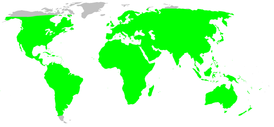
|
|

Male
Agelena labyrinthicaThe Latin name Agelenidae comes from the words ago lene - “I act timidly”, indicating the intermittent nature of the run of individuals of this family (in relation to other spiders, whose movement is mostly smooth and constant). Despite this, the name “funnel,” or “herbal,” is more often used in many modern languages. One of the species that is very famous in Eastern Europe is the house spider ( Tegenaria domestica ).
Beige-brown, with an oblong abdomen, striped limbs and a long pair of front legs (sometimes even longer than the hind legs). The size of the males varies from half to two centimeters. Females are usually a centimeter larger. The very first distinguishing characteristic is two dark stripes all over the back of the body. There are no strips on the first three molts.
They have four pairs of eyes, two of which are located in front in the same row. Two more eyes are located on the sides, and the last two on top. All eyes are simple except the last. Because of this, Agelenidae relies more on motion sensors (forelegs) than on vision.
Species of this family weave funnels in the form of funnels. The spider uses the web for hunting and protection, although it usually runs much faster than its own kind in size (the genus Tararua , for example, can run up to 2 km per hour with almost no stops, chasing the victim).
On a web, a spider, as a rule, sits a little deeper in the funnel and waits for prey to pass by, which, just touching the laid web, will be instantly attacked. After killing the prey with poison, the spider drags it to his funnel. Often his funnel changes position due to the accumulated number of corpses of insects. For more than two to three weeks, the spider does not linger on it.
The funnel is sticky and not sticky, it depends on the type. If the web is not sticky, then the web will get tangled around the booty legs.
The genera Agelenopsis and Hololena make excellent cobwebs; their cobwebs can be seen on bushes and grass in the autumn morning, when dew gathers on the web. Its area on the grass can reach 3 m². Moreover, several individuals can have an adjacent web (which is not the case with other species of spiders).
Funnel spiders are often aggressive, but almost not dangerous. According to their behavior, they are nocturnal, and the orbiting spiders often compete with them. The genus Malthonica is perhaps the only one whose representatives hunt as actively during the day as at night, so they are least likely to be seen on the web.
The genus Tegenaria , namely, Tegenaria agrestis (Meadow Spider), has an unreasonably bad reputation in connection with an allegedly poisonous bite. In Europe, there was not a single case of serious consequences after the bite of this spider. However, many American arachnologists have confirmed the involvement of the meadow spider in serious medical consequences in bitten patients (which in most cases resulted in skin necrosis ).
In fact, Tegenaria does not have enough toxins in its poison to achieve a similar effect. Most likely, an infection, penetrating the skin through chelicera, could play a large role in these situations. This is a significant factor, since not all spiders can bite it.
42 kinds of spiders:
- Acutipetala Dankittipakul & Zhang, 2008 - Thailand (2 species)
- Agelena Walckenaer, 1805 - from Africa to Asia (69 species, 1 subspecies), Agelescape caucasica
- Agelenella Lehtinen, 1967 - Yemen , Socotra (1 view)
- Agelenopsis Giebel, 1869 - North America (13 species)
- Ageleradix Xu & Li, 2007 - China (6 species)
- Agelescape Levy, 1996 - Southwest Asia (7 species)
- Ahua Forster & Wilton, 1973 - New Zealand (4 species)
- Allagelena Zhang, Zhu & Song, 2006 - from Central Europe to Asia (5 species)
- Azerithonica Guseinov, Marusik & Koponen, 2005 - Azerbaijan (1 view)
- Barronopsis Chamberlin & Ivie, 1941 - USA , Cuba , Bahamas (7 species)
- Benoitia Lehtinen, 1967 - from Africa to Asia (9 species)
- Calilena Chamberlin & Ivie, 1941 - USA (16 spp. , 5 subspecies)
- Hadites Keyserling, 1862 - Croatia (1 view)
- Histopona Thorell, 1869 - Europe (18 species)
- Hololena Chamberlin & Gertsch, 1929 - USA (30 species)
- Huangyuania Song & Li, 1990 - China (1 view)
- Huka Forster & Wilton, 1973 - New Zealand (5 species)
- Kidugua Lehtinen, 1967 - Congo (1 view)
- Lycosoides Lucas, 1846 - North Africa (10 Species)
- Mahura Forster & Wilton, 1973 - New Zealand (18 species)
- Maimuna Lehtinen, 1967 - Southwest Asia (7 species)
- Malthonica Simon, 1898 - Eurasia , Africa (41 species, 1 subspecies) Malthonica lehtineni
- Melpomene OP-Cambridge, 1898 - from the USA to Central America , Costa Rica (12 species)
- Mistaria Lehtinen, 1967 - Africa, Yemen (1 species, 1 subspecies)
- Neoramia Forster & Wilton, 1973 - New Zealand, Campbell Islands (22 species)
- Neorepukia Forster & Wilton, 1973 - New Zealand (2 species)
- Neotegenaria Roth, 1967 - Guiana (1 view)
- Novalena Chamberlin & Ivie, 1942 - from the USA to Central America (19 species)
- Olorunia Lehtinen, 1967 - Congo (1 view)
- Oramia Forster, 1964 - from Australia to New Zealand, Lord Howe , Chatham (8 species)
- Oramiella Forster & Wilton, 1973 - New Zealand (1 view)
- Orepukia Forster & Wilton, 1973 - New Zealand (24 species)
- Paramyro Forster & Wilton, 1973 - New Zealand (2 species)
- Porotaka Forster & Wilton, 1973 - New Zealand (2 species)
- Pseudotegenaria Caporiacco, 1934 - Europe (5 species)
- Rualena Chamberlin & Ivie, 1942 - from the USA to Central America (12 species)
- Tararua Forster & Wilton, 1973 - New Zealand (7 species)
- Tegenaria (Teghenaria) Latreille, 1804 - USA, Eurasia (110 species)
- Textrix Sundevall, 1833 - Europe (7 species)
- Tikaderia Lehtinen, 1967 - Himalayas (1 view)
- Tortolena Chamberlin & Ivie, 1941 - USA, from Mexico to Costa Rica (2 species)
- Tuapoka Forster & Wilton, 1973 - New Zealand (2 species)
- ↑ Lange A. B. Subtype Chelicerata // Animal Life. Volume 3. Arthropods: trilobites, chelicerae, tracheal breathing. Onychophors / ed. M.S. Gilyarova , F.N. Pravdina, Ch. ed. V. E. Sokolov . - 2nd ed. - M.: Education, 1984. - S. 68. - 463 p.
- ↑ Platnick, NI (2010). Currently valid spider genera and species . The world spider catalog, version 10.5. American Museum of Natural History. (English) (Retrieved October 5, 2010)
- How to Know the Spiders by BJ Kaston. Dubuque, 1953.
- Biology of Spiders , by Rainer F. Foelix, second edition, 1996


