Doolittle Raid - an episode of the Second World War , in which 16 medium ground-based B-25 "Mitchell" ground bombers on April 18, 1942 , commanded by Lieutenant Colonel James Doolittle , took off from the US aircraft carrier " Hornet ", attacked territory for the first time in this war Japan The raid was launched in response to the attack on Pearl Harbor (December 7, 1941).
| Raid Doolittle | |||
|---|---|---|---|
| Main conflict: World War II | |||
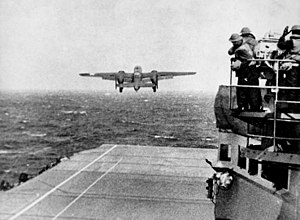 B-25 takes off from the deck of the aircraft carrier "Hornet" | |||
| date | April 18, 1942 | ||
| A place | Tokyo , Japan | ||
| Total | The victory of the Americans. | ||
| Opponents | |||
| |||
| Commanders | |||
| |||
| Forces of the parties | |||
| |||
| Losses | |||
| |||


Content
Progress of operation
April 18 at 7:38, when the American aircraft carrier Hornet was 650 miles from Honshu Island and 250 miles from the planned departure point of the aircraft, it was discovered by two Japanese patrol vessels . The Nashville cruiser escorting the aircraft carrier sank them, but from the Japanese sailors caught from the water, the Americans learned that the Japanese had time to report the squadron by radio.
Fearing that the enemy would raise aircraft and send ships to intercept, the squadron commander, Vice Admiral William Halsey, ordered that he immediately prepare for launch. For the first time in the world, ground-based bombers ( B-25 Mitchell ) took off from the short deck of an aircraft carrier [1] .
A squadron of 16 vehicles, which took off on a raid, hit 13 targets: metallurgical, machine-building and chemical enterprises, a shipyard, two power plants, fuel depots, and a light aircraft carrier in the port of Yokohama . According to Japanese data, 50 people died on the ground and 400 people were injured. At one of the weapons factories there was a large fire.
During the bombing, not a single aircraft was lost. However, it was impossible to put the bombers back on the aircraft carrier, and a landing was planned in eastern China . 15 bombers reached China. Four aircraft made a hard landing on water or rice fields and crashed. Three people died, seven were injured. Crews of 11 aircraft were thrown out with parachutes. Eight Americans were captured by Japanese. Three — Dean Hallmark, William Farrow, and Harold Recession — were killed on October 15, 1942 in violation of the Geneva and Hague conventions and customs of war. Robert Möller died in the camp on December 1, 1943. [one]
The only surviving vehicle under the command of Captain Edward Yorke sat down at the Soviet Far Eastern airfield Unashi and was confiscated. The Soviet Union , fearing the reaction of Japan to this incident, interned pilots (it was originally supposed to land all the planes in Vladivostok , but the USSR did not agree for the same reason - to wage war on two fronts at that moment would be very difficult). Then the crew was brought first to the city of Okhansk, Molotov region (now the Perm Territory), where they spent 8 months, and then first to Tashkent, and then to Ashgabat, where on May 11, 1943, under the guise of a false escape , they were transferred to British zone of occupation in Iran . From there, along the Trans-Iranian Lend-Lease Supply Route, they got home. The same route for the "escape" was used by the rest of the American bomber teams, which, after receiving injuries that precluded returning to American territory, would land in the USSR After the disclosure of information about this in the American newspapers by one of the pilots, the route was changed.
The raid had a small military, but of great political importance, it can be compared with the raid of Soviet aviation on Berlin on the night of August 7-8, 1941. Indeed, on September 5, 1941, reporting on the progress of preparations for the attack on Pearl Harbor, the chief of the Japanese General Staff, Hajime Sugiyama, assured the emperor that retaliatory air strikes on Japanese territory were impossible for Americans. In fact, it was the first serious injection that did not know the defeat of the Japanese Empire before.
Coincidentally, after this raid, the United States, which until this moment had suffered a series of defeats, began a series of victorious operations .
Reflection in art
Already in 1944, the movie Thirty Seconds Over Tokyo ( English: Thirty Seconds Over Tokyo ) was shot, dedicated to this event.
In the film “ Pearl Harbor ” (2001), one of the plots is devoted to the raid; In addition, the process of preparing aircraft and crews was demonstrated.
See also
- Bombing of Berlin by Soviet aviation in 1941
Notes
- ↑ 1 2 Reid Dolittle: the beginning of a new era in military affairs // BBC , April 18, 2017
Literature
- Doolittle and Halsey air raid on Tokyo (April 18) - Morison S. E. The US Navy in World War II: Rising Sun over the Pacific Ocean, December 1941 - April 1942. - M .: ACT; SPb .: Terra Fantastica, 2002.
- Raid Doolittle - Futida M., Okumia M. The Battle of Midway Atoll. - M .: Military Publishing , 1958
- Lieutenant Colonel Doolittle's raid - the first American air raid on Japan - B-25 Mitchell Part 2