The Japanese flying squirrel [1] [2] , or the small flying squirrel [1] ( Latin Pteromys momonga ) is one of two types of Asian (Eurasian) flying squirrels . The species name momonga received from its Japanese name.
Japanese flying squirrel | ||||||||||||||||
|---|---|---|---|---|---|---|---|---|---|---|---|---|---|---|---|---|
 | ||||||||||||||||
| Scientific classification | ||||||||||||||||
| ||||||||||||||||
| Latin name | ||||||||||||||||
| Pteromys momonga Temminck , 1845 |
Security status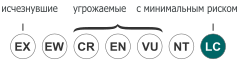 IUCN 3.1 Least Concern : 18701 |
Range - evergreen mountain forests of the islands of Kyushu and Honshu . Body dimensions are 15-20 cm, tail length is 10-14 cm, weight is about 200 g. Wool on top is gray-brown, bottom is white or light gray. Pregnancy lasts 4 weeks, 2 to 5 cubs are born. At 1.5 months young growth becomes independent. Lives in a natural environment for up to 5 years, in captivity up to 15.
The Japanese flying squirrel is a nocturnal animal that feeds on bark , nuts , seeds , and sometimes insects . It builds nests in hollows and forks of trees from moss and lichens .
Fishing value does not mean fragile skin. The risk of species extinction is minimal (LC).
See also
- Common flying squirrel
Notes
- ↑ 1 2 Sokolov V.E. Mammals Latin, Russian, English, German, French. / edited by Acad. V. E. Sokolova. - M .: Rus. lang., 1984. - S. 147. - 10,000 copies.
- ↑ Complete Illustrated Encyclopedia. "Mammals" Prince. 2 = The New Encyclopedia of Mammals / Ed. D. MacDonald . - M .: Omega, 2007 .-- S. 442. - 3000 copies. - ISBN 978-5-465-01346-8 .