Banin ( azerb. Banin ; French; Banine ; real name - Umm al-Banu Mirza kizi Asadullaeva - Azerb. Əsədullayeva Ümmülbanu Mirzə qızı ; 1905 - 1992 ) - French writer and memoirist of Azerbaijani origin.
| Banin Asadullaeva | |
|---|---|
| Banine | |
 | |
| Birth name | Umm al-Banu Asadullayev |
| Aliases | |
| Date of Birth | 1905 |
| Place of Birth | Baku |
| Date of death | 1992 |
| Place of death | Paris ( France ) |
| Citizenship | Azerbaijan Democratic Republic |
| Occupation | |
| Genre | autobiography |
| Language of Works | |
Biography
Born in January 1905 in the family of the Baku oil industrialist Mirza Asadullaev, received a good home education, studied European languages. Her mother, Ummulbanu, was the daughter of another oil tycoon Musa Nagiyev ; died in difficult births. After the establishment of Soviet power in Baku, her family went to Turkey , and since 1924 settled in Paris .
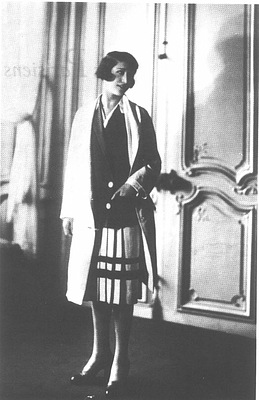
In Paris, she had to work as a saleswoman, fashion model, and continue her education. Then she begins to engage in translations, journalism, and edits on the radio broadcasts in French.
Gradually, Banin entered the literary circles of Paris and became known among Russian emigrant writers who made up a special layer of the emigrant elite. Here, among her acquaintances were the philosophers Berdyaev , Shestov , Lossky , poets and writers V. Ivanov, M. Tsvetaeva , K. Balmont , I. Severyanin , Ivan Bunin , Teffi , Remizov , Merezhkovsky and his wife Z. Gippius , Kuprin , Zaitsev Adamovich . In his memoirs, Banin especially highlights Taffy and Ivan Bunin, who were among her close friends.
Banin died at the age of 87 and was buried in Paris. And although she left a great literary heritage, including novels, journalism, translations, diaries and letters, as well as reprints of her books and unfinished manuscripts, her work as a whole is little known in Azerbaijan . Only in 1988 in Baku did her novel “Caucasian Days” (translated from French Hamlet Godzhaev) be published in the Azerbaijani language. Notes and messages about her and her work began to appear. However, the vast legacy left by the remarkable writer is still awaiting its publishers and researchers.
Creativity
Banin’s first novel, “Nami” ( 1943 ), which narrated the events in Azerbaijan in the pre-revolutionary period and the socio-political disaster that affected all sectors of society, was not particularly successful. However, this did not stop Banin, two years later she published the novel " Caucasian Days " ( 1945 ), which made her name known to the French reader.
In this novel, which was of an autobiographical nature, the writer recreates childhood pictures, scenes of pre-revolutionary times that are dear to the heart, portraits of her relatives, grandfather on the part of Musa Nagiyev ’s mother, a famous millionaire, another grandfather, Shamsi Asadullaev , also a millionaire, his father Mirza Asadullayev, who became Government of the Azerbaijan Democratic Republic, Minister of Trade, relations between relatives and friends.
Her descriptions recreate the biography of the writer, the history of the famous houses of the Baku oil industry, the realities and colors of the era, the atmosphere of childhood, customs and manners, folk holidays and ceremonies. The novel captured the relationship of the young heroine with the people around her, the mindsets and views of her contemporaries, their attitude towards the events of a turning point.
From the descriptions of his house, the Absheron dacha with their households, the author's attention switches to events that influenced her fate and the life of her relatives. This is the arrival of the Red Army in Baku , the establishment of Soviet power: against this background, further misadventures of the family are recreated. Banin, in particular, says that according to the will of her grandfather, she (she was then 13 years old) and her three older sisters became millionaires. However, a few days later, with the arrival of the Bolsheviks, they suddenly lost their wealth, were faced with the need to leave their homeland.
Following the novel Caucasian Days, one after another, Banin's new books are published: Paris Days ( 1947 ), Meeting with Ernst Junger ( 1951 ), I Chosen Opium ( 1959 ), After After ( 1961 ), “ Foreign France ”( 1968 ),“ Call of Last Hope ”(1971),“ Portrait of Ernst Junger ”( 1971 ),“ Ernst Junger in various faces ”( 1989 ),“ What Maria Told Me ”( 1991 ).
Conventionally, Banin’s work can be divided into two parts: works in which the Azerbaijani theme is reproduced, motifs, memoirs and a retrospection, and those related to French and European themes. Although in most of her books known to us there is an autobiographical factor; she herself, as an author, belongs to two worlds: the East and Azerbaijani roots, the eastern mentality and the European world - by education and lifestyle. This is manifested in the general creative orientation towards the European reader, to whom she is trying to open her world, all that connects her with the Eastern tradition is a property that is found in those Azerbaijani emigrant writers who are trying not only to understand another tradition, but also to be understood. in a foreign land.
On the other hand, this is also a technique that allows one to draw attention through oneself, one’s own life, experience, and worldview to events, facts, little-known to the reader, and destinies of people who are extraordinary and of interest to the European reader.
These are primarily topics related to her homeland, where events occurred that influenced the entire course of world development: the capitalist system collapsed and a new “Soviet system” arose. How did this happen, what caused it, what consequences did it have? .. It was curious for the European reader, and the writer tried to satisfy his curiosity.
But if her first novel “Nami” only reproduced the “common features” of changing times, then the novel “Caucasian Days” became more specific in recreating events that were tragic for her and her family, the entire estate of the rich and oil industrialists, who had lost power and wealth overnight, privileges, comfort, wealth and amenities. It was already personal, her very life, fate, the stories of her relatives, in a word, it was that literature that fit into the stream of works that recreated the collapse of the old world. But unlike the novels and novels of Soviet authors (Shamo by S. Ragimov , The World Is Collapsing, by M. Jalal and others), it was a different look - not just an eyewitness, but a victim of the crash.
In this regard, a new quality of her creative manner begins to show itself powerfully - autobiographical, more precisely, even documentary, factual, making the story realistic and, what is important, convincing and truthful evidence of the participant in the events. This becomes an important property of Banin's entire prose. If the “Caucasian” or “Azerbaijani theme” satisfied the cognitive interest of the French and, more broadly, the European reader in the pre-war years ( 20 - 40s ), then in the future Banin identified another fruitful creative layer for himself - the life of a person who ended up in exile.
The émigré theme allowed us to take a fresh look at different aspects of lifestyle, everyday life, human relationships in the “country of habitat” - and look at ourselves, our own life and fate as if from the outside, with an open mind, comprehending the reasons and circumstances that led to emigration. To enable readers representing the indigenous population of the country to see and understand the situation and condition of people who find themselves in these new conditions, next to the masters of life, as if second-class people ... Of course, we are talking about Russian emigration, about emigrants from the Soviet Union, to whom ranks herself Banin.
She wrote in the Figaro newspaper (December 2, 1991):
Russian emigration consisted of representatives of all classes of society: from White Guards to ballet stars, from nobles to writers, from priests to freethinkers. From philosophers to millionaires.
These people represented not only all classes, but also all nationalities, all peoples living within the tsarist empire, from the Baltic to the Caucasus. Of these, it would be possible to recreate the Russian Empire in miniature.
At first, the Russian emigres in Paris formed something like a ghetto, which Taffy, a novelist, little known here, but popular in Russia, described with her usual liveliness and sarcasticity in the story The Town.
This town had 40,000 inhabitants, one church and many taverns.
The town was crossed by a rivulet. Once upon a time in ancient times it was called Sekana, then Sena , then when the town grew around it, they began to call it “our little Neva”. The inhabitants lived compactly, either on the outskirts of Passy, or in the Rive Gauche area. The population of the town consisted of men and women, the younger generation, as well as generals who lived on credit and wrote memoirs in order to glorify the author’s name and bring shame on the heads of compatriots.
Banin, when she turned in the direction of the Russian or, rather, her own emigration, had no desire to “become famous” or “dishonor” her compatriots. In relation to the new authorities in her native Azerbaijan, she did not show hatred or even hostility in an open, invective form, describing everything as it is, and with this objective manner of narration she achieved greater expressiveness and reliability in the description of the class adversary. However, in the description of her relatives and loved ones who were affected by the disaster, she also proceeded from an outwardly impartial narrative manner.
The main thing that kept the narration of the “Parisian” books of Banin was psychologism, the ability to pass the story through his own, subjective, but largely fair perception of the author - a delicately sensitive and emotionally responsive woman. Intellectuals and artists capable of reproducing the subtlest, it would seem, almost elusive psychological traits and moods of the hero.
In this sense, it’s difficult to find a writer in Azerbaijani literature of the 20th century, especially in its “female” link, who, so realistically, taking into account the socio-psychological state and character relationships, could create a “love story”, or, more precisely, “Unrequited feelings”, as Banin did in the novel “Bunin's Last Duel”. She did it subtly and correctly in relation to an elderly emigrant writer who revealed her feelings to her.
“Love is submissive to all ages,” the poet said. And Banin the narrator understands this and seeks to reveal her psychological subsoil, show love-game, love that exalts and stimulates the creative nature: her, Banin, and her “counterpart” in the novel - Ivan Bunin, who has already reached the Nobel laureate laurels. She supports this “fire” of the master’s attraction to the woman “exotic” and wayward, as the hero sees her in the novel. She could immediately extinguish this "fire", rejecting his feelings, turn the "theme" in the other direction. But after all, she is a woman who is not alien to coquetry, changes in moods, in relation to a man who shows interest in her ...
This may be of interest to her: her partner is worthy of all attention. And as a person, and as a writer, a living classic, and as one of the masters of the Russian emigration, monitored by the Soviet authorities, sending his representatives to him to return to his homeland, promising privileges, fees, a summer residence, all sorts of benefits ...
But even more so, he is her hero, the hero of her novel. That love story, which, having arisen between them, did not become mutual, but took on the features of love-suffering, a love game in which both participate: he is a middle-aged man, spoiled by everyone's attention, and she is a writer for whom this story provides fertile material , the opportunity to show a well-known person in Russia and in the world close, at sunset, in exile on weekdays - from close range.
Banin does not idealize Bunin in his novel, reproduces his image taking into account the already existing idea of him in an emigrant environment, adds details and details, shows weaknesses, behavior in everyday life, character traits, relationships in the family, with his wife, with other women.
Of particular interest are the pages dedicated to Konstantin Simonov and his wife, actress Valentina Serova, who, as Banin writes, tried to seduce Bunin with promises of prosperity and return him to his homeland ...
This story, reliable in details, creates an idea of Bunin as a person true to his principles and beliefs, presenting him in the true light: a patriot who did not change his convictions and did not give in to promises, despite the financial difficulties and the difficult life of the emigrant.
The novel “The Last Duel of Bunin” is the undoubted success of Banin, who managed to create a love story from personal history, which unfolds before our eyes with all its vicissitudes; from the first acquaintance to new meetings, where there are quarrels, and resentment, and hope for reciprocity, and a bitter sense of futility of relations ...
Banin creates a figurative system from a bizarre combination of facts, events, with a plot open for further movement, which develops in accordance with the psychological and emotional states of the characters. She does not give concessions to any of them, trying to be truthful and objective to the end, trusting the reader in her assessments and conclusions.
Another page of Banin’s work opens with the history of her relationship with the famous German writer, philosopher and entomologist Ernst Junger, whom she met in 1943, when he, an officer in the German army, served in Paris.
Junger, a man of liberal views who condemned war and fascism, is the author of such books as “Steel Storms”, “On Marble Rocks”, which even before the war won him fame in pacifist circles. He read Banin’s novel Nami. Then the acquaintance began, which lasted until the death of the writer.
Banin became the mediator of Ernst Jünger in his literary affairs in Paris, translated his articles into French, dedicated three books to him - “Meetings with Ernst Jünger”, “Portrait of Ernst Jünger”, “Diverse Ernst Jünger”.
Neither these three books of Banin, nor the works of Ernst Jünger “Heliopolis” and “Paris Diary”, in which there are many pages devoted to Banin, are unknown to our reader today.
In recent years, an elderly writer has been working on a novel about Our Lady - “What Maria told me,” also unknown to us. She handed over her archive - books, letters, documents - to the German writer Rolf Stimmer.
Living in Paris, Banin was not fenced off from her distant homeland, she was vividly interested in the processes taking place in Azerbaijan. In France, she gained fame as a French writer. And in the Soviet press of that time ("Week", 1987, No. 18), her work is also referred to as French literature. A question that deserves to be the subject of a special study in Azerbaijani literary science.
The writer, herself, gave a clear and unambiguous answer to this question when she appeared in the French newspaper Mond (January 20, 1990 ) in difficult days for the Azerbaijani people, where her article under the heading Nagorno-Karabakh was preceded by an editorial remark: “Azerbaijan the point of view is expressed by the Azerbaijani writer Um al-Banu. ” In this article, Banin gives information about Karabakh, the Armenians who came to Azerbaijani lands at the beginning of the XIX century, resettled by the tsarist government as a result of the war with Iran and Turkey. She talks about the long-standing claims of Armenians to Azerbaijani lands, about the relations of the Dashnaks with the Bolsheviks and their joint actions against the Azerbaijani people. “While they often talk about the Armenians as“ victims ”of Ottoman imperialism, for some reason no one talks about the atrocities that the Armenians committed in Azerbaijan in the past,” Banin writes, thereby expressing his commitment as patriots, “his indignation as an honest and objective person. "
Being a well-known novelist in France, Banin was engaged in journalism as well as translations: she translated fiction into French from Russian, English and German.