Aristarchus of Samos ( ancient Greek Ἀρίσταρχος ς Σάμιος ; c. 310 BC , Samos - c. 230 BC ) - ancient Greek astronomer , mathematician and philosopher of the 3rd century BC e. who first proposed the heliocentric system of the world and developed a scientific method for determining the distances to the Sun and Moon and their sizes.
| Aristarchus of Samos | |
|---|---|
| Greek Ἀρίσταρχος ὁ Σάμιος | |
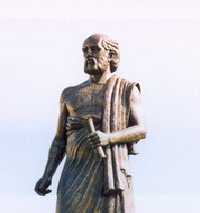 Monument to Aristarchus of Samos at Aristotelian University , Thessaloniki | |
| Date of Birth | OK. 310 BC e. |
| Place of Birth | Samos island |
| Date of death | OK. 230 BC e. (approx. 80 years) |
| Scientific field | astronomy, math |
| Known as | creator of the heliocentric system of the world |
Content
- 1 Biographical information
- 2 Works
- 2.1 "On the magnitudes and distances of the sun and moon"
- 2.2 The first heliocentric system of the world
- 2.3 Work on improving the calendar
- 2.4 Other work
- 3 Memory
- 4 See also
- 5 notes
- 6 Literature
- 7 References
Biographical information
Information about the life of Aristarchus, like most other astronomers of antiquity , is extremely scarce. It is known that he was born on the island of Samos . The years of life are not exactly known; period approx. 310 BC e. - OK. 230 BC e., usually indicated in the literature, is established on the basis of indirect data [1] . According to Ptolemy [2] , in 280 BC. e. Aristarchus observed the solstice ; this is the only reliable date in his biography. Aristarchus' teacher was an outstanding philosopher, a representative of the peripatetic school of Straton of Lampsack . It can be assumed that for a considerable time Aristarchus worked in Alexandria , the scientific center of Hellenism [3] . Due to the nomination of the heliocentric system of the world, he was accused of godlessness, dishonesty on the part of the poet and philosopher Cleanthus, but the consequences of this accusation are unknown.
Works
“On the magnitudes and distances of the Sun and Moon”
Of all the works of Aristarchus of Samos, only one thing has survived to us, “On the magnitudes and distances of the Sun and the Moon” [4] , where for the first time in the history of science he tries to establish the distances to these celestial bodies and their sizes. Ancient Greek scholars of the previous era have repeatedly spoken out on these topics: for example, Anaxagoras from Klazomen believed that the Sun was larger than the Peloponnese in size [5] . But all these judgments did not have any scientific basis: the distances and sizes of the Sun and the Moon were not calculated on the basis of any astronomical observations, but were simply fabricated [6] . In contrast, Aristarchus used a scientific method based on the observation of lunar phases and solar and lunar eclipses . Its constructions are based on the assumption that the moon has the shape of a ball and borrows light from the sun. Therefore, if the Moon is in quadrature, that is, it looks cut in half, then the angle of the Earth - the Moon - the Sun is straight.
Now it’s enough to measure the angle between the Moon and the Sun α and, “solving” a right triangle, establish the ratio of the distances from the Earth to the Moon and from the moon to the sun : . According to the measurements of Aristarchus, α = 87 °, this implies that the Sun is about 19 times farther than the Moon. True, at the time of Aristarchus there were still no trigonometric functions (in fact, he himself laid the foundations for trigonometry in the same essay “On the magnitudes and distances of the Sun and Moon” [7] ). Therefore, to calculate this distance, he had to use rather complex calculations, described in detail in the mentioned treatise.
Further, Aristarchus drew some information about solar eclipses : clearly imagining that they occur when the Moon blocks the Sun from us, Aristarchus pointed out that the angular dimensions of both luminaries in the sky are approximately the same. Consequently, the Sun is as many times larger than the Moon, how many times further, that is (according to Aristarchus), the ratio of the radii of the Sun and the Moon is approximately 20.
The next step was to measure the ratio of the sizes of the Sun and the Moon to the size of the Earth. This time Aristarchus draws on the analysis of lunar eclipses . The reason for the eclipses is completely clear to him: they occur when the moon falls into the cone of the earth's shadow. According to his estimates, in the region of the lunar orbit, the width of this cone is 2 times the diameter of the moon. Knowing this value, Aristarchus, using rather witty constructions and the previously derived ratio of the sizes of the Sun and the Moon, concludes that the ratio of the radii of the Sun and the Earth is more than 19 to 3, but less than 43 to 6. The radius of the moon was also estimated: according to Aristarchus, it is about three times smaller than the radius of the earth, which is not so far from the correct value (0.273 radius of the earth).
Aristarchus underestimated the distance to the Sun by about 20 times. The reason for the error was that the lunar quadrature moment can only be established with a very large uncertainty, which leads to the uncertainty of the value of the angle α and, therefore, to the uncertainty of the distance to the Sun. Thus, the method of Aristarchus was quite imperfect, unstable to errors. But this was the only method available in antiquity.
Contrary to the name of his work, Aristarchus does not calculate the distance to the Moon and the Sun, although he, of course, could easily do this, knowing their angular and linear dimensions. The treatise states that the angular diameter of the moon is 1/15 of the zodiac sign, that is, 2 °, which is 4 times the true value. It follows that the distance to the moon is about 19 Earth radii. It is curious that Archimedes in his work “ Calculus of grains of sand ” (“ Psammit ”) notes that it was Aristarchus who first received the correct value of 1/2 °. In this regard, the modern science historian Dennis Rawlins believes that the author of the treatise "On the magnitudes and distances of the Sun and the Moon" is not Aristarchus himself, but one of his followers, and the value 1/15 of the zodiac arose by mistake of this student, who incorrectly rewrote the corresponding meaning from the original work of his teacher [8] . If we make the corresponding calculations with a value of 1/2 °, we get a value of the distance to the Moon of about 80 Earth radii, which is more than the correct value by about 20 Earth radii. This is ultimately due to the fact that the Aristarchian estimate of the width of the earth's shadow in the region of the lunar orbit (2 times the diameter of the moon) is underestimated. The correct value is approximately 2.6. This value was used a century and a half later by Hipparchus of Nicaea [9] (and, possibly, Aristarchus' younger contemporary Archimedes [10] ), due to which it was established that the distance to the Moon is about 60 Earth radii, in accordance with modern estimates.
The historical significance of the work of Aristarchus is enormous: it is from him that the astronomers advance on the “third coordinate”, during which the scale of the solar system , the Milky Way , the Universe were established [11] .
First Heliocentric System of the World
Aristarchus first (in any case, publicly) hypothesized that all planets revolve around the Sun, and the Earth is one of them, making a revolution around the daylight in one year, while rotating around an axis with a period of one day ( heliocentric system of the world ) . The works of Aristarchus himself on this subject did not reach us, but we know about them from the works of other authors: Aetius (pseudo-Plutarch), Plutarch , Sextus Empiricus and, most important, Archimedes [12] . So, Plutarch in his essay “On the Face Visible on the Disc of the Moon” notes that
this husband [Aristarchus of Samos] tried to explain celestial phenomena by the assumption that the sky is motionless and the earth moves along an inclined circle [ecliptic], while rotating around its axis.
And here is what Archimedes writes in his essay “ The Calculus of Sand grains ” (“ Psammit ”):
Aristarchus of Samos, in his “Assumptions” ... believes that fixed stars and the Sun do not change their place in space, that the Earth moves in a circle around the Sun at its center, and that the center of the sphere of fixed stars coincides with the center of the Sun [13] .
The reasons forcing Aristarchus to push the heliocentric system are unclear. Perhaps having established that the Sun is much larger than the Earth, Aristarchus came to the conclusion that it is unreasonable to consider a larger body (the Sun) moving around a smaller one (the Earth), as the great predecessors Eudoxus of Cnidus , Callippe and Aristotle considered it . It is also unclear how much he and his students substantiated the heliocentric hypothesis, in particular, whether with its help he explained the backward movements of the planets [14] . However, thanks to Archimedes, we know about one of the most important conclusions of Aristarchus:
The size of this sphere [sphere of fixed stars] is such that the circle described, according to his assumption, by the Earth, is located to the distance of fixed stars in the same ratio as the center of the ball is to its surface [13] .
Thus, Aristarchus concluded that his theory implies a huge remoteness of stars (obviously, due to the unobservability of their annual parallaxes ). In itself, this conclusion must be recognized as another outstanding achievement of Aristarchus of Samos.
It is hard to say how widespread these views were. A number of authors (including Ptolemy in Almagest ) mention the school of Aristarchus, without giving, however, any details [15] . Among the followers of Aristarchus, Plutarch indicates the Babylonian Seleucus . Some historians of astronomy provide evidence of the widespread occurrence of heliocentrism among ancient Greek scientists [16] , but most researchers do not share this opinion.
The reasons why heliocentrism never became the basis for the further development of ancient Greek science are not completely clear. According to Plutarch , "Cleanthos believed that the Greeks should bring [Aristarchus of Samos] to trial because he seems to be moving the Hearth of Peace from place", referring to the Earth [17] ; Diogenes Laertius indicates among the works of Cleanthes the book “Against Aristarchus”. This Cleanthus was a Stoic philosopher, a representative of the religious trend of ancient philosophy [18] . It is unclear whether the authorities followed the call of Cleanthus, but the educated Greeks knew the fate of Anaxagoras and Socrates , who were persecuted largely for religious reasons: Anaxagoras was expelled from Athens , Socrates was forced to drink poison . Therefore, the accusations of the kind that were brought by Cleanthus Aristarchus were by no means an empty phrase, and astronomers and physicists, even if they were supporters of heliocentrism, tried to refrain from publicly publishing their views, which could lead to their oblivion.
The heliocentric system was developed only after nearly 1800 years in the writings of Copernicus and his followers. In the manuscript of his book “On the Rotations of the Celestial Spheres”, Copernicus referred to Aristarchus as a supporter of the “mobility of the Earth,” but in the final version of the book this link disappeared [19] . Whether Copernicus knew during the creation of his theory about the heliocentric system of the ancient Greek astronomer, remains unknown [20] . The priority of Aristarchus in creating the heliocentric system was recognized by the Copernicans Galileo and Kepler [21] .
Calendar Improvement Work
Aristarchus had a significant impact on the development of the calendar . III century writer e. Censorin [22] indicates that Aristarchus determined the length of the year in days.
In addition, Aristarchus introduced a calendar period of 2434 years. A number of historians indicate that this period was derived from a twice as large period, 4868 years, the so-called “Great Year of Aristarchus”. If we take the duration of the year that underlies this period is 365.25 days (callippus year), then the Great Year of Aristarchus is 270 saros [23] , or synodic months , or 1778037 days. The above value of the Aristarchian year (according to Censorin) is exactly days.
One of the most accurate definitions of the synodic month (the average period of the lunar phase change) in ancient times was the value (in the six-decimal number system used by ancient astronomers) days [24] . This number was the basis of one of the theories of the movements of the moon, created by ancient Babylonian astronomers (the so-called System B). D. Rawlins [25] made convincing arguments in favor of the fact that this value of the length of the month was also calculated by Aristarchus according to the scheme
days, where 1778037 is the Great Year of Aristarchus, 270 is the number of saros in the Great Year, 223 is the number of months in saros. "Babylonian" meaning it turns out, if we assume that Aristarchus first divided 1778037 into 233, received 7973 days 06 hours 14.6 minutes, and rounded the result to minutes, then divided 7973 days 06 hours 15 minutes by 270. As a result of this procedure, the exact value is exactly days .
The measurement of the length of the year by Aristarchus is mentioned in one of the documents of the Vatican collection of ancient Greek manuscripts . This document contains two lists of measurements of the length of the year by ancient astronomers, in one of which the value of the length of a year in days, in another - days. By themselves, these entries, like other entries in these lists, look meaningless. Apparently, the ancient scribe made mistakes when copying older documents. D. Rawlins [26] suggested that these numbers ultimately result from the decomposition of certain quantities into a continued fraction . Then the first of these values turns out to be equal
days
second -
days.
Appearance in magnitude the significance of the duration of the Great Year of Aristarchus testifies in favor of the correctness of this reconstruction. The number 152 is also associated with Aristarchus: his observation of the solstice (280 BC) took place exactly 152 years after a similar observation by the Athenian astronomer Meton . Value approximately equal to the duration of the tropical year (the period of the seasons, based on the solar calendar). Value very close to the duration of the sidereal (stellar) year - the period of the Earth's rotation around the Sun. In the Vatican lists, Aristarchus is chronologically the first astronomer for whom two different values of the length of the year are given. These two species of the year, tropical and sidereal, are not equal to each other due to the precession of the earth's axis, according to the traditional view discovered by Hipparchus about a century and a half after Aristarchus. If the reconstruction of the Vatican lists according to Rawlins is correct, then the distinction between the tropical and sidereal years was first established by Aristarchus, who should be considered the discoverer of the precession in this case [27] .
Other works
Aristarchus is one of the founders of trigonometry . In the essay “On Sizes and Distances ...” he proves, in modern terms, the inequality
where α and β are two acute angles satisfying the inequality β < α [28] .
According to Vitruvius , Aristarchus improved the sundial (including the invention of a flat sundial) [29] . Aristarchus also worked in optics , believing that the color of objects arises when light falls on them, that is, that paints in the dark have no color [30] . It is believed that he set up experiments to determine the resolution of the human eye [31] .
Contemporaries recognized the outstanding significance of the works of Aristarchus of Samos: his name was invariably named among the leading mathematicians of Hellas, the essay “On the magnitudes and distances of the Sun and the Moon”, written by him or one of his students, was included in the obligatory list of works that astronomers had to study in Ancient Greece, his writings were widely cited by Archimedes , by all accounts, the greatest scholars of Hellas (in the treatises of Archimedes that have come down to us, the name Aristarchus is mentioned more often than the name of any other scientist [32] ).
Memory
In honor of Aristarchus, a lunar crater , an asteroid ( (3999) Aristarchus ), as well as an airport in his homeland, the island of Samos, are named.
See also
- Earth's daily rotation
- Heliocentric system of the world
- Astronomy of Ancient Greece
Notes
- ↑ Heath 1913, Wall 1975.
- ↑ Almagest , Book III, Chapter I.
- ↑ It is usually stated that Ptolemy calls Alexandria the place of observation of the solstice produced by Aristarchus, but, strictly speaking, this is not mentioned in the Almagest ; al-Biruni ( Canon of Mas'uda , Book VI, ch. 6) claims that this observation took place in Athens, but its source is unclear.
- ↑ The Russian translation is given in Veselovsky 1961 .
- ↑ Leo Krivitsky. Evolutionism. Volume One: The History of Nature and the General Theory of Evolution . - Litres, 2015 .-- ISBN 9785457203426 .
- ↑ Zhytomyr 1983.
- ↑ Van der Waerden 1959; Duke 2011.
- ↑ Rawlins 2009.
- ↑ Klimishin 1987.
- ↑ Zhytomyr 2001.
- ↑ Gingerich 1996.
- ↑ See links at the end of the article.
- ↑ 1 2 Archimedes. The calculus of grains of sand (Psammit). - M.-L., 1932. - P.68
- ↑ Carman, 2017 .
- ↑ Ptolemy generally carefully ignores any achievements of Aristarchus.
- ↑ Van der Waerden 1987, Rawlins 1987, Thurston 2002, Russo 2004. For more details see the article Heliocentric system of the world .
- ↑ Plutarch, On the Face Visible on the Disc of the Moon (passage 6) .
- ↑ Thus, he is known for his “Anthem to Zeus” (Veselovsky 1961, p. 64).
- ↑ Veselovsky 1961, p. fourteen.
- ↑ Von Erhardt and von Erhardt-Siebold, 1942; Africa, 1961; Rosen, 1978; Gingerich, 1985.
- ↑ Galileo, Dialogues on the two most important systems of the world (p. 414 editions in Russian in 1961; see also p. 373, 423, 430); for Kepler, see Rosen, 1975.
- ↑ See Heath 1913, p. 314.
- ↑ Saros is the recurrence period of eclipses, equal to 18 years 11⅓ days.
- ↑ days.
- ↑ Rawlins 2002.
- ↑ Rawlins 1999.
- ↑ Rawlins 1999, p. 37.
- ↑ Veselovsky 1961, p. 38.
- ↑ Veselovsky 1961, p. 28.
- ↑ Veselovsky 1961, p. 27.
- ↑ Veselovsky 1961, p. 42.
- ↑ Christianidis et al. 2002, p. 156.
Literature
- Van der Waerden B. L. Awakening Science. Mathematics of ancient Egypt, Babylon and Greece . - M .: GIFFL, 1959.
- Veselovsky I.N. Aristarchus of Samos - Copernicus of the Ancient World // Historical and Astronomical Studies, vol. VII. - M. , 1961. - S. 17-70 .
- Eremeeva A.I., Tsitsin F.A. History of astronomy. - M .: Publishing House of Moscow State University, 1989.
- Zhitomirsky S.V. Antique ideas about the size of the world // Historical and Astronomical Studies, vol. Xvi. - M. , 1983. - S. 291-326 .
- Zhitomirsky S.V. The heliocentric hypothesis of Aristarchus of Samos and ancient cosmology // Historical and Astronomical Studies, vol. Xviii. - M. , 1986. - S. 151-160 .
- Zhitomirsky S.V. Antique astronomy and orphism. - M .: Janus-K, 2001.
- Klimishin I. A. Discovery of the Universe. - M .: Science, 1987.
- Kolchinsky I.G., Korsun A.A., Rodriguez M.G. Astronomers: A Biographical Reference. - 2nd ed., Revised. and additional .. - Kiev: Naukova Dumka, 1986. - 512 p.
- Pannekoek A. History of Astronomy . - M .: Science, 1966.
- Panchenko D.V. On the failure of Aristarchus and the success of Copernicus // In collection: ΜΟΥΣΕΙΟΝ: Prof. A. I. Zaitsev on the occasion of the 70th anniversary .. - SPb. : publishing house of St. Petersburg State University, 1997. - S. 150-154 .
- Protasov B. Yu. Geometry of the starry sky // Quantum. - 2010. - No. 2 .
- Rozhansky I.D. History of natural science in the era of Hellenism and the Roman Empire. - M .: Science, 1988.
- Shchedrovitsky G. P. Experience of the logical analysis of reasoning ("Aristarchus of Samos"). - In the book: Shchedrovitsky G.P. Philosophy. The science. Methodology ( ISBN 5-88969-002-7 ). - M. , 1997. - S. 57-202.
- Shchedrovitsky G.P. Experience in the analysis of a single text containing a solution to a mathematical problem. - In the book: G. Schedrovitsky On the Method of Thinking Research ( ISBN 5-903065-01-5 ). - M. , 2006 .-- S. 286-359.
- Schetnikov A.I. Measurement of astronomical distances in Ancient Greece // Schole. - 2010. - No. 4 . - S. 325-340 .
- Africa T. W. Copernicus' Relation to Aristarchus and Pythagoras // Isis. - 1961. - Vol. 52. - P. 406–407.
- Batten A. H. Aristarchus of Samos // Royal astron. soc. of Canada. Journal. - 1981. - Vol. 75. - P. 29-35.
- Berggren J. L., Sidoli N. Aristarchus's On the Sizes and Distances of the Sun and the Moon: Greek and Arabic Texts // Archive for History of Exact Sciences. - 2007. - Vol. 61, No. 3 . - P. 213-254.
- Christianidis J. et al. Having a Knack for the Non-intuitive: Aristarchus's Heliocentrism through Archimedes's Geocentrism // History of Science. - 2002. - Vol. 40, No. 128 . - P. 147-168.
- Carman C. The first Copernican was Copernicus: the difference between Pre-Copernican and Copernican heliocentrism // Archive for History of Exact Sciences. - 2017.
- Duke D. The Very Early History of Trigonometry // DIO: The International Journal of Scientific History. - 2011 .-- Vol. 17. - P. 34-42. Archived March 26, 2012.
- Gingerich O. Did Copernicus owe a debt to Aristarchus? // J. Hist. Astronom. - 1985. - Vol. 16, No. 1 . - P. 37-42.
- Gingerich O. The Scale of the Universe: A Curtain-Raiser in Four ACTS and Four Morals // Publications of the Astronomical Society of the Pacific. - 1996. - Vol. 108. - P. 1068-1072.
- Heath T. L. Aristarchus of Samos, the ancient Copernicus: a history of Greek astronomy to Aristarchus . - Oxford .: Clarendon, 1913 (reprinted New York, Dover, 1981).
- Momeni F. et al. Determination of the Sun's and the Moon's sizes and distances: Revisiting Aristarchus' method // American Journal of Physics. - 2017 .-- Vol. 85, No. 3 . - P. 207-215.
- Pinotsis A. D. Comparison and historical evolution of ancient Greek cosmological ideas and mathematical models // Astronomical & Astrophysical Transactions. - 2005. - Vol. 24, No. 6 . - P. 463-483.
- Rawlins D. Ancient Heliocentrists, Ptolemy, and the equant // American Journal of Physics. - 1987. - Vol. 55. - P. 235-9. Archived December 2, 2016.
- Rawlins D. Continued-Fraction Decipherment: Ancestry of Ancient Yearlengths and pre-Hipparchan Precession // DIO. - 1999. - Vol. 9.1.
- Rawlins D. Aristarchos and the "Babylonian" System B Month // DIO. - 2002. - Vol. 11.1.
- Rawlins D. Aristarchos Unbound: Ancient Vision // DIO. - 2008 .-- Vol. 14. - P. 13-32.
- Rosen E. Aristarchus of Samos and Copernicus // Bulletin of the American Society of Papyrologists. - 1978. - Vol. xv. - P. 85-93.
- Rosen E. Kepler and the Lutheran attitude towards Copernicanism in the context of the struggle between science and religion // Vistas in Astronomy. - 1975 .-- Vol. 18, No. 1 . - P. 317—338.
- Russo L. The forgotten revolution: how science was born in 300 BC and why it had to be reborn. - Berlin .: Springer, 2004.
- Sidoli N. What We Can Learn from a Diagram: The Case of Aristarchus's On The Sizes and Distances of the Sun and Moon // Annals of Science. - 2007. - Vol. 64, No. 4 . - P. 525-547.
- Stahl W. Aristarchus of Samos // In: Dictionary of Scientific Biography. - 1970. - Vol. 1. - P. 246-250.
- Thurston H. Greek Mathematical Astronomy Reconsidered // Isis. - 2002. - Vol. 93. - P. 58-69.
- Van der Waerden B. L. The heliocentric system in Greek, Persian and Hindu astronomy // In: From deferent to equant: A Volume of Studies in the History of Science in the Ancient and Medieval Near East in Honor of ES Kennedy (Annals of the New York Academy of Sciences). - 1987, June. - Vol. 500. - P. 525-545).
- Von Erhardt R. and von Erhardt-Siebold E. Archimedes' Sand-Reckoner. Aristarchos and Copernicus // Isis. - 1942. - Vol. 33. - P. 578-602.
- Wall B. E. Anatomy of a precursor: the historiography of Aristarchos of Samos // Studies in Hist. and Philos. Sci. - 1975 .-- Vol. 6, No. 3 . - P. 201-228.
Links
Treatise of Aristarchus of Samos
- Aristarchus of Samos . About the sizes and mutual distances of the Sun and the Moon (the Russian translation is included in the article by Veselovsky, 1961) .
Antique references to the heliocentric system of Aristarchus
- Archimedes . Psammit (p. 68) .
- Plutarch . On the face visible on the disk of the moon (passage 6) .
- Plutarch . Platonic questions (question VIII) Archived on June 17, 2012.
- Plutarch . Platonic questions (Question VIII, paragraph 1) .
- Plutarch . Sentiments concerning nature with which philosophers were delighted, book II, chapter XXIV "On the eclipse of the Sun" . Archived on August 28, 2011.
- Pseudo-Plutarch . Opinions of philosophers (Prince II, p. 24) .
- Sextus Empiricus . Against scientists .
Research
- Bonnard A. Greek civilization. Ch. XII. Alexandria science. Astronomy. Aristarchus of Samos (Russian)
- Aristarchus of Samos (The MacTutor History of Mathematics archive )
- Stahl W. Aristarchus of Samos (Dictionary of Scientific Biography )
- The Moon's Distance by Aristarchus
- Dennis Rawlins Contributions. Contains a brief description of Dennis Rawlins' research on the work of Aristarchus of Samos (English)
- Aristarchus and the Size of the Moon