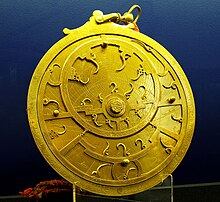
Astrolabe ( Greek ἁστρολάβον , astrolabon , "taking the stars") is one of the oldest astronomical instruments , used to measure horizontal angles and determine the latitudes and longitudes of celestial bodies [1] . Based on the principle of stereographic projection .
Content
- 1 History
- 2 Astrolabe device
- 3 Application of astrolabia
- 4 Other types of astrolabes
- 5 See also
- 6 notes
- 7 Literature
- 7.1 Treatises on astrolabes
- 7.2 Research
- 8 References
- 8.1 Hypatia and astrolabia (evidence)
History
Astrolabe first appeared in ancient Greece . The principle of stereographic projection that translates circles on a sphere into circles on a plane was discovered by Apollonius of Perga . Vitruvius, in his essay Ten Books on Architecture, describing an astronomical instrument called a spider, says that he was “invented by the astronomer Eudoxus, while others say Apollonius.” One of the components of this instrument was a drum, on which, according to Vitruvius, "the sky with a zodiac circle is drawn."
The stereographic projection described in the II century BC. e. Claudius Ptolemy in the composition "Planisphere". However, Ptolemy himself called another tool “astrolabon” - the armillary sphere . The final form of astrolabe was developed in the IV century. n e. Theon of Alexandria , who called this device "small astrolabon." The first treatises on astrolabe that have come down to us belong to philosophers and theologians Sinesis (IV – V centuries A.D. ), John Philopon (VI centuries A.D. ), Sever Seboht (VII century A.D. )
Scientists of the Islamic East improved astrolabe and began to use it not only to determine the time and duration of day and night, but also to carry out some mathematical calculations and for astrological predictions. There are many works of medieval Islamic authors on the various designs and applications of astrolabe. These are the books of al-Khorezmi , al-Astrulabi , al-Zarqali , al-Sidzhizi , al-Fargani , al-Sufi , al-Biruni , Nasir al-Din at-Tusi and others. In the XVIII century. Ismail Effendi writes a guide to the use of astralabia.
Since the XII century, astrolabes have become known in Western Europe , where at first they used Arabic instruments, and later they began to make their own according to Arabic patterns. In the XIV century. The treatises on the device of astrolabe, written by the famous writer Jeffrey Chaucer and the Byzantine scholar Nikifor Grigora, were widely popular [2] .
Astrolabe reached its peak of popularity in Europe during the Renaissance, in the 15th-16th centuries, along with the armillary sphere, it was one of the main tools of astronomical education. Knowledge of astronomy was considered the basis of education, and the ability to use astrolabe was a matter of prestige and a sign of appropriate education. European masters, like their predecessors to the Arabs, paid great attention to decoration, so that the astrolabes became a subject of fashion and collecting at the royal courts. In the XVI century, they began to make them on the basis of their own calculations, to apply in European latitudes .
One of the best toolmakers of the 16th century was the Flemish master Gualterus Arsenius . His astrolabes were distinguished by accuracy and grace of forms, therefore, various noble persons ordered him to make them. One of them, made by Arsenius in 1568 and once owned by the Austrian commander Albrecht von Wallenstein , is now kept in the Museum of MV Lomonosov .
The modern descendant of astrolabe is the planisphere - a moving map of the starry sky used for educational purposes.
Astrolabe device
The basis of classical astrolabe is the "plate" - a round piece with a high side and a suspension ring for accurate leveling of the device relative to the horizon . The outer limb of the plate has a scale digitized in degrees and in hours.
A tympanum is enclosed in this “plate” - a round flat disk, on the surface of which points and lines of the celestial sphere are applied in stereographic projection, which are preserved during its daily rotation: this is the pole of the world located in the center of the tympanum and the circles of the celestial equator and the northern tropic concentric with it and the southern tropic (which usually served as the boundary of the tympanum); then - a straight vertical line of the celestial meridian ; finally, the horizon , its parallels (" almucantaras "), the zenith point and the azimuth circles passing through it. The position of the horizon and zenith will be different for different latitudes of the place of observation, therefore, for observations made at different latitudes, different tympans must be made.
A “spider” is superimposed on the tympanum - a round curved lattice on which in the same stereographic projection, using the curved arrows, the location of the brightest stars located north of the southern tropic is indicated. On the "spider" is also indicated the zodiac circle with a scale showing the annual movement of the Sun along the ecliptic . The scale of some astrolabes even reflects the unevenness of this annual movement.
The convenience of using stereographic projection in astrolabe is that in this projection all circles on the sphere are displayed in circles or straight lines on the plane; but straight lines and circles are most easily constructed and engraved in the manufacture of tympanum and spider. Almucantaras form a hyperbolic bundle of circles on the tympanum, azimuthal lines form an elliptical bundle of circles conjugated to it.
Everything is held together by an axis passing through the central holes of the listed parts. On the same axis from the back of the plate is attached an alidade - a sighting line with diopters. A circular degree scale is applied on the back side, according to which the target readings are made. Here you can also find a variety of nomographic scales , such as the scale of tangents (“direct shadow”, umbra recta ) and cotangents (“reverse shadow”, umbra versa ), a scale for recalculating equal hours that occur when dividing the day into 24 parts, into the so-called "Unequal hours", a scale for determining the qibla , etc.
The use of astrolabe
After measuring the height of the Sun or the star with the help of alidade, the spider is rotated so that the image of the ecliptic point at which the Sun is at a given moment of the year, or the image of the star falls on the image of almucanthrate corresponding to this height. At the same time, a stereographic image of the sky at the moment of observation is obtained on the front side of the astrolabe, after which the azimuth of the star and the exact time are determined, as well as the horoscope (lit. “hour indicator”) - the degree of the ecliptic rising above the horizon at the time of observation.
All other numerous methods of treatment with astrolabe are derived from this basic technique.
Other types of astrolabes
Chelovekoy astrolabe. As al-Biruni wrote, the device of this astrolabe, invented by al-Sijizi , comes "from the belief of some people that the ordered movement of the Universe belongs to the Earth, and not to the celestial sphere." On its tympanum, ecliptic and stars are depicted, and on the moving part - the horizon and almucantaras.
The perfect astrolabe. In this astrolabe, invented by al-Sagani , the center of design is not the north pole of the world, but an arbitrary point in the celestial sphere. In this case, the main circles of the sphere are depicted on the tympanum no longer with circles and straight lines, but with circles and conical sections.
Universal astrolabe. In this astrolabe, invented by al-Khojandi , one of the equinoxes was taken as the design center. In this case, the celestial equator and the ecliptic are depicted on the tympanum in straight lines. The tympanum of this astrolabe, unlike the tympanums of ordinary astrolabes, is suitable for any latitude. Here, the functions of a conventional astrolabe spider are performed by a ruler rotating around the center of the tympanum and called the "moving horizon."
Spherical astrolabe. The celestial sphere is represented in this astrolabe as a sphere, and its spider also has a spherical shape.
Observational astrolabe. This astrolabe is a combination of the armillary sphere and ordinary astrolabe embedded in the ring representing the meridian.
Linear astrolabe. This astrolabe, invented by Sharaf al-Din at-Tusi , is a rod with several scales, with sighting threads attached to it.
Sea astrolabe. This device, invented by Portuguese masters at the beginning of the 15th century, is a purely observational device and is not intended for performing analog calculations.
See also
- Armillary sphere
- Astronomical clock
- Celestial sphere
- Planetarium
- Planisphere
- Sextant
Notes
- ↑ Astrolabe is ... What is Astrolabe in geodesy, definition . tochno-rostov.ru. Date of treatment June 7, 2018.
- ↑ Why Should Anybody Care about Byzantine Science? Archived on March 17, 2013.
Literature
Treatises on Astrolabe
- Synesius of Cyrene. On an Astrolabe.
- John Philoponus Concerning the using and arrangement of the astrolabe and the things engraved upon it. In: Gunther RT Astrolabes of the World . Oxford, 1932, pp. 61-81.
- Severus Sebokht. Description of the Astrolabe. In: Gunther RT Astrolabes of the World . Oxford, 1932, pp. 82-103.
- Geoffrey Chaucer. A Treatise on the Astrolabe. The Works of Geoffrey Chaucer . Boston, 1957.
Research
- Rosenfeld B.A. Apollonius of Perga . M .: MCCNMO, 2004.
- Tagi-Zade A.K., Vakhabov S.A. Astrolabes of the medieval East . Historical and Astronomical Research , 12, 1975, p. 169-225.
- Morrison JE The astrolabe . Janus, 2007.
- Neugebauer O. The Early History of the Astrolabe. Studies in Ancient Astronomy IX . Isis, Vol. 40, No. 3 (Aug., 1949), pp. 240—256
- North JD The Astrolabe. Scientific American , 230: 1, January 1974, p. 96-106
Links
- Astrolabe // Brockhaus and Efron Encyclopedic Dictionary : in 86 volumes (82 volumes and 4 additional). - SPb. , 1890-1907.
- The Astrolabe . Website by J. E. Morrison
- ShadowsPro program for modeling astrolabes and sundials
- ASṬORLĀB (Encyclopædia Iranica)
- Robert T. Gunther, The astrolabe. An extract from Astrolabes of the World (1932)