Hydrogen fluoride ( hydrogen fluoride , hydrofluoride , hydrogen fluoride , H F ) is a colorless toxic gas (under standard conditions) with a pungent odor, exists at room temperature mainly in the form of a H 2 F 2 dimer , below 19.9 ° C is a colorless mobile volatile liquid . Miscible with water in any respect with the formation of hydrofluoric (hydrofluoric) acid . It forms an azeotropic mixture with water with a concentration of 35.4% HF.
| Hydrogen fluoride | |
|---|---|
 | |
 | |
 | |
| Are common | |
| Systematic name | hydrogen fluoride |
| Chem. formula | Hf |
| Physical properties | |
| condition | gas or mobile fluid |
| Molar mass | 20.01 g / mol |
| Density | 0.99 g / cm³ |
| Ionization energy | |
| Thermal properties | |
| T. melt. | −83.4 ° C |
| T. bale. | 19.54 ° C |
| Cr. point | 188 |
| Enthalpy of Education | −273.3 kJ / mol |
| Steam pressure | |
| Chemical properties | |
| pK a | 3.17 |
| Solubility in water | 72.47 (20 ° C) |
| Classification | |
| Reg. CAS number | 7664-39-3 |
| PubChem | |
| Reg. EINECS number | |
| Smiles | |
| Inchi | |
| RTECS | |
| Chebi | |
| ChemSpider | |
| Security | |
| Toxicity |  0 four 2 OH |
Content
Molecule Structure
The hydrogen fluoride molecule is strongly polar, μ = 0.64⋅10 −29 C · m. Hydrogen fluoride in liquid and gaseous states has a greater tendency to associate due to the formation of strong hydrogen bonds . The hydrogen bond energy FH ••• FH is approximately 42 kJ / mol, and the average degree of polymerization in the gas phase (at boiling point) ≈4. Even in the gaseous state, hydrogen fluoride consists of a mixture of polymers H 2 F 2 , H 3 F 3 , H 4 F 4 , H 5 F 5 , H 6 F 6 . Simple HF molecules exist only at temperatures above 90 ° C. Due to the high bond strength, the thermal decomposition of hydrogen fluoride becomes noticeable only above 3500 ° C (which is higher than the melting temperature of tungsten - the most refractory metal). For comparison, thermal decomposition in water becomes noticeable at temperatures above 2000 ° C.
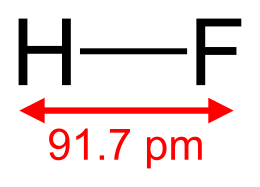
In the crystalline state, HF forms orthorhombic crystals consisting of chain-like structures: angle HFH = 116 °, d (FH) = 95 pm , d (F ••• H) = 155 pm. Similar zigzag
chains with an angle of HFH = 140 °) also have HF polymers existing in the gas phase.
Properties
Physical Properties
- The critical temperature of hydrogen fluoride is 188 ° C, the critical pressure is 64 atm.
- The heat of vaporization of liquid HF at the boiling point is only 7.5 kJ / mol (about 6 times less than that of water at 20 ° C). This is due to the fact that evaporation per se changes little the nature of the association of hydrogen fluoride (the dimeric form characteristic of a liquid is also retained in vapors , in contrast to the phase transition of water).
- The dielectric constant of liquid hydrogen fluoride (84 at 0 ° C) is very close to the value of d.p. for water.
Chemical Properties
- The chemical properties of HF depend on the presence of water. Dry hydrogen fluoride does not affect most metals and does not react with metal oxides. However, if the reaction begins, then it goes on for some time with autocatalysis , since as a result of the interaction, the amount of water increases:
- Liquid HF is a strong ionizing solvent . All electrolytes dissolved in it, with the exception of perchloric acid HClO 4 , are bases:
- In liquid hydrogen fluoride, acidic properties are exhibited by compounds which are acceptors of fluoride ions, for example, BF 3 , SbF 5 :
- Amphoteric compounds in liquid hydrogen fluoride are, for example, aluminum and chromium (III) fluorides:
-
- (AlF 3 - as an acid )
- (AlF 3 - as the base )
- (AlF 3 - as an acid )
-
- Hydrogen fluoride in a gaseous state and in the form of an aqueous solution reacts with silicon dioxide :
- Provided that the hydrogen fluoride is in a gaseous state:
- Provided that hydrogen fluoride in the form of an aqueous solution:
- Hydrogen fluoride is unlimitedly soluble in water, and ionization of HF molecules occurs:
-
- K d = 7.2⋅10 −4
- K d = 5.1
-
- An aqueous solution of hydrogen fluoride ( hydrofluoric acid ) is an acid of medium strength. Fluoride salts are called fluorides . Most of them are hardly soluble in water; only fluorides NH 4 , Na, K, Ag (I), Sn (II), Ni (II) and Mn (II) are well soluble. All salts of hydrofluoric acid are toxic.
Getting
Explosive fluorine interacts with hydrogen even at low temperatures and (unlike chlorine ) in the dark with the formation of hydrogen fluoride:
In industry, hydrogen fluoride is obtained by the interaction of fluorspar and strong non-volatile acids (for example, sulfuric ):
The process is carried out in steel furnaces at 120-300 ° C, in comparison with similar reactions to the production of other hydrogen halides, the reaction of obtaining hydrogen fluoride from fluorides is very slow. Parts of the plant used to absorb hydrogen fluoride are made from lead .
Safety
Hydrogen fluoride (hydrofluoride) has a pungent odor, is very toxic, smokes in the air (due to the formation of small droplets of solution with water vapor) and strongly corrodes the walls of the respiratory tract. Hydrogen fluoride has weak narcotic properties.
For more information on the toxicology of hydrogen fluoride, see Art. Hydrofluoric acid
Application
It is used to produce cryolite , fluoride derivatives of uranium , freons , organofluorine substances, opaque etching of silicate glass (hydrofluoric acid - for transparent etching). The unusual solubility of biological molecules in liquid hydrogen fluoride without decomposition (e.g. proteins) is used in biochemistry. The addition of fluorine acceptors to liquid hydrogen fluoride allows the creation of super acidic media .
Interesting Facts
- The famous science fiction writer Ivan Efremov wrote the novel “The Heart of a Snake” , in which he described the hypothetical life that has formed on the planet, where the main role in nature is played not by oxygen , but by fluorine , and instead of water, the planet’s surface is covered with oceans of hydrogen fluoride. A deep analogy between the properties of water and hydrogen fluoride led the writer to this idea.
- Hydrogen fluoride reacts with glass , so it is stored in plastic containers. When storing hydrogen fluoride in a glass dish, they resort to coating the glass with paraffin to protect it from hydrogen fluoride.
Notes
Literature
- Akhmetov N. S. "General and inorganic chemistry" M.: Higher school, 2001.
- Karapetyants M. Kh. , Drakin S. I. General and inorganic chemistry. M .: Chemistry, 1994.