Luis Walter Alvarez ( Eng. Luis Walter Alvarez ; June 13, 1911 , San Francisco - September 1, 1988 , Berkeley ) is an American experimental physicist . Member of the NAS of the USA (1947). Nobel Laureate (1968).
| Luis Walter Alvarez | |
|---|---|
| English Luis walter alvarez | |
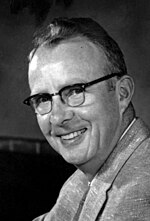 | |
| Date of Birth | |
| Place of Birth | San Francisco , California , USA |
| Date of death | |
| Place of death | Berkeley (California) , California , USA |
| A country | |
| Scientific field | physics |
| Place of work | University of California (since 1936) |
| Alma mater | University of Chicago |
| Academic degree | ( 1932 ), ( 1934 ) and ( 1936 ) |
| supervisor | |
| Known as | Manhattan Project Member discoverer of resonances and other elementary particles |
| Awards and prizes | John Scott Medal (1952) Einstein Prize (1961) US National Science Medal ( 1963 ) A. Michelson Prize (1965)  Nobel Prize in Physics ( 1968 ) Nobel Prize in Physics ( 1968 ) Enrico Fermi Award (1987) |
| Signature | |
Content
Biography
Luis Alvarez was born in San Francisco in the family of a professor at the University of California , a doctor and a journalist in the field of medicine, Walter Clement Alvarez . He studied at the University of Chicago , which he graduated in 1932. Since 1936 he worked at the University of California , since 1945 as a professor. At the same time in 1954-1959 and 1976-1978 he held the position of Deputy Director of the E. O. Lawrence Radiation Laboratory in Berkeley . In 1969, Alvarez was elected president of the American Physical Society .
Physics Research
Alvarez's scientific works are devoted to atomic and nuclear physics , accelerator technology , elementary particle and cosmic ray physics , optics , and radar . In 1937, he discovered a new type of radioactive transformation - the phenomenon of K-capture (capture by the nucleus of an electron from the K-layer ). In 1939, using the cyclotron as a high-frequency mass spectrometer , he discovered the He-3 helium isotope. Together with F. Bloch in 1940, Alvarez determined the magnetic moment of a free neutron . In the same year, for the first time, he managed to accelerate carbon ions , while at the same time offering an original speed selector for flight time.
During World War II, he participated in the development of a nuclear bomb (the " Manhattan Project "), and later investigated the consequences of its use in Hiroshima . After the war ended, in 1946, he built the first linear proton accelerator with drift tubes. Later, Alvarez created the first large bubble chamber and developed a modern technique for working with such devices, which made them suitable for the quantitative study of elementary particles . In particular, under his leadership, a hydrogen bubble chamber was realized and millions of images of particle interactions were obtained. As for the technique, on its basis, starting in 1955, a large cycle of studies was carried out, which led to the discovery in 1960 of short-lived unstable particles - the so-called resonances . This work in 1968 was awarded the Nobel Prize in Physics (“For the discovery of many resonant states made possible by the use of hydrogen bubble chambers and data analysis” [5] ).
Together with a large team of researchers in 1956, Alvarez discovered a new elementary particle - sigma-null-hyperon . In 1955-1956, he experimentally proved that tau and theta mesons have approximately equal masses and lifetimes, which indicates the identity of these particles. In 1956, Alvarez discovered an important phenomenon of muon catalysis , and in 1961 another particle, the omega meson .
Activities in other areas
Luis Alvarez stood out for the versatility of his interests. So, in 1965, he led an expedition to Egypt , which with the help of cosmic rays tried to find out if there were still no (hidden) rooms in the pyramid of Chefren in Giza . In 1980, he, along with his son Walter Alvarez , a geologist by profession, proposed the meteor hypothesis of the Late Cretaceous extinction (see Chicxulub Crater , as well as Dinosaur Extinction ). The basis of the hypothesis was the iridium anomalies discovered by them in marine sediments ( Cretaceous – Paleogene boundaries ).
Among other things, Alvarez proposed an original theory of the assassination of John F. Kennedy [6] .
Publications
- L. Alvarez. The current state of elementary particle physics (Nobel lecture) . - UFN , 1970, T. 100, No. 1.
Notes
- ↑ 1 2 Luis Alvarez - Facts - Nobelprize.org .
- ↑ Library of Congress Authorities - Library of Congress .
- ↑ SNAC - 2010.
- ↑ 1 2 3 http://www.nobelprize.org/nobel_prizes/physics/laureates/1968/alvarez-bio.html
- ↑ The Nobel Prize in Physics 1968. Luis Alvarez
- ↑ Alvarez, 1987 , p. 239-250.
Literature
- Hramov Yu. A. Alvarez Louis Walter // Physicists: Biographical Reference / Ed. A.I. Akhiezer . - Ed. 2nd, rev. and add. - M .: Nauka , 1983 .-- S. 12 .-- 400 p. - 200,000 copies. (in per.)
- Alvarez L. W. Alvarez: Adventures of a Physicist. - New York: Basic Books , 1987 .-- xii + 292 p. - ISBN 0-465-00115-7 .