Harriet Tubman (born Araminta Ross ); circa 1820, Dorchester County, Maryland - March 10, 1913 , Auburn , NY ) - American abolitionist , anti- slavery and social reform activist in the USA .
| Harriet tabman | |
|---|---|
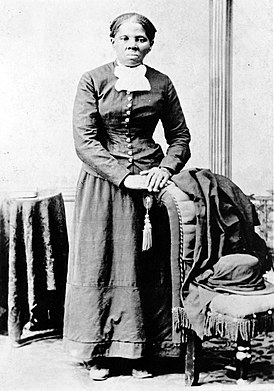 | |
| Birth name | |
| Date of Birth | |
| Place of Birth | |
| Date of death | |
| Place of death | |
| Citizenship |  USA USA |
| Occupation | , , , , |
| Spouse | |
| Awards and prizes | National Women's Hall of Fame ( 1973 ) [d] [d] |
| Autograph | |
Biography
Life in captivity
Araminta Ross was born into a family of slaves Harriet Green and Ben Ross and grew up on a farm in Dorchester County, Maryland. She was the eleventh child in the family. The exact date and place of birth is unknown. From the age of 7, she worked as a servant, doing various housework and looking after the host children on neighboring farms. Then she began to work on the plantation, like the rest of her relatives.
At the age of 13, she received a fatal blow to the head, which bothered her all her life and even provoked visions. She was in the store when a white overseer demanded her help in beating a runaway slave. When she refused and stood in the path of the overseer, he threw a two-pound weight in her head. Harriet nearly died from the blow. Recovery lasted for many months.
At 24, she married John Tabman, a free Negro. But when she started talking about the escape from slavery to the north, he did not even want to hear about it. He said that if she tried to escape, he would immediately extradite her. However, she was afraid that she would be sold into slavery further south, and when she finally decided to seek happiness and go north in 1849 , she did it herself (or rather, with her brothers Ben and Henry), without saying a word to her husband. The first attempt to escape ended in failure - the brothers who fled along with Tabmen forced her to return; the second attempt was successful.
Underground Rail
Having fled from captivity in Maryland to the North in September 1849, she worked as a maid in hotels and clubs, first in Philadelphia ( Pennsylvania ), and later in Cape May ( New Jersey ). When Harriet returned to her husband in 1851, she discovered that he had married another woman.
She also joined the abolitionist movement, spending most of her savings on the eradication of slavery. In December 1850, she helped her niece and her young children, who were about to be sold at auction, to flee. By this time, the Law on Runaway Slaves of 1850 had already been passed, which allowed the prosecution and detention of runaway slaves in territories where slavery had already been abolished, which made Tabmen's activities even more risky.
However, from that moment on, Harriet began making her journeys south to free the slaves. At this time, she actively participated in the activities of the Underground Railroad, which transported fugitive Negroes from the southern states to the North or to Canada . By the start of the Civil War, she freed her family, including most of her brothers and sisters.
When Harriet was only 30, she was already called " Moses " for her ability to save slaves. In total, in the 1850s, she made 19 trips to the South, personally freeing more than 300 slaves and inspiring thousands to flee. Slave owners promised a large monetary reward for the capture of the girl (up to 12 thousand dollars), but they could not grab either Harriet herself or her charges - in her own words, she did not have a single failure and she "did not lose a single person."
Her first biographer Sarah Hopkins Bradford quoted the following words of Tabmen: “For me there was only such a choice that I had the right to: freedom or death. The choice was only this: either freedom or death. And if I did not have freedom, then I would have had something else, that is, no one would have caught me alive. I will fight for my freedom until I have enough strength. I will fight for freedom, no matter what it costs me. ”
John Brown
In April 1858, she met another famous fighter against slavery, John Brown . She claimed that on the eve of Brown’s visit to her house, she had a prophetic vision in a dream. Brown highly appreciated the contribution of Harriet, considered her “better than all men that he had ever met” and addressed her only as “General Tabmen”. Harriet shared his opinion that the universal liberation of slaves is possible only by armed means.
Staying in touch with Brown, at a meeting in Canada in May 1858, she learned of his intention to occupy the federal arsenal in Harpers Ferry ( West Virginia ), after which she helped him recruit volunteers, weapons and money for this purpose and make a plan. Her knowledge of communications and supply networks in the states bordering Canada was invaluable to Brown.
It was assumed that Tabmen would help with Brown’s raid, but when in the fall of 1859 he and his people expected to start his speech, they could not contact Harriet. It is believed that she was unable to join the raid on October 16, 1859 due to a serious illness (according to a less common opinion, she shared the skepticism of the abolitionist Frederick Douglas regarding the validity of Brown’s plan or still recruited former slaves in the Canadian state of Ontario). After Brown's execution, Tabman said that "John Brown did not die on the gallows ... He was not a mortal man, the Lord was in him" and "with his death he did more than a hundred people with his life."
Civil War
During the Civil War of 1861 - 1865, Tabmen fought in the army of the northerners against the slave owners of the South . She was a nurse and scout . In the summer of 1863 she participated in a raid of a Negro partisan detachment, which freed 750 slaves.
She tried for a long time to beg for a military pension - $ 1800 as a late payment from the federal government, which refused to recognize her veteran status. When Harriet finally officially retired in 1899, she received the money not for her personal merits in the war, but as the widow of Nelson Davis, a civil war veteran whom she married in 1869.
Subsequent Life
After the war ended, Harriet Tabman lived for more than fifty years, during which she often had to feel the need, trying to feed her parents and numerous relatives, as well as a large number of homeless people who were seeking shelter and food at her farm in Obernai (New York State ), where she lived since 1857 . Despite this, she maintained two schools in the South for freed slaves. Harriet could open a house for the elderly in Oberna only after a long struggle with local bureaucrats in 1908 .
After the war, Harriet Tabman continued the struggle against oppression of African Americans and for equal rights for women. She participated in the suffrage movement along with Susan Anthony , giving lectures in New York, Washington and Boston, in which she spoke about her example and the contribution of other women to the victory as evidence of the equality of men and women. She was the main speaker at the first meeting of the Federation of African American Women in 1896 .
In 1869, her first biography, Scenes in the Life of Harriet Tubman , was published, written by Sarah Hopkins Bradford, who wrote children's books, taught Sunday school, raised money for the Harriet family, and read bible stories to her elderly parents. In subsequent editions, the name was changed to "Harriet Tubman - The Moses of Her People " ( Harriet Tubman: The Moses of Her People ).
At the beginning of the 20th century, the elderly Tabmen actively participated in the life of the African Methodist Episcopal Church of Zion.
Memory
On March 10, 1913, in Obernai, Harriet Tabman passed away, having died of pneumonia at the age of more than 90 years. A heroic woman was buried at Fort Hill Cemetery with military honors. A year later, at the direction of the city authorities, they opened a memorial plaque in memory of Harriet Tabmen.
In 2016, it was decided to place a portrait of Harriet Tabman on a 20-dollar bill instead of President Andrew Jackson , a former slave trader and proponent of a tough policy against the Native American Indian. The idea came from the initiative group Women on twenty-dollar bills ( Women On 20s ), whose goal in 2020 was to celebrate the centenary of granting women voting rights with a portrait of a woman on a dollar bill. Most of the participants in the Internet poll voted for Tabman, which allowed her to bypass the 14 remaining candidates, including Eleanor Roosevelt , Rosa Parks and the first Cherokee female leader Wilma Mankiller. It is noteworthy that on the banknote of twenty dollars there were already women: the goddess of Liberty in 1863 and Pocahontas in 1865. However, in 2019, a change in the design of the bill was postponed until at least 2028 [10] .
Notes
- ↑ Union List of Artist Names
- ↑ German National Library , Berlin State Library , Bavarian State Library , etc. Record # 119004682 // General regulatory control (GND) - 2012—2016.
- ↑ BNF ID : 2011 Open Data Platform .
- ↑ 1 2 SNAC - 2010.
- ↑ Encyclopædia Britannica
- ↑ FemBio
- ↑ Larson K. C. http://www.harriettubmanbiography.com/harriet-tubman-biography.html
- ↑ A century after Harriet Tubman died, scholars try to separate fact from fiction / M. Baron - Washington : Fred Ryan , 2013 .-- ISSN 0190-8286
- ↑ http://www.jstor.org/stable/2292932
- ↑ Higgins, Tucker. Harriet Tubman $ 20 bill no longer coming in 2020: Mnuchin says redesign postponed . CNBC (May 22, 2019). Date of treatment August 14, 2019.
Literature
- Conrad E. Harriet Tubman. Negro soldier and abolitionist. - N. Y. , 1942.