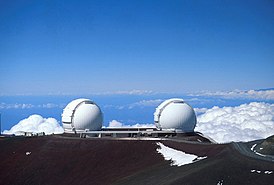
The Mauna Kea Observatory is an international project that includes a number of independent research centers; telescopes are located on the top of the Mauna Kea volcano at an altitude of 3730 m to 4190 m above sea level in the United States , on the island of Hawaii . The equipment of the observatory is located on an area of 212 hectares in the special use zone, also called the “astronomical site” and part of the Mauna Kea scientific reserve [1] . The astronomical site was created in 1967. It is located on land protected by the law on the conservation of historical monuments because of its great importance for Hawaiian culture. The observatory is managed and leased by the University of Hawaii .
| Mauna Kea Observatory | |
|---|---|
| The observatories at mauna kea | |
 | |
| Type of | astronomical observatory |
| The code | 568 ( observations ) |
| Location | Mauna Kea , Hawaii , USA |
| Coordinates | |
| Height | |
| opening date | 1956 |
| Website | |
| Instruments | |
| CSO | 10.4 m submillimeter |
| CFHT | 3.58 m Cassegrain |
| Gemini North | 8.1 m Cassegrain |
| IRTF | 3.0 m infrared |
| Jcmt | 15 m submillimeter |
| Subaru | 8.2 m optical |
| SMA | 8.2 m radio telescope |
| UKIRT | 3.8 m infrared |
| VLBA receiver | 25 m radio telescope |
| Kek | 2 × 10 m optical / infrared |
The location of the observatory is perfect for optical observations in the infrared and visible regions of the spectrum, since due to its isolation it has an extremely low level of light pollution . Observations of the sky are also favored by high astronomical visibility , low humidity , due to the location above most of the water vapor contained in the atmosphere, clean air, good weather and almost equatorial location [2] .
Content
- 1 History
- 1.1 Creation
- 1.2 Development
- 1.3 Earthquake in 2006
- 2 Management
- 3 Location
- 4 telescopes
- 5 Protests
- 6 See also
- 7 notes
- 8 References
History
Creation
After studying photographs taken during the Apollo space program , which contained much more details than any ground-based telescope, Gerard Kuiper began to search for an arid place for observations in the infrared spectrum [3] [4] . When he began his search in Chile , he also decided to test the Hawaiian Islands . The test results on the Haleakala volcano on the island of Maui were promising, but the mountain was located too low in the inverse layer and was often covered by clouds.
Kuiper began to consider the possibility of locating the observatory on the highest island mountain in the world - the Mauna Kea volcano on the island of Hawaii. Although the top of this volcano is often covered with snow, the air on it is extremely dry [3] . After testing, Kuiper found that low humidity conditions are ideal for receiving infrared signals. He convinced the Governor of the Hawaiian Islands, John Anthony Burns, to pave a dirt road to the top, where he built a small telescope on top of the slag cone of Puyu Poliahu ( Harbor Puʻu Poliʻahu ) [3] [5] [6] . This peak was the second highest point of the volcano. Its highest point was considered sacred land, so Kuiper did not build on it [7] . Then Kuiper tried to enlist NASA support to finance a larger facility with a large telescope, residential complex and other necessary buildings. NASA, in turn, decided to announce an open tender for construction. A professor at the University of Hawaii , physicist John Jefferis, has posted an application on behalf of the university. Jefferis gained fame for his observations at the Sacramento Peak Observatory . It was proposed the construction of a two-meter telescope to meet the needs of NASA and the university. And although large telescopes were not usually attributed to universities without reputable astronomers, Jefferies and the University of Hawaii won the NASA contract, infuriating Kuiper, who believed that “his mountain” was “stolen” from him [3] [10] .
Kuiper abandoned his place (the very first telescope on Mauna Kea) and competition and began working in Arizona on another NASA project. After major trials of the Jefferis team, it was found that the best places to observe are near the top at the top of the slag cone. The tests also found that Mauna Kea is excellent for nighttime observation due to many factors, including rarefied air, permanent trade winds and its location in the middle of the sea. Jefferis built a 2.24-meter telescope with the permission of the state of Hawaii to build a reliable all-weather road to the top. Construction began in 1967, and in 1970 the telescope began work [3] .
Development
Other research groups began to request permission to sublease land at an accessible peak. By 1970, the US Air Force and Lowell Observatory had built two 0.6-meter telescopes. In 1973, Canada and France agreed to build a 3.6-meter CFHT telescope on Mauna Kea [11] . However, local organizations began to show concern about the environmental impact of the observatory. As a result, the Department of Land and Natural Resources prepared the initial plan in 1977, which was supplemented in 1980. In January 1982, the Board of Trustees of the University of Hawaii approved a plan to support the further development of scientific facilities at this location [12] . In 1998, an 823-hectare site belonging to the observatory was transferred to the Mauna Kea Ice Age Reserve . The 1982 plan in 2000 was supplemented by an application providing service until 2020: in accordance with it, the Office of Mauna Kea Management was established [13] , 212 hectares were allocated for astronomical research, and the remaining 4,356 hectares were transferred to "preserve nature and culture." This plan was then revised to reassure Hawaiian society, which believed that the mountain, which is of great cultural value to the Hawaiians, was not properly respected [12] .
As of 2012, there are 13 different observation devices on the territory of the Mauna Kea Science Reserve, funded by 11 countries. This is one of the best optical, infrared and submillimeter observatories in the world [14] . 9 of its telescopes operate in the visible and infrared ranges, 3 in the submillimeter range, and one in the radio range. The sizes of telescope mirrors range from 0.9 to 25 meters [15] (for comparison, the Hubble Space Telescope has a 2.4-meter mirror - a mirror of the same size is used in the penultimate dimensions telescope at Mauna Kea UH88 [15] ). The planned construction of new telescopes, including the thirty-meter telescope (TMT) , caused controversy because of their potential cultural and environmental impact [16] [17] . The increase in the number of telescopes at the Keck Observatory , which required more space, was ultimately canceled [18] . Three or four of the 13 existing telescopes should be dismantled over the next decade to make way for the thirty meter telescope. This will be the last place on Mauna Kea on which the telescope will be built [19] .
2006 Earthquake
On October 15, 2006, near the observatory, an earthquake occurred . Tremors led to minor damage to several telescopes at the observatory. The JCMT telescope measured its deviation from the gravitational field of the earth and recorded an earthquake with its tilt sensors [20] . The CFHT telescopes and the Keck Observatory suspended operations until October 19 [21] [22] .
Management
In 1968, the Mauna Kea Nature Reserve was established and leased by the Hawaii State Land and Natural Resources Administration [23] . The University of Hawaii manages this place [23] and leases it to several international projects that have already invested more than $ 2 billion in science and technology [1] . After the lease period ends in 2033, 40–45 square kilometers of land will be returned to the state of Hawaii [19] .
Location
The high altitude and isolated location in the center of the Pacific Ocean makes Mauna Kea one of the best places on Earth for astronomical observations, especially in the submillimeter, infrared and visible ranges. Available statistics show that Mauna Kea is the best place in terms of the quality of the received optical and infrared images.
The living quarters for astronomers doing research at the observatory are located at the Onizuki International Astronomical Center , also called Hale Pōhaku (from Hawaiian - “stone house”), which is connected to the top of a steep 11-kilometer dirt road and is located at an altitude of 2800 meters above sea level.
The station for visitors is located at an altitude of 2800 meters. Mount Mauna Kea is so high that tourists are advised to stop at the station for visitors for at least 30 minutes to get used to the atmospheric conditions before moving on. Scientists often stay at Hale Pōhaku for 8 hours or more before spending the whole night at the top observatories. Working with some telescopes requires researchers to spend the whole night at Hale Pōhaku before working on top.
Telescopes
Telescopes located on top of Mauna Kea are funded by government agencies in various countries. The University of Hawaii directly operates two telescopes. The 12 buildings in the observatory include 13 telescopes [24] located around the top of Mauna Kea:
- California Institute of Technology (CSO) Submillimeter Observatory : California Institute of Technology - closed in 2015
- Canada-France-Hawaii Telescope : Canada, France, University of Hawaii
- Gemini Observatory : USA , UK , Canada, Chile , Australia , Argentina , Brazil
- IRTF Telescope : NASA
- James Clark Maxwell Telescope (JCMT): China , Japan , South Korea , Taiwan , UK, Canada
- Subaru Telescope : Japan National Astronomical Observatory
- Submillimeter Antenna System (SMA): Taiwan, USA
- British infrared telescope (UKIRT): Lockheed Martin Advanced Technology Center, University of Hawaii, University of Arizona
- University of Hawaii 88-inch Telescope (UH88) : University of Hawaii
- 36-inch telescope from the University of Hawaii (Hoku Kea) : University of Hawaii at Hilo
- One of the VLBA receivers: USA
- Keck Observatory : California Association of Astronomical Research
There is also a space reserved for the construction of the Thirty-Meter Telescope and a proposed space for telescopes of the Pan-STARRS system . UKIRT and UH88 telescopes are planned to be decommissioned [25] .
Protests
The enthusiasm of the governor and lawmakers of the state of Hawaii with the development of the observatory and the allocation of ever larger areas for it, provoked protests in the city of Hilo on the island of Hawaii. Indigenous Hawaiians believed that the place where the observatory is located was sacred and that the development of the mountain, even for scientific purposes, would desecrate this place. Ecologists were worried about the population of rare local birds, and the residents of Hilo were looking at the domes of telescopes from the city. At meetings at City Hall, Jefferis took over the opponents of the observatory, emphasizing the economic advantages and prestige that the island will receive [3] . Nevertheless, the number of opponents of the observatory continued to grow [26] . Over the years, the confrontation with the observatory has been one of the most obvious examples of conflicts that science has encountered when using environmentally and culturally significant objects [27] . Shortly after the start of the expansion of observatories, the number of opponents of development increased. As soon as access to the top of the road was open, it began to be used by vacationing skiers who objected to its closure during the construction of telescopes to prevent vandalism. The hunters and the National Audubon Society , supported by Governor George Arioshi, were also concerned about the situation [7] .
The Audubon society protested against the further expansion of the observatory towards the habitat of the endangered palilla - an endemic living in some areas on the mountain. More than half of the species of native birds disappeared due to habitat reduction during the arrival of early settlers from the west or the introduction of new species from other places competing with local ones for resources. Hunters and athletes were concerned that the use of telescopes would affect wildlife hunting [28] . The Mauna Kea Conservation Movement, caused by the spread of telescopes, was convinced that the further development of the observatory was blasphemous [29] . Non-profit organizations of indigenous Hawaiians, such as Kahea, set themselves the goal of protecting the cultural heritage and the environment, and opposing the development of the Mauna Kea Observatory due to the fact that this place is sacred in the traditional Hawaiian religion [30] . Today, the Mauna Kea Observatory is the world's largest telescope observatory in infrared and submillimeter astronomy. Due to its important role in Hawaiian culture, the observatory’s land is protected by US law on the conservation of historical monuments, but the observatory is still allowed to develop [31] .
See also
- Reflector (telescope)
- Paranal Observatory
- La Silla Observatory
- Inter-American Observatory Cerro Tololo
- Very Large Telescope
- European extremely large telescope
Notes
- ↑ 1 2 The Economic Impact of Astronomy in Hawai'i . University of Hawaii Economic Research Organization (August 28, 2014). Date of treatment July 14, 2015.
- ↑ About Mauna Kea Observatories
- ↑ 1 2 3 4 5 6 7 JB Zirker. An Acre of Glass: A History and Forecast of the Telescope . - JHU Press, October 18, 2005. - P. 89–95. - ISBN 978-0-8018-8234-0 .
- ↑ Educational Foundation for Nuclear Science, Inc. Bulletin of the Atomic Scientists . - Educational Foundation for Nuclear Science, Inc., November 1964. - P. 35.
- ↑ David Yount. Who Runs the University ?: The Politics of Higher Education in Hawaii, 1985-1992 . - University of Hawaii Press, 1 January 1996. - P. 232. - ISBN 978-0-8248-1821-0 .
- ↑ Astronomy Now . - Intra Press, 1991 .-- P. 45.
- ↑ 1 2 Barry R. PARKER. Stairway to the Stars: The Story of the World's Largest Observatory . - Springer, November 11, 2013 .-- ISBN 978-1-4899-6052-8 .
- ↑ David Leverington. A History of Astronomy: from 1890 to the Present . - Springer Science & Business Media, December 6, 2012 .-- P. 276. - ISBN 978-1-4471-2124-4 .
- ↑ Måalamalama: A History of the University of Hawaiʻi . - University of Hawaii Press, January 1998. - P. 210–211. - ISBN 978-0-8248-2006-0 .
- ↑ Joseph N. Tatarewicz. Space Technology & Planetary Astronomy . - Indiana University Press, 1990. - P. 82. - ISBN 0-253-35655-5 .
- ↑ Pickles, Andrew Timeline of Astronomy in Hawaiʻi (Link not available) . Mauna Kea Observatories Outreach Committee (2003). Date of treatment October 2, 2010. Archived July 27, 2011.
- ↑ 1 2 University of Hawaii . Mauna Kea Comprehensive Management Plan: UH Management Areas (PDF) (link not available) . Hawai`i State Department of Land and Natural Resources (January 2009). Date of treatment August 19, 2010. Archived March 4, 2016.
- ↑ Mauna Kea Science Reserve Astronomy Development Plan 2000–2020 - Summary (PDF). en: Institute for Astronomy - University of Hawaii (August 1999). Date of treatment August 19, 2010. Archived August 21, 2010.
- ↑ University of Hawai`i. Mauna Kea Comprehensive Management Plan (Link unavailable) 6–1. Hawai`i State Department of Land and Natural Resources (January 2009). Date of treatment January 18, 2012. Archived March 4, 2016.
- ↑ 1 2 Mauna Kea Telescopes . en: Institute for Astronomy - University of Hawaii . Date of treatment August 29, 2010.
- ↑ Thirty Meter Telescope Selects Mauna Kea (link not available) . Press release . California Institute of Technology , University of California , and the Association of Canadian Universities for Research in Astronomy (August 21, 2009). Date of treatment August 29, 2010. Archived August 10, 2010.
- ↑ University of Hawaii Develop New Telescope for "Killer" Asteroid Search (inaccessible link) . Press release . en: Institute for Astronomy - University of Hawaii (October 8, 2002). Date of treatment November 22, 2017. Archived March 23, 2016.
- ↑ Ruling could block Mauna Kea projects (August 8, 2006). Date of treatment November 4, 2010.
- ↑ 1 2 Hawaii prunes Mauna Kea telescope hub: Nature News & Comment
- ↑ Davis, Gary News from the JCMT . Canadian Astronomical Society (2007). Дата обращения 14 июля 2015.
- ↑ 2006 October 15 Earthquake Aftermath at CFHT . Canada–France–Hawaiʻi Telescope (January 11, 2007). Дата обращения 27 августа 2010.
- ↑ Earthquake Update from WM Keck Observatory . WM Keck Observatory. Дата обращения 27 августа 2010.
- ↑ 1 2 History . Office of Mauna Kea Management. Дата обращения 2 февраля 2015.
- ↑ Mauna Kea Observatories . Maunakea Telescopes . University of Hawaii Institute of Astronomy. Date of treatment December 3, 2015.
- ↑ Third Maunakea observatory set for decommissioning . University of Hawaii News . University of Hawaii. Date of treatment December 3, 2015.
- ↑ Terry D. Oswalt. The Future of Small Telescopes in the New Millennium . — Springer Science & Business Media, 2003. — P. 18. — ISBN 978-94-010-0253-0 .
- ↑ GeoHumanities: Art, History, Text at the Edge of Place . — Routledge, 13 April 2011. — P. 476. — ISBN 978-1-136-88347-7 .
- ↑ Mark Gordon. Recollections of "Tucson Operations": The Millimeter-Wave Observatory of the National Radio Astronomy Observatory . — Springer Science & Business Media, 18 July 2007. — P. 136–140. — ISBN 978-1-4020-3236-3 .
- ↑ Robert F. Oaks. Hawaii:: A History of the Big Island . — Arcadia Publishing, 1 November 2003. — P. 131. — ISBN 978-1-4396-1403-7 .
- ↑ Ned Kaufman. Place, Race, and Story: Essays on the Past and Future of Historic Preservation . — Routledge, 11 September 2009. — P. 14. — ISBN 978-1-135-88972-2 .
- ↑ Judith Schachter. The Legacies of a Hawaiian Generation: From Territorial Subject to American Citizen . — Berghahn Books, 15 September 2013. — P. 43. — ISBN 978-1-78238-012-2 .
Links
- Mauna Kea Observatory web page (англ.)
- Mauna Kea webcams (англ.)
- Weather forecast for Mauna Kea summit (англ.)
- Office of Mauna Kea Management (англ.)