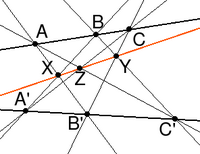
Papp's theorem is a classical theorem of projective geometry . It is formulated as follows:
Let A , B , C be three points on one line, A ' , B' , C ' be three points on another line. Let three lines AB ' , BC' , CA ' intersect three lines A'B , B'C , C'A , respectively, at points X , Y , Z. Then the points X , Y , Z lie on the same line. |
It is easy to see that the dual formulation to Papp's theorem is only a reformulation of the theorem itself:
Let the lines pass through point A, pass through point A '. crosses and at points B and C, crosses and at points C 'and Z, crosses and at points B 'and X. Then the lines BC', B'C and XZ intersect at one point (point Y in the drawing) or parallel. |


Pappa's theorem is a degenerate case in Pascal's theorem : if, in Pascal's theorem, the hexagon inscribed in a conic is replaced by an inscribed in a pair of intersecting lines, then it becomes equivalent to Pappa's theorem. Pascal himself considered a pair of lines to be a conic section (that is, he considered Papp's theorem a special case of his theorem).
Content
History
The statement and proof of this theorem are contained in the "Mathematical Collection" of Papp of Alexandria (beginning of the 4th century A.D.). In modern times, the theorem was published by the publisher and commentator on Papp Federico Commandino in 1566 .
Evidence
Proof by removing points to infinity
Let the point is the intersection point of the lines on which the points lie , , and , , .
Consider the intersection of lines:
Now apply the projective mapping that translates the line to infinity. Then .
Because : . Now it is necessary to prove that .
Consider these triangles.
It follows that (by the second sign of the similarity of triangles ) .
Q.E.D.
Proof through Menelaus theorem
Applying to Triangles , and Menelaus theorem , one can also prove this statement.
See also
- Pappe's area theorem
Links
- R. Courant, G. Robbins, What is Mathematics? Chapter IV, § 5.3.