Candidu Portinari ( port. Candido Portinari , December 29, 1903 , Brodowski , Sao Paulo - February 6, 1962 , Rio de Janeiro ) - the largest [4] Brazilian artist of the XX century.
| Candidu Portinari | ||
|---|---|---|
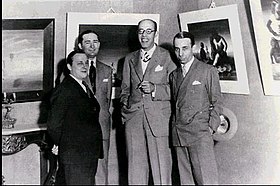 Candida Portinari (left), along with Antonio Bento , Mario de Andrade and Rodrigue Melu Franco , 1936 | ||
| Birth name | port. Candido portinari | |
| Date of Birth | ||
| Place of Birth | Brodowski , Sao Paulo | |
| Date of death | ||
| Place of death | Rio de Janeiro | |
| Citizenship |  Brazil Brazil | |
| Style | modernism | |
| Awards |
| |

 | ... people like Orozco , Rivera , Portinari, Tamayo and Guayasamin are like the peaks of the Andes ... Pablo Neruda |  |
Content
Biography
Childhood and Education
Candidu Portinari was born on December 30, 1903 on the Fazenda Santa Rosa coffee plantation near Sao Paulo , the second of twelve children in the family. Parents, Batista Portinari and Dominga Torquato, emigrated to Brazil from the Italian region of Venice at the end of the 19th century . In 1906, parents left the coffee plantation and engaged in petty trade in the neighboring village, now the city of Brodowski . Candido Portinari attended elementary school in Brodowski from 1911 to 1916 , but discontinued classes after third grade. At ten years old, he painted his first painting, and in 1918, together with a school friend, he joined a group of wandering artists and sculptors of Italian origin, who made money by painting churches in Brazilian cities. Vitorio Gregolini, one of the artists in the group, became his first painting teacher.
In 1919, he settled with relatives in Rio de Janeiro, earns a living by odd jobs. I tried to enter the National School of Fine Arts ( port. Escola National de Belas Artes ), but the competition does not pass. In 1920, he still manages to go to school, the only educational institution in Brazil where formal teaching of art and architecture was conducted. He attended art school until 1928 . He studied under Lucilio de Albuquerque , then under Juan Batista da Costa . In November 1922, he first participated in the school's annual exhibition (salon), his work was noted, but did not receive a prize; in subsequent years he received prizes and medals. While studying at school, Portinari is forced to work, first in a bookstore, then as editor of the journal “Revista Academica”, published by the medical faculty of the university. Since 1924, he is regularly mentioned in the press. In 1928 he received the prize of the annual salon for the painting "Portrait of Olegariu Mariana". The prize was a paid trip to Europe.
In May 1929, the first solo exhibition of Portinari was held in Rio de Janeiro, in which 25 of his portraits were exhibited. In June he sailed to Europe, where he remained until 1931 , living in Paris and visiting London , Lourdes , Spain ( Madrid , Toledo and Seville ) and Italy ( Pisa and Florence ). In Paris, he met Uruguayan Maria Victoria Martinelli, who remained his companion until the end of his life. In January 1931, Portinari returned with her to Brazil. During his stay in Paris, Portinari's efforts were mainly aimed at studying Western painting and visiting museums, during which he created very few works. After arriving in Brazil, he works a lot, trying to compensate for this by creating new paintings.
1931-1945
After returning, Portinari settled in Rio de Janeiro, in the Lapa region, at that time bohemian and artistic. Every year until 1936, his personal exhibitions were held at the Palace Hotel, organized by the Association of Brazilian Artists. In 1931, he joined the commission for the reform of art education at the School of Fine Arts, which abolished, in particular, the strict selection criteria, so that representatives of different artistic movements gained access to education. A year later, at the request of the teachers of the School, the commission was disbanded.
In December 1934, a large solo exhibition was held in Portinari in São Paulo , and one of his paintings was acquired by the State Museum of São Paulo ( port of Pinacoteca do Estado de Sao-Paolo ), which was his first painting bought by the state museum. In July 1935, Candida Portinari began teaching at the newly created University of the Federal District (now the University of Rio de Janeiro ), which was taught by the best specialists from all over the country. In the same year, his work “Coffee” was selected for the international exhibition in Pittsburgh , organized by the Carnegie Endowment (Brazil represented eight artists, a total of 21 countries were represented at the exhibition). The painting received a second prize and was purchased by the Ministry of Education for the Museum of Fine Arts in Rio de Janeiro .
Since 1936 , Portinari began to receive government orders. He completed four panels for the Highway Monument, located on the highway between Rio de Janeiro and Sao Paulo. At the end of the year, the new Minister of Education of Brazil, Gustavo Capanema , invited Portinari to carry out murals in the building of the Ministry, which was commissioned by a group of architects, including Oscar Niemeyer, under the general supervision of Lucio Costa . Portinari decided to make them in the form of a fresco . This technique has never been used in Brazil before. The frescoes were completed in 1944 and are considered the pinnacle of Portinari's work. However, the artist was criticized for having supported the dictatorial regime of President Zhetuliu Vargas by frescoing . In 1939, he performed three paintings for the Brazilian pavilion at the World Exhibition in New York .
In 1939, Portinari's only son, Juan Candidou, was born, the dictator of Brazil, Jetulio Vargas, dismissed the University of the Federal District, and in November at the Museum of Fine Arts in Rio de Janeiro, a personal exhibition of the artist was held, where 269 paintings were exhibited. In 1940, the entire issue of the authoritative literary journal Revista Academica was dedicated to Candid Portinari and consisted of more than forty articles about the artist. In August 1940, a personal exhibition of the artist was held at the Institute of Arts in Detroit , one of the leading American art museums, and from September to November, Portinari and his family were in the United States on the occasion of another personal exhibition of the artist in New York. At the beginning of 1941, a well-published book about Portinari was published at the University of Chicago publishing house, with more than a hundred illustrations of his work.
From July 1941 to December 1942, Candidu Portinari worked on the murals of the building of the Library of Congress in Washington . In February, he returned to Brazil and spent three months with his parents in Brodsky, where he completed the painting for the church altar. Immediately after that, he writes a series of paintings on biblical subjects for the Radio Tupi building in São Paulo. In the paintings, the obvious influence of “ Guernica ” by Picasso , which he saw a few months earlier in New York, can be traced. In June 1943 , a large Portinari exhibition was again held at the Museum of Fine Arts in Rio de Janeiro, and in October 1944 another exhibition opened in Washington.
In June 1945, Portinari painted the church of St. Francis of Assisi , designed by Oscar Niemeyer in Pampulie , Belo Horizonte district. The unconventional architecture and murals of the church caused a protest, and the church was consecrated only after 15 years.
1945-1957
At the end of 1945, Candidu Portinari participated in the Senate elections on the list from the Communist Party , but was not elected. Brazil had just freed itself from the dictatorship of Vargas, and the sympathies of left-wing intellectuals for the Communists were commonplace. Portinari remained a member of the Communist Party until the end of his life, although in the late 1950s he did not take an active part in its activities. He spent almost the whole of 1946 , from February to November, in Paris, where his exhibition was held, and where he received the Order of the Legion of Honor . Upon returning to Brazil, he again joined the election campaign as a Communist candidate for the Senate. In particular, he traveled to most of the state of Sao Paulo , from which he ran, participated in rallies. He was not elected again, and in May 1947 the Communist Party of Brazil was banned. Portinari was called to the police to testify. The exhibition in the USA this year was the last before a break of 12 years, since in the political climate of the USA of the 1950s it was practically impossible to hold an exhibition of a communist artist. From May to September, Portinari held his exhibitions in Argentina and Uruguay , then returned to Rio de Janeiro for a short time, but in November, alone (without a family) went to voluntary exile in Montevideo due to increased persecution of former communists by the government . In June 1948 he returned to Brazil.
In 1949, he was unable to travel to the United States (visa denial) and to Mexico, but in November went to France, then to Italy, and in June 1950 participated in the Venice Biennale with six paintings, but the works were coldly received by critics and did not receive prizes. In December 1949, the book of Portugari in Montevideo by Uruguayan poet Sipriano Vitureira was published. In November 1950, Portinari returned to Brazil. In 1951, a monograph on the artist edited by Eugenio Luragi was published in Milan. In October 1952, he received an order to execute two panels for one of the halls of the UN headquarters under construction in New York (the contract was signed only in 1955 , the panels were finished in 1956, the artist was in Brazil all this time); in the same month he completed a poster for the World Peace Congress in Vienna. In 1952, he worked on the murals of the church in Batatais near Brodowski, the murals were discovered in March 1953 . In April, he first underwent surgery; health problems that arose for the first time were associated with the use of a certain type of paint.
In 1953, for the first time in ten years, a personal exhibition of Portinari is held in Rio de Janeiro, in 1954 - in Sao Paulo. In the summer, on the recommendation of doctors, Candidu Portinari stopped painting for some time. He endured it very hard, writing once “They forbade me to live ...”
In February 1956, panels made for the UN were shown at an exhibition in Rio de Janeiro, which was opened by Brazilian President Juscelina Kubitschek , and attracted great public attention. In April, Portinari again sailed to Europe, then to Israel at the invitation of the government, where his exhibition was held in four cities. A large number of sketches made in Israel, served as the basis for the so-called Israeli cycle, which the artist began to work on after returning to Brazil in the same year.
On September 6, 1957, panels for the UN headquarters building were solemnly presented to the public in New York. The artist himself was not invited to the opening ceremony because of his leftist views.
In November 1957, the artist began to write an autobiography, which in one form or another was occupied until his death.
Recent years
In April 1958, the exhibition "50 Years of Contemporary Art" opened in Brussels . One of Portinari’s paintings, Enterro na rede, was selected to participate in the exhibition as one of the hundred best paintings of the 20th century. In July, he was invited to Mexico as a jury member of the first All-American Exhibition of Painting and Graphics. In addition, he became the only artist whose works (39) were exhibited in a separate room at the exhibition.
In 1960, Portinari and Maria Martinelli separated after 30 years of marriage. Her presence has always had a strong influence on the artist, and after a divorce, he falls into prostration. In addition, in April of that year, the government was relocated to the new capital, Brasilia , built several years before. All the major artists of the country took part in the design of the buildings, but Portinari only created a sketch of one of the panels of the chapel in the palace of Alvorad. The sketch, exhibited in 1958 , was subjected to devastating criticism, and the artist never completed the panel, thereby not taking part in the design of the new capital. This in no way improved his morale.
On May 6, 1960, the granddaughter of the artist Denise was born, which became one of the central themes of his late work. In less than two years remaining, he painted at least 16 portraits of her and a large number of poems.
In August 1960, Portinari received a telegram from Mexico from his wife, David Siqueiros , who was imprisoned for propaganda of leftist views, asking for intervention. Portinari immediately sent a telegram to Mexican President Adolfo Lopez Mateos requesting the release of the artist.
In the fall of 1961, the artist completed his last three paintings, after which he went to France, together with Maria, with whom they lived separately for more than a year. One of the goals of the trip was to visit his son living in France. Upon arrival in Le Havre, Portinari was informed that he was forbidden to enter France as a persona non grata . Apparently, this was due to his sharp criticism of the French policy in Tunisia . After negotiations, he still managed to get a temporary visa for 60 days. As a condition, he agreed not to make political statements while in the country.
On December 12, 1961, Portinari returned to Rio de Janeiro and finally parted with his wife.
In 1961, the symptoms of lead poisoning returned to him, which at the beginning of 1962 were so intensified that he could not work. Candidu Portinari died on February 6, 1962. He was buried in the cemetery of St. John the Baptist in Rio de Janeiro .
The Brazilian government expressed condolences, and the state of Guanabara (actually the city of Rio de Janeiro) declared a three-day mourning.
Creativity
Portinari received a classical art education at the art school, and during his two-year stay in Europe, he met both the great masters of the past ( Giotto and Piero della Francesca [5] and contemporary French artists, including Matisse and van Dongen : After returning to Brazil, he developed his own style closest to Mexican artists David Siqueiros and Diego Rivera . or otherwise associated with Brazil or Latin America.
Portinari represented figurative art at a time when abstract painting completely dominated. In pre-war paintings, such as "Coffee", the artist depicts deformed human figures, uses colors. After the outbreak of the war, his style changed under the strong influence of “Guernica” by Picasso . Color occupies a minimal place in the post-war work of the artist, many paintings are designed in gray tones. (The murals of the church of Francis of Assisi in Pampulha are also monochrome, but executed in blue).
Portinari is also known as an illustrator who has completed illustrations for more than a dozen books. So, in 1944, the book of the classic of Brazilian literature by Machado de Assis, “Posthumous Notes of Bras Cubas” with 88 illustrations by the artist , was published.
The memory of the artist
Candidu Portinari House Museum is open in Brodowski .
The artist’s name is the highway ( port. Rodovia Candido Portinari ), connecting the cities of Ribeiran Preto and Franca . The road passes through Brodowski and Batatais .
Portinari named streets in many cities in Brazil. In Sao Paulo there is Avenida Candida Portinari.
Rewards
He was awarded the Brazilian Order of Cultural Merit .
Notes
- ↑ 1 2 Benezit Dictionary of Artists - 2006. - ISBN 978-0-19-977378-7 , 978-0-19-989991-3
- ↑ BNF ID : 2011 Open Data Platform .
- ↑ SNAC - 2010.
- ↑ Geraldo Edson de Andrade, Depois da Semana de 22. A busca da identidade , in the book: Historia da Pintura no Brasil, ed. Raul Mendes Silva, Rumo Certo (Rio de Janeiro, 2007) ISBN 978-85-98793-04-7 , p. 137
- ↑ Cristina Vaz, Candido Portinari Archived on November 19, 2006.
Links
- Projeto Portinari (English) , (port.) - a project for the centenary of the artist.
- Portinari House Museum in Brodowski (port)