Lily of the valley ( Latin Convallária majális ) is a species of herbaceous flowering plants , common in regions with a temperate climate of the Northern Hemisphere . According to traditional ideas, it is the only species of the genus Lily of the valley ( Convallaria ); at the same time, three subspecies considered within the lily of the valley in May are sometimes distinguished into separate species [2] .
| May lily of the valley | |||||||||||||||||||||||
 | |||||||||||||||||||||||
| Scientific classification | |||||||||||||||||||||||
|---|---|---|---|---|---|---|---|---|---|---|---|---|---|---|---|---|---|---|---|---|---|---|---|
| |||||||||||||||||||||||
| International scientific name | |||||||||||||||||||||||
Convallaria majalis L. , 1753 | |||||||||||||||||||||||
| Area | |||||||||||||||||||||||
| |||||||||||||||||||||||
Content
Distribution and habitat
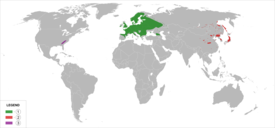
The range of the species (including populations of Keyske lily of the valley and mountain lily of the valley ) covers the whole of Europe , the Caucasus , Asia Minor , China , as well as North America .
In Russia - in the European part , Transbaikalia , Amur Region , Primorye , Sakhalin and the Kuril Islands .
Lily of the valley grows in deciduous and pine , as well as in mixed forests , at the edges and glades . It develops especially well in floodplain oak forests , on rich soil with good moisture and a neutral reaction [3] .
In pristine habitats, it grows very widely, creating significant curtains. The yield of dry shoots in communities where lily of the valley prevails (in complex pine forests, oak forests and aspen forests of lily of the valley) is 6–30 kg / ha [3] . Shade tolerant plant.
Lily of the valley has been cultivated for a long time, varieties with larger as well as double flowers, with a pinkish halo and other features have been obtained.
- Security status
In natural habitats, lily of the valley is intensively destroyed, especially near large settlements, due to trampling during the collection of flowers and medicinal raw materials .
Botanical Description
Perennial herbaceous plant 15-30 cm tall. The underground rhizome is horizontal creeping, not thicker than a goose feather , bearing near the apex several pale small lower leaves, half-hidden in the ground. The roots are small, numerous, fibrous.
Overhead shoots shortened. Bottom leaves are followed by two (rarely three) large, perfectly whole broad-lanceolate (or oblong-elliptic) pointed root leaves , between which there is a large kidney at the top of the rhizome. A flower-bearing stalk emerges from the corner of the grassroots leaf, grasping both green ones from below, bearing a brush of 6–20 flowers, turned mainly in one direction. The flower-bearing stalk is leafless or carries leaves only under an inflorescence; rarely with threadlike leaves. Fragrant flowers gracefully wilted. Flowering time - from May to June.
Long curved pedicels - with membranous bracts . The flowers have a simple spherical leafy rounded bell perianth 4–9 mm long and 3–7 mm wide, white (less often pale pink) in color, with six bent lobes. There are six stamens ; they are with thick and short threads attached to the base of the perianth. The ovary is round, ending with a short column and a small stigma [4] . The inflorescence has been formed in the kidney since the summer of the previous year [3] .
Flower formula : [5] .
The fruit is an orange-red spherical berry of 6-8 mm in diameter, containing one or two almost spherical seeds . Berries are stored on the plant for a long time. Fruiting in June - early July.
Propagated both by seeds and vegetatively by rhizomes. When developing from seeds, it blooms in nature in the seventh year of life [3] .
The following year, the apical bud continues to be a rhizome and again brings two (with the exception of three) large leaves, but the stalk rarely appears annually.
From left to right: young plants (Germany); curtain of lilies of the valley in oak grove (France); berries | ||||||||||
Taxonomy
Convallaria majalis L. , 1753, Species plantarum 1: 314-315 [6] .
Traditionally, the species is considered as the only one in the genus of lilies of the valley. Species , which are sometimes distinguished as independent species, have a geographical isolation from the nominal variety, while their morphological features are weakly expressed [4] .
Synonyms
- Convallaria bracteata Dulac nom. illeg.
- Convallaria fragrans Salisb. nom. illeg.
- Convallaria latifolia Mill.
- Convallaria linnaei Gaertn.
- Convallaria mappii CCGmel.
- Convallaria scaposa gilib. nom. inval.
- Convallaria transcaucasica Utkin ex Grossh.
- Lilium convallium Garsault nom. inval.
- Lilium-convallium majale (L.) Moench
- Polygonatum majale (L.) All.
Varieties
- Convallaria majalis L. var. keiskei ( Miq. ) Makino - Keyske Lily of the Valley [ syn. Convallaria keiskei Miq. - Lily of the valley Keyske]. It grows in the Far East , in Transbaikalia and Mongolia , as well as in Myanmar [7] . It differs in large ( up to 15 cm ) dark green leaves, large flowers and late flowering.
- Convallaria majalis L. var. majalis . A variety common in Europe and the Caucasus [7] .
- Convallaria majalis L. var. transcaucasica ( Utkin ex Grossh. ) Knorring - May Transcaucasian Lily of the valley [ syn. Convallaria transcaucasica Utkin ex Grossh. - Lily of the valley Transcaucasian]. North Caucasus and Transcaucasia , Turkey [7] .
- Convallaria majalis L. var. montana ( Raf. ) HEAhles - Mountain lily of the valley [ syn. Convallaria montana raf. - Lily of the valley]. East of the United States ( English American lily-of-the-valley ). American botanists [8] distinguish it into another independent species, Convallaria majuscula Greene , which has a limited range in the United States and the status of “endangered” in Kentucky [9] .
Toxicity
The whole lily of the valley plant is poisonous, it contains konvallatoksin .
Cultivation
Lilies of the valley are propagated mainly by cuttings . To do this, cut off the upper part of the rhizome and plant it in clay-sandy soil rich in leaf humus , at a distance of 20-25 cm from each other.
For distillation , stocks of cuttings are stored in the fall, cutting off the upper parts of the rhizome about 5 cm long. Choose those in which the apical kidney is large and round. Such cuttings are planted in spacious pots, 10 or 12 each. Actually, very low greenhouses are built for distillation, in which pots with lilies of the valley are introduced. Pots are covered with moss or buried in the sand almost completely; the surface of the pots is also covered with moss.
The temperature in the greenhouse during distillation must be maintained between 30 and even 35 ° C. After three weeks, the plants begin to bloom. Moss must always be kept moist. When plants appear from moss, the pots are put into the light, shading them for the first time. Thus, you can get blooming lilies of the valley even for the New Year.
In late XIX - early XX centuries, lilies of the valley were actively distilled in Germany , for example, in Berlin , from where they were imported into Russia in large numbers.
Meaning and Application
In medicine
May lily of the valley is a well-known medicinal plant that is part of the pharmacopoeia of many countries. Introduced into Russian scientific medicine by S. P. Botkin [3] .
As raw materials are used grass ( lat. Herba Convallariae ), leaf ( Folium Convallariae ), flowers of May lily of the valley ( Flores Convallariae ). These are the aerial parts of wild plants collected during flowering, dried at a temperature of 50-60 ° C or in the air in the shade [10] . In the sandy forest , where the lily of the valley forms low light green shoots with two, and often with one leaf, the yield of its shoots is 6-10 g / m² (air-dry weight), in oak forests on rich soils the shoots of lily of the valley are dark green, with two, often with three leaves, and their productivity increases to 30 g / m² [11] .
The main active ingredients are cardiotonic glycosides ( cardenolides ), derivatives of strophanthus , strophanthus . The main ones are convallatoxin , convalloside , convallotoxol .
Cardiotonic preparations are produced from raw materials: tincture and Korglikon .
In addition to cardiotonic agents, a total flavonoid preparation, convaflavin , is obtained , which is used as a choleretic agent for cholecystitis , cholangitis , etc.
In ornamental gardening
Lily of the valley has long been (since the 15th century) cultivated for beautiful fragrant flowers, it has several garden forms ( cultivars ):
- `Alba Pleno`, or` Alba Plena` (`Flore Pleno`, or` Flore Plena`) - has up to 12 large white double flowers
- `Albostriata` - notable for leaves with creamy white longitudinal stripes
- 'Aureovariegata', or 'Lineata', or 'Striata', or 'Variegata' - with yellow longitudinal stripes
- `Berolinensis` - large-flowered, used for distillation
- 'Latifolia' - with wide leaves and pink double flowers
- 'Grandiflora' - with large flowers
- 'Picta' - with purple spots at the base of the stamens
- 'Prolificans' - notable for the fact that the pedicels branch, forming crowded inflorescences
- 'Rosea' - with light pink flowers
Varieties with 22-24 flowers in inflorescence ('Fortin's Giant'), with yellow-green border on the leaves ('Hardwick Hall'), with white or golden frequent stripes along the leaves ('Vic Pawlowski's Gold') were bred and introduced into the culture, up to 50 cm high ('Victor Ivanovich' [12] ) and others.
'Alba Pleno'
'Rosea'
The smell of lily of the valley in perfumery
Despite the fact that the aroma of May lily of the valley is one of the widely used in the perfume industry , they get it exclusively by synthetic means. The plant does not contain enough essential oil so that it can be obtained by distillation . By extraction with non-polar solvents, you can get lily of the valley in absolute , which is not widely used in perfumery. Although it has a pleasant smell, it still loses to synthetic compounds that more accurately convey the aroma of a flower and are also cheaper [13] . Some researchers argue that the smell of lily of the valley "gives confidence, causes creative activity, perseverance and sobriety of thought" [14] .
May lily of the valley leaves are eaten by the larvae of some lepidoptera , including Antitype chi .
Lily of the valley in fairy tales, myths, legends and poetry
A large number of tales, myths and legends associated with the lily of the valley.
The famous fairy tale of the Brothers Grimm about Snow White . When Snow White escaped from her evil stepmother, she accidentally scattered her necklace, which turned into fragrant flowers. They serve as lanterns for the dwarves , they live in small forest little men - elves . In the lilies of the valley, sunbeams hide for the night.
In Roman mythology, there is a mention of how once the hunting goddess Diana got into an unfamiliar forest where the fauns lived. Seeing the beauty, they began to pursue her. The girl ran away from them. But she had to run too long and quickly, her body was covered with droplets of fragrant sweat that fell to the ground and turned into magical flowers.
Oh lily of the valley, why are you so happy with your eyes?
Others have luxurious and magnificent flowers,
And brighter colors in them, and more fun patterns, -
But the charms in them are not your mysterious.
What is the secret of your spell? What are you broadcasting to your soul?
How are you beckoning so much to yourself and have fun in your heart?
Ile of the joys of the past you resurrect a ghost!
Or do you expect future bliss?
I do not know. But me is your fragrance
Like a wine stream, it warms and intoxicates
Like music, it makes me breathless
And, like the fire of love, nourishes heat lanit.
Oh first lily of the valley! Out of the snow
You ask for the sun's rays;
What a virgin bliss
In your fragrant purity!
An old Russian legend tells of the water princess Volkhov , who fell in love with Sadko . Upon learning of his love for Lyubava, in despair she went ashore in order to hear the songs of her beloved one last time. When among the birches she saw the silhouettes of Sadko and Lyubava in the moonlight, she hardly restrained a cry tearing from her chest. Weakened by grief, Volkhova left to immerse herself forever in the cold water kingdom. Only the moon in the sky witnessed her tears rolling from her eyes and pearls falling between the grasses. Tears turned into lilies of the valley - evidence of love and pain of the Volkhov. Another legend says that lilies of the valley are Mavka’s laughter that poured pearls through the forest when she first felt the joy of love.
The lily of the valley is also known as the "tears of the Mother of God", because, according to Christian legend, the tears of the Virgin , shed by her on the Holy Cross , turned into the lily of the valley [15] . According to another legend, lilies of the valley appeared from droplets of blood of St. George during his battle with the dragon .
In England, in Sussex , a legend developed about the battle of Tolbiac, St. Leonard (one of the associates of Clovis , converted to Christianity) with the terrible dragon Sin. From the spilled blood of St. Leonard, lilies of the valley grew - the flowers of purity and holiness [15] .
In poetic works, lily of the valley flowers are always associated with purity, tenderness, fidelity, love, with the most exalted feelings.
Lily of the valley was the favorite flower of Pyotr Ilyich Tchaikovsky . He dedicated his poem to him. Having settled in Klin , the composer landed lilies of the valley in a park adjacent to the house.
A passionate admirer of lilies of the valley was the French writer Henri Mürger , who set off every spring to admire them in the vicinity of Paris [15] .
Many old books dedicated to Nikolai Copernicus contain his portrait, where he is depicted with a bouquet of lilies of the valley in his hands. The image of lilies of the valley here is explained by the fact that Copernicus was better known to contemporaries not as an astronomer, but as a major specialist in law, mathematics and as a good doctor, and lily of the valley was then one of the symbols of medical art.
May lily of the valley in culture and heraldry
- Lily of the valley is used in some English translations of the Song of Songs (Songs 2: 1) for the Hebrew word shoshana (usually denoting a rose ).
- In France, May 1 is the day of lilies of the valley.
- " Lilies of the Valley " is a song performed by Gelena Velikanova .
- “Lily of the Valley” is the name of the song of the British rock band Queen from the album Sheer Heart Attack .
- May lily of the valley is the official flower emblem of the Swedish province of Estrikland [16] .
Stylized images of lily of the valley are placed on the fields of emblems of a number of cities. From left to right: Appenvir (France), Boppelsen (Switzerland), Lunner (Norway) | ||||||||||
From left to right: Mellerud (Sweden), Saint-Sebastian-sur-Loire (France), Weilar (Germany) | ||||||||||
Notes
- ↑ For the conventionality of indicating the class of monocotyledons as a superior taxon for the plant group described in this article, see the APG Systems section of the Monocotyledonous article .
- ↑ Convallaria information in The Plant List (2013, Version 1.1). (eng.)
- ↑ 1 2 3 4 5 Gubanov I.A. et al. Wild useful plants of the USSR / ed. ed. T.A. Rabotnov . - M .: Thought , 1976. - S. 67-68. - 360 p. - ( Reference guides to the geographer and traveler ).
- ↑ 1 2 Knorring, 1935 .
- ↑ Botany: a textbook for students. educate. institutions environments. prof. Education / A. S. Rodionova et al. - M .: Izdat. Center "Academy", 2006. - S. 260. - 288 p. - ISBN 5-7695-2245-3 .
- ↑ Sp. Pl. 1: 314-315. 1753
- ↑ 1 2 3 According to the GRIN website (see the link in the plant card).
- ↑ See, for example, ITIS
- ↑ PLANTS Profile for Convallaria majuscula (American lily-of-the-valley) | USDA PLANTS
- ↑ Blinova K.F. et al. Botanical-Pharmacognostic Dictionary: Ref. allowance / Ed. K.F. Blinova, G.P. Yakovleva. - M .: Higher. school, 1990. - S. 203-204. - ISBN 5-06-000085-0 .
- ↑ Gubanov I.A. et al. Wild useful plants of the USSR / ed. ed. T.A. Rabotnov . - M .: Thought , 1976. - S. 22. - 360 p. - ( Reference guides to the geographer and traveler ).
- ↑ Patent holder - Igor Robertovich Shumov
- ↑ Poucher, WA Perfumes, cosmetics and soaps. - vol. 2. - London: Chapman and Hall Ltd., 1959.
- ↑ Melnichenko T. A. Commodity research of perfumes and cosmetics "(for secondary specialized educational institutions). - Rostov: Phoenix, 2002. - Page 19.
- ↑ 1 2 3 4 Zolotnitsky M.F. Flowers in legends and traditions. - M. , 1913.
- ↑ Svenska landskapsblommor : [ arch. 09/29/2017 ]: [ Swede. ] . - Naturhistoriska riksmuseet , 1996 .-- 8 augusti. - Date of appeal: 04.04.2018.
Literature
- Great Soviet Encyclopedia : [in 30 vol.] / Ch. ed. A.M. Prokhorov . - 3rd ed. - M .: Soviet Encyclopedia, 1969-1978.
- Lily of the Valley // Brockhaus and Efron Encyclopedic Dictionary : in 86 volumes (82 volumes and 4 additional). - SPb. , 1896. - T. XVII.
- Vavilova L.P. Experience in the cultivation and distillation of lily of the valley // Introduction and methods of culture of flower-decorative plants . - M .: Nauka, 1997 .-- 168 p.
- Gubanov I.A. et al. 345. Convallaria majalis L. - May lily of the valley // Illustrated identifier of plants in Central Russia. In 3 t . - M .: T-in scientific. ed. KMK, Institute of Technology. ISS., 2002. - T. 1. Ferns, horsetails, crowns, gymnosperms, angiosperms (monocotyledons). - S. 455. - ISBN 8-87317-091-6 .
- Plant life : in 6 tons / hl ed. A. L. Takhtadzhyan . - M .: Enlightenment , 1982. - T. 6: Flowering plants / ed. A. L. Takhtadzhyana. - S. 163-164. - 543 p. - 300,000 copies.
- Knorring O. E. Rod 293. Lily of the valley - Convallaria L. // Flora of the USSR : in 30 tons / chap. ed. V.L. Komarov . - L .: Publishing House of the Academy of Sciences of the USSR , 1935. - T. 4 / ed. volumes V. L. Komarov. - S. 467-468. - 760, XXX p. - 5175 copies.
- Poucher, WA Perfumes, cosmetics and soaps. - London: Chapman and Hall Ltd., 1959. - T. 2. (English)
- Rath, Gernot; Orzechowski G; Dr. Madaus & Co. Die Convallaria majalis, ihr Weg durch die Geschichte. - Köln, 1959. (German)
Links
- Lily of the valley on the USDA NRCS website (Eng.) (Retrieved February 22, 2009)
- Rubinina A. Lilies of the valley (Unavailable link) (10/05/2006). Date of treatment March 8, 2013. Archived March 9, 2013.
- Lily of the valley in the Encyclopedia of Ornamental Garden Plants (Retrieved February 22, 2009)
- Lily of the valley on the site NarMed