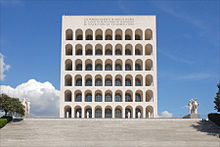
The quarter of the world exhibition ( Italian: Esposizione Universale di Roma , “Rome's World Exhibition”, abbreviated EUR ) is an extensive complex of business buildings, built by order of Benito Mussolini in 1935–43. in the south-west of Rome in preparation for the world exhibition (not held).
The quarter was supposed to embody in stone the idea of a "new Roman Empire ." Its architectural appearance was the subject of controversy between the developers of the project, led by Marcello Piacentini . The multi-storey Palace of Italian civilization (architects J. Guerrini, E. La Padula, M. Romano) was called upon to become the most representative building. Called the “Square Coliseum ”, the palace “gives the impression of an architectural utopia, fused from ancient archetypes” [1] .
The remaining buildings of the quarter were also built from traditional Italian materials ( marble , tuff , limestone ), but they were based on the principles of even more rigorous rationalism . It is easy to notice the similarity of some buildings with the architectural fantasies of Giorgio de Chirico [1] . According to experts, the buildings "have some kind of Spartan, ascetic appearance, with monotonous facades, which are sometimes decorated with pilasters or columns without capitals and in some places outside are decorated with sculptures with utterly simplified texture and plasticity" [1] .
In the postwar period, the Pigorini Ethnographic Museum and the Pallottomatica sports complex designed by Piacentini and Nervi were opened on the territory of the quarter. The peculiar architecture of the quarter attracted the attention of many directors - Bernardo Bertolucci (" Conformist "), Federico Fellini (" Boccaccio 70 "), Peter Greenaway (" Belly of the Architect "), Michael Leman (" Hudson Hawk ") and others.