The period of oscillations is the smallest period of time during which the system performs one complete oscillation (that is, it returns to the same state [1] in which it was at the initial moment, chosen arbitrarily).
| Period | |
|---|---|
| Dimension | T |
| Units | |
| SI | from |


In principle, it coincides with the mathematical concept of the period of a function , but having in mind the function as a function of the dependence of the physical quantity oscillating on time.
This concept in this form is applicable to both harmonic and anharmonic strictly periodic oscillations (and approximately - with this or that success - and non-periodic oscillations, at least close to periodicity).
In the case when it comes to oscillations of a harmonic oscillator with attenuation , the period is understood to mean the period of its oscillating component (ignoring the attenuation), which coincides with the doubled time interval between the nearest passage of the oscillating quantity through zero. In principle, this definition can be more or less accurate and useful in some generalizations to damped oscillations with other properties.
Designations: conventional standard designation of the oscillation period: (although others may apply, most often it sometimes etc.).


Units: second and, in principle, units of time in general.
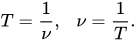
The oscillation period is related by the ratio of reciprocal reciprocity with the frequency :
For wave processes, the period is also connected in an obvious way with the wavelength

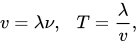
Where - wave propagation velocity (more precisely [2] - phase velocity ).

In quantum physics, the period of oscillations is directly related to energy (since in quantum physics the energy of an object — for example, a particle — is the frequency [3] of oscillations of its wave function).
The theoretical calculation of the oscillation period of a particular physical system is reduced, as a rule, to finding a solution of dynamic equations (equations) that describes this system. For the category of linear systems (and approximately - for linearized systems in the linear approximation, which is often very good), there are standard relatively simple mathematical methods that allow this (if the physical equations describing the system themselves are known).
For the experimental determination of the period, clocks , stopwatch , frequency meters , strobe lights , strobotachometers , oscilloscopes are used . Beats are also used, a heterodyning method in different forms, the principle of resonance is used . For waves, you can measure the period indirectly - through the wavelength, for which interferometers , diffraction gratings, etc. are used. Sophisticated methods are sometimes required that are specially developed for a specific difficult case (the measurement of time itself can be difficult, especially when it comes to extremely short or, on the contrary, very large times, or the difficulty of observing an oscillating quantity).
Content
- 1 Periods of fluctuation in nature
- 2 Periods of oscillation of the simplest physical systems
- 2.1 Spring pendulum
- 2.2 Mathematical pendulum
- 2.3 Physical pendulum
- 2.4 Torsional pendulum
- 2.5 Electric oscillatory (LC) circuit
- 3 notes
- 4 References
Periods of fluctuation in nature
The idea of oscillation periods of various physical processes is given by the article Frequency intervals (given that the period in seconds is the reciprocal of the frequency in hertz).
A certain idea of the magnitude of the periods of various physical processes can also give a scale of frequencies of electromagnetic waves (see. Electromagnetic spectrum ).
The periods of oscillation of the sound heard by a person are in the range
- 5 · 10 −5 s to 0.2 s
(its clear boundaries are somewhat arbitrary).
The periods of electromagnetic waves corresponding to different colors of visible light are in the range
- 1.1 · 10 −15 s to 2.3 · 10 −15 s .
Since at extremely large and extremely small periods of oscillation, measurement methods tend to become more and more indirect (up to a smooth flow into theoretical extrapolations), it is difficult to name a clear upper and lower boundary for the oscillation period measured directly. The time of existence of modern science (hundreds of years) can give some estimate for the upper boundary, and the period of oscillations of the wave function of the heaviest particle known now can give the lower boundary.
In any case, the Planck time can serve as a lower boundary , which is so short that, according to modern concepts, it is not only unlikely to be physically measured at all [4] , but it is also unlikely that in a more or less visible future it will be possible to approach the measurement of quantities even many orders of magnitude larger, and the border from above - the lifetime of the universe - more than ten billion years.
Oscillation periods of simplest physical systems
Spring Pendulum
The oscillation period of the spring pendulum can be calculated by the following formula:
,
Where - mass of cargo - spring stiffness .
Mathematical Pendulum
The period of small oscillations of a mathematical pendulum :
Where - suspension length (for example, threads), - acceleration of gravity .
The period of small fluctuations (on Earth) of a mathematical pendulum 1 meter long with good accuracy [5] is 2 seconds.
Physical Pendulum
The period of small fluctuations of the physical pendulum :
Where - moment of inertia of the pendulum relative to the axis of rotation, - mass of the pendulum, - the distance from the axis of rotation to the center of mass .
Torsion Pendulum
The period of oscillation of the torsion pendulum :
Where - moment of inertia of the pendulum relative to the axis of torsion, and - rotational stiffness coefficient of the pendulum.
Electric oscillating (LC) circuit
The oscillation period of the electric oscillatory circuit ( Thomson's formula ):
,
Where - coil inductance , - capacitor capacity .
This formula was derived in 1853 by the English physicist William Thomson .
Notes
- ↑ The state of a mechanical system is characterized by the positions and velocities of all its material points (more strictly, by the coordinates and velocities corresponding to all degrees of freedom of a given system), for a non-mechanical one, by their formal counterparts (which can also be called coordinates and velocities in the sense of an abstract description of a dynamic system, amount, also equal to the number of its degrees of freedom).
- ↑ For monochromatic waves, this refinement is self-evident, for close to monochromatic waves, it is intuitively obvious by analogy with strictly monochromatic waves, for substantially nonmonochromatic waves, the clearest case is that the phase velocities of all monochromatic components coincide with each other, so the commented statement is also true.
- ↑ Accurate to units of measurement: in traditional (ordinary) systems of physical units, frequency and energy are measured in different units (since before the advent of quantum theory the coincidence of energy and frequency was unknown, and, of course, each of the quantities had its own independent unit of measurement) therefore, when measuring them in ordinary (different) units, for example, joules and hertz, a conversion factor (the so-called Planck constant ) is required. However, you can select a system of units so that the Planck constant in it becomes equal to 1 and disappears from the formulas; in such a system of units, the energy of any particle is simply equal to the oscillation frequency of its wave function (which means that it is inverse to the period of this oscillation).
- ↑ This refers, of course, to the impossibility of experimentally measuring the times of specific processes or periods of oscillations of this order, and not just calculating a certain number.
- ↑ Better than 0.5% if we take the metrological or accepted technical value of gravity acceleration; And with a spread of ~ 0.53% for the maximum and minimum values of the acceleration of gravity observed on the ground.
Links
- Period of hesitation - article from the Great Soviet Encyclopedia