Ordinary hops , or Creeping hops ( Latin: Húmulus lúpulus ) - a species of herbaceous perennial plants of the genus Hops ( Humulus ) of the Cannabaceae family.
| Common hops | |||||||||||||||||||||
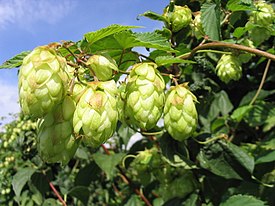 Common hops. General view of the plant | |||||||||||||||||||||
| Scientific classification | |||||||||||||||||||||
|---|---|---|---|---|---|---|---|---|---|---|---|---|---|---|---|---|---|---|---|---|---|
| |||||||||||||||||||||
| International scientific name | |||||||||||||||||||||
Humulus lupulus L. , 1753 | |||||||||||||||||||||
Content
Distribution and habitat
The plant is widespread in the temperate climate of Eurasia and North America ; also found in northern Africa (in Morocco ). The homeland of the plant is unknown.
In Russia, it is distributed almost everywhere in the European part and Western Siberia , with the exception of the Far North , in the Caucasus and Altai .
It grows on rich soils in river valleys, ravines, in riverine and baire damp broad-leaved forests, in shrubbery, in willows and alders.
It has long been bred on special plantations.
Botanical Description
Perennial liana. The stem , winding clockwise , tetrahedral, hollow inside, covered with sharp spikes , up to 7 m in length. The rhizome is long, creeping.
Leaves at the base are lane-shaped three-five-lobed, deeply cordate, with ovate pointed lobes, coarse-grained, opposite, long-arched , with inter-arterial stipules along the edge; the upper leaves are whole.
Dioecious plant. Male inflorescences on the branches of the second order in the form of panicle inflorescence, consisting of dichasia , turning into curls . Male flowers are small, green, with a five-leaf perianth and five stamens with straight threads. Female flowers in pineal complex inflorescences. Scales of cones, arranged in pairs, are stipules of undeveloped leaves, in the bosom of which there are double curls of two to four or six flowers, without first-order flowers. Bracts in the fruit grow and bear yellow glands containing lupulin . Female flowers consist of a pestle at the base surrounded by a filmy whole-cup-shaped perianth. It blooms in July - August.
The fruit is a nut with a spiral folded embryo , ripens in August - September.
Chemical Composition
Hop fruit contains essential oil (up to 3%, according to other sources, 0.3–1.8% [2] ), hop resins, wax , gum , and bitter substances (16–26%, according to other sources, 11–21 % [2] ), valerianic , n-aminobenzoic and hopic acids , lupulin glycoside , carotene , ascorbic acid , choline , thiamine , nicotinic acid , yellow coloring matter, tannins (3%), flavonoids . Young shoots and leaves contain 0.095-0.19% of ascorbic acid.
Hop essential oil is aromatic, light or dark yellow in color, its main component is myrcene (30-50%) and myrcenol . The composition of the oil also includes linalool , geraniol , farnesene , karyofillen , luparol , luparenol , esters of formic , acetic , butyric and other acids.
Hop resins are a complex complex of substances (a mixture of phenols , resin acids and neutral resins ). The quantitative content of phenols and resin acids determines the brewing value of a particular hop variety. The content of bitter substances varies depending on the variety of hops and cultivation conditions (climatic and soil), as well as on the timing of harvesting. The greatest amount of bitter substances is observed at the beginning of bruising of the fruit.
Economic Significance and Application
Hop collodion, the so-called “bumps”, was used in the past for dyeing tissues [3] .
Bees collect pollen from hops.
A decorative plant, climbing, cultivated to obtain cones and landscaping slopes, arbors, fences, balconies.
From long stems, it is possible to obtain fiber suitable for the manufacture of coarse burlap and ropes [3] .
Application in the food industry
Hop fruit, collected at the beginning of ripening, has long been used in brewing and baking (for making liquid yeast), and in baking some varieties of bread. Hop tannins regulate wort fermentation and prevent souring of beer . Essential oil, resins, lupulin give the beer a peculiar aroma and a bitter taste [3] .
Young underground hop shoots that have just come to the surface are eaten in the spring in vegetable dishes as asparagus or cauliflower and for green cabbage soup as nettles [4] .
Medical Use
As a medicinal raw material, they use the fruit of ordinary hop ( Latin Strobilus Lupuli ) or female "cones" of ordinary hop ( Amenta Lupuli ). Mating with stalks is harvested in July - August, when they have a yellowish-green color. Dry quickly in the shade or in well-ventilated areas [2] .
Essential oil and extract are used as part of complex preparations of cardiovascular action and for kidney diseases.
The extract is included in the drug "Urolesan" [2] .
Humulin and essential oil have a calming (sedative) effect, are part of the drug “ Valocordin ”, which is recommended for cardiovascular neurosis , angina pectoris , intestinal spasms .
Hop cones are part of soothing tea [2] , their decoction is used as a painkiller for kidney stones and bladder inflammation and for the treatment of pyelonephritis [2] , for insomnia , as a sedative , for neurasthenia , as well as for cystitis and frequent urge to urinating , sometimes as an anti-zingotic .
The extract from hop cones has estrogenic activity and is being studied for hormone therapy . Substances with antibacterial action were isolated from cones; they are used in the manufacture of cosmetics [3] .
Extracts from hop cones - an integral part (often the basis) of a number of therapeutic creams for acne , dandruff , for the treatment of dermatitis .
In folk medicine, hop cones were used as appetizing bitterness and a lactogenic agent (infusion) [3] , for diseases of the spleen , liver and gall bladder , gastritis , pulmonary tuberculosis , cystitis, edema , malaria , eczema , in case of metabolic disorders , and excessive sexual arousal ; roots - with migraine , jaundice .
The plant was used externally as a painkiller for neuralgia , radiculitis , gout , bruises , for aromatic baths , for the treatment of furunculosis , ulcers , lichen and eczema ; a decoction of hop cones wash their hair from dandruff and to strengthen hair with early baldness .
In folk veterinary medicine, hops were used for edema, to improve digestion and as an anti-inflammatory .
Due to the toxicity of the plant with internal use, it is necessary to strictly dose it.
Plant in Culture
A stylized image of hops is found on the State and regional emblems of the Chuvash Republic ;
Common hops are depicted on the arms of many settlements.
Coat of arms of Chuvashia; coat of arms of ; Coat of arms of Lonnerstadt ; coat of arms of Llamas de la Ribera ; coat of arms of Bukkov ; coat of arms of Rohrbach | ||||||||||
Classification
Taxonomy
Species The common hop is a member of the genus Hops ( Humulus ) of the Cannabaceae family of the order Rosaceae .
| 8 more families (according to APG II System ) | another view Japanese hops | ||||||||||||
| order rosaceae | hops | ||||||||||||
| Department of Flowering, or Angiosperms | hemp family | species Hops | |||||||||||
| another 44 order flowering plants (according to APG II System ) | 9 more births | ||||||||||||
Subordinate Taxa
Within the species, a number of varieties are distinguished: [5]
- Humulus lupulus var. cordifolius ( Miq. ) Maxim.
- Humulus lupulus var. lupuloides E.Small
- Humulus lupulus var. lupulus
- Humulus lupulus var. neomexicanus A.Nels. & Cockerell
- Humulus lupulus var. pubescens E.Small
From left to right. Leaves. Male flowers. Female flowers. Cones (female flowers) | ||||||||||
Notes
- ↑ For the conventionality of specifying the class of dicotyledons as a superior taxon for the plant group described in this article, see the APG Systems section of the Dicotyledonous article .
- ↑ 1 2 3 4 5 6 Blinova K. F. et al. Botanical-Pharmacognostic Dictionary: Ref. allowance / Ed. K.F. Blinova, G.P. Yakovleva. - M .: Higher. school, 1990. - S. 253-254. - ISBN 5-06-000085-0 .
- ↑ 1 2 3 4 5 Gubanov I.A. et al. Wild useful plants of the USSR / ed. ed. T.A. Rabotnov . - M .: Thought , 1976 .-- S. 100 .-- 360 p. - ( Reference guides to the geographer and traveler ).
- ↑ Wild Edible Plants / Ed. Acad. W. A. Keller; USSR Academy of Sciences; Mosk. nerd. Garden and Institute of History Mater. culture to them. N. Ya. Marra. - M .: b. and., 1941. - S. 14. - 40 p.
- ↑ According to the GRIN website (see plant card).
Literature
- Flora of the USSR : in 30 tons / hl ed. V.L. Komarov . - M .; L .: Publishing House of the Academy of Sciences of the USSR , 1936. - T. 5 / ed. volumes V. L. Komarov. - S. 382-383. - 762, XXVI p. - 5175 copies.
- Dudchenko L.G., Koziakov A.S., Krivenko V.V. Spicy-aromatic and spicy-flavoring plants: Reference book / Otv. ed. K. M. Sytnik. - K .: Naukova Dumka , 1989 .-- 304 p. - 100,000 copies. - ISBN 5-12-000483-0 .
- Gubanov I.A. et al. 441. Humulus lupulus L. - Climbing hops // Illustrated identifier of plants in Central Russia. In 3 t . - M .: T-in scientific. ed. KMK, Institute of Technology. ISS., 2003. - T. 2. Angiosperms (dicotyledonous: dicotyledonous). - S. 39. - ISBN 9-87317-128-9 .
- Common hops // Medicinal plants / Auth. I.N. Putyrsky, V.N. Prokhorov. - Minsk: Book House, 2005. - 704 p. - (Big book of tips).
Links
- Humulus lupulus : information on a taxon in the Plantarium project (a identifier of plants and an illustrated atlas of species). (Retrieved January 21, 2012)
- Common hops on ecosystema.ru (Retrieved January 21, 2012)