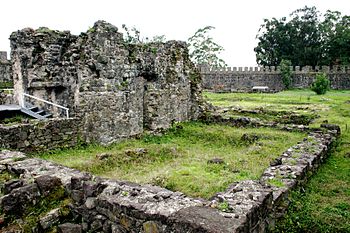
The Gonio Fortress ( abh . Aҧsartә and abaash. Georgian . გონიოს ციხე, formerly called Apsara , Apsara or Asparunt ) was a Roman outpost in Adjara , on the Black Sea coast , 15 km south of Batumi , at the mouth of the Chorokhi River. The village is located 5 kilometers north of the Turkish border. The name of the fortress is derived from the self-name of the Abkhaz in the plural "aҧsʻar". [one]
The first mention of the fortress belongs to Pliny the Younger ( I century AD. ). In the II century AD, it was a well-fortified Roman city in Colchis . Later fell under the influence of Byzantium. The name “Gonio” was first mentioned in the report of Trabzon historian Michael Panaret in the XIV century . For some time there was a place of Genoese trade. In 1547, Gonio became part of the Ottoman Empire, it lasted until 1878, when, after the treaty, San Stefano Adjara became part of the Russian Empire .
The city was also known for its theater and hippodrome. In addition, the tomb of the Apostle Matthias , who was elected to the number of the twelve apostles after the betrayal of Judas Iscariot , could supposedly be in the fortress of Gonio. However, the Georgian government currently prohibits excavations near the grave. Other archaeological excavations are carried out in the fortress, paying particular attention to Roman times.
Gonio is currently experiencing a tourist boom. During the summer months, many tourists from Tbilisi use beaches that are considered to be more environmentally friendly than beaches near Batumi (located 15 km north of the fortress).
Notes
Links
- Kakhidze, Emzar, Recent Archaeological Finds in Apsarus . Third International Congress on Black Sea Antiquities, 2005. (English)
- Pictures of Gonio castle (eng.)
- Kakhidze E. Apsaros: A Roman Fort in Southwestern Georgia // Meetings of the Black Sea Region: Between Conflict and Coexistence / Eds. PG Bilde and JH Petersen. Aarhus, 2008 (Black Sea Studies, 8), 303-332; http://www.pontos.dk/publications/books/bss-8-files/bss-8-16-kakhidze .