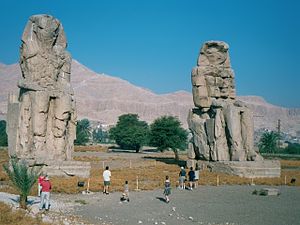
Colossi of Memnon (the local Arabic name is el-Colossat, or es-Salamat) are two massive stone statues that actually depict Pharaoh Amenhotep III , not Memnon . For the past 3400 years, they have stood in the necropolis of Thebes , on the other side of the Nile River from the modern city of Luxor .
Two statues depict the seated Amenhotep III (c. XIV century BC). His hands are on his knees, and his gaze is directed east to the river and the rising sun. Two smaller figures are carved on the front of the throne along his legs. This is his wife Tia and mother Mutemuya . Side panels display the god Neil Hapi .
The statues are made of blocks of quartzite sandstone , which were mined from the quarry in Jebel al-Ahmar (not far from modern Cairo ) and transported for 670 km on land, and not on the waters of the Nile (they were too heavy to transport up the river). The blocks used by Septimius Severus engineers to reconstruct the northern colossus could be brought from Edfu (north of Aswan ). Given the stone platforms on which the statues stand, they reach 18 meters in height. The weight of each statue is estimated at 700 tons. [1] [2] [3]
The original purpose of the Colossi of Memnon was to guard the entrance to the Amenhotep Memorial Temple (or simply the funeral temple ) - a massive religious center built during the life of the pharaoh, where he was revered as an incarnate god on earth before and after his departure from this world. In his days, this temple complex was the largest and most luxurious in Egypt. Covering a total of 35 hectares, even subsequent rivals, such as the Ramesseum Ramses II or Medinet-Abu Ramses III , could not cover such an area; even the temple in Karnak , which stood at the time of Amenhotep , was smaller.
With the exception of the Colossi, very little is left of the Temple of Amenhotep today. Since the colossi stand in the floodplain of the Nile, annual floods eroded them at the base. Known lithography , made in the 1840s, depicting Colossi surrounded by water.
The Greek historian and geographer Strabo , who lived at the beginning of the 1st century AD, talks about the earthquake (in 27 BC) that destroyed the northern colossus.
Having split, the statue gained a reputation for “singing” every morning at dawn: a slight moan or whistling may have been caused by the rising temperature and evaporation of moisture inside the porous stone. In the year 19 e. Germanicus visited these places. The tone of the sound made by the statue throughout the ancient world was considered the reference for tuning musical instruments [4] . Colossal legends spread throughout the world, and travelers reached out to admire the statues. The mysterious sound effects of the statues ceased in 199 when the Roman emperor Septimius Severus, in an attempt to appease the oracle , ordered the collection of cracked pieces.
Memnon, by whose name the colosses are known, was the hero of the Trojan War , the king of Ethiopia , who led his troops from Africa to Asia Minor to help protect the besieged city, but was ultimately killed by Achilles . The name Memnon means "Ruler of the Morning Dawn."

Northern Colossus.

The side surface of the statue.


Links on the page
- ↑ Science magazine
- ↑ “The Seventy Wonders of the Ancient World”, edited by Chris Scarre (1999) Thames & Hudson, London
- ↑ Time Life Lost Civilizations series: Ramses II: Magnificence on the Nile (1993)
- ↑ G.E. Shilov . Simple gamma (musical scale device) . - M .: Fizmatgiz , 1963 .-- 24 p. - (Popular Lectures in Mathematics, vol. 37). (inaccessible link)
Links
- Colossus of Memnon (Nova / PBS )
- Book XVII, Strabo's Geography
- Temple of Amenhotep III
- Description by Count de Forbin (English)
- Colossi of Memnon (Russian)
- Victor Solkin - Amenhotep III: personality, era and "style" of civilization. Part I.