Intel 4004 is a 4-bit microprocessor developed by Intel Corporation and released on November 15, 1971. This chip is considered the world's first commercially available single-chip microprocessor [1] .
| Intel 4004 | |
|---|---|
| CPU | |
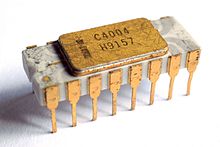 Intel 4004 microprocessor in gray striped ceramic case | |
| Production | from November 15, 1971 to 1981 |
| Manufacturer | Intel Corp. |
| CPU frequency | 500-740 kHz |
| Production technology | 10 microns |
| Instruction sets | 46 instructions |
| Connector | Dip16 |
Content
History
In 1969, the small Japanese company Nippon Calculating Machine, Ltd. (subsequently Busicom Corp. ), a calculator manufacturer, ordered 12 chips from Intel (the logical system design was developed by Busicom employee Masatoshi Shima (嶋 正 利)), which were to be used in the new desktop calculator. Such microcircuits were always characterized by highly specialized functions and were intended to perform strictly defined work, therefore, for each new application, it was necessary to re-develop the entire chipset. This approach to Intel seemed unprofitable. 32-year-old Marchian Edward (Ted) Hoff offers Intel and Busicom management to reduce the number of chips by using a central processor that will have to perform arithmetic and logic functions, one instead of several chips. The idea was accepted with a bang by the leadership of both firms. During the fall of 1969, Ted Hoff, with the help of Stanley Massor, proposed a new chip architecture, the number of which was reduced to 4, including the central processor : 4-bit central processor (CPU), ROM for storing software and RAM for storing user data. The development of the microprocessor did not begin until April 1970, when Federico Faggin, a physicist from Italy, began working at Intel as the chief designer of the MCS-4 family. Fagin, thanks to a deep knowledge of the silicon gate MOS technology developed by him at Fairchild in 1968, and the great experience gained in 1961 in the Italian company Olivetti in the field of computer logical design, managed to reduce the CPU microprocessor into a single chip. In 1968, when Federico worked at Fairchild, he also implemented the world's first commercial microcircuit that used silicon shutter technology: Fairchild 3708 .
At Intel, Fagin developed a new, until then, non-existent method for designing arbitrary logic circuits and contributed to many innovations in the development of processes and microcircuits, which are very important for implementing a microprocessor in a single chip. Masatoshi Shima, who worked as a software engineer at Busicom and had no experience in the design of MOS devices, helped Fajin develop the MCS-4, and later began working with him at Zilog , founded in late 1974 by Fajin and Ralph Ungermann completely dedicated to microprocessors. Fajin and Sima together developed the Zilog Z80 microprocessor, which is still being produced.
The thing is that each product category has been assigned a number. The first Intel products were memory chips ( PMOS chips), which were assigned the numbering 1xxx. The 2xxx series developed NMOS chips. Bipolar circuits were assigned to the 3xxx series. 4-bit microprocessors are designated 4xxx. CMOS chips were designated 5xxx, memory on magnetic domains - 7xxx, eight-bit or more microprocessors and microcontrollers belonged to the 8xxx series. Series 6xxx and 9xxx were not used.
The second digit indicated the type of product: 0 - processors, 1 - RAM chips, 2 - controllers, 3 - ROM chips, 4 - shift registers, 5 - EPLD chips, 6 - PROM chips, 7 - EPROM chips , 8 - surveillance chips and circuits synchronization in pulse generators, 9 - chips for telecommunications.
The third and fourth digits corresponded to the serial number of the product, and since the first processor needed three more specialized microcircuits (ROM, RAM, and an I / O expander) that were released earlier than 4004, the microprocessor was named 4004.
On November 15, 1971, the 4004 microcircuit is released - the first microprocessor that, at a cost of $ 200, implemented on a single chip the functions of a large computer processor. The world's first microprocessor was announced in November 1971 in the journal . In 2006, Intel celebrated the 35th anniversary of one of the most significant achievements in technology history. The 4004 microprocessor was produced in a 16-pin DIP type case; the crystal dimensions were 12 mm² (3 × 4 mm). The processor could execute 60,000 (on average; maximum - up to 93,000 ) instructions per second (for comparison, one of the first fully electronic computers - the American ENIAC - executed only 5000 (maximum) instructions per second with a bit capacity of 20 bits , occupied 280 m² , weighed 27 tons and consumed 174 kW of energy). Intel predicted the decisive importance of microprocessors in the miniaturization of computers and, therefore, bought back from Busicom the copyright for the 4004 microprocessor and its advanced versions for $ 60,000 [2] .
However, in 1971, the processor did not become a bestseller. Intel's strategy was to sell 4004 to expand the market for the much more popular 1101/1103 memory chips. Only the 8080 microprocessor and the electronic "great-grandson" 4004 began to enjoy well-deserved popularity.
The legend is widespread that this processor was used in the onboard equipment of the Pioneer-10 interplanetary probe. However, in reality, Pioneer-10 computers had different bit depths (18 and 16 bits) [3] .
4xxx Series Specialized Chips
Initially, the 4004 chip came with three specialized chips: ROM, RAM, and an I / O expander. And although these microcircuits had their own notation (series 1xxx, 2xxx and 3xxx), they got a second name in the 4xxx category, which began to be denoted next to their usual numbering:
- 4001 - 256-byte masked ROM (256 8-bit software instructions), and one built-in 4-bit I / O port.
- 4002 - 40-byte RAM (80 4-bit cells), and one built-in 4-bit output port; The RAM in the chip is organized in 4 “registers” of twenty 4-bit cells:
- 16 data cells (in the original calculator used for mantissa digits)
- 4 status cells (in the original calculator were used for exponent numbers and signs)
- 4003 - 10-bit I / O expander (shift register converting serial code to parallel)
Along with the release of 4040 , new chips appeared, also compatible with 4004:
- 4308 - a 1024-byte masked ROM (1024 8-bit program instructions), and four built-in 4-bit I / O ports. Complete replacement for four 4001 circuits.
- 4008, 4009 - a kit for connecting standard memory chips (ROM, ROM, RAM) and input-output ports. Allows you to connect up to 16 different memory devices in the format of 8 bits of address, 8 bits of data. The previously undocumented WPM (Write Program Memory) command is used to write to RAM. It also supports up to 16 four-bit input ports and up to 16 four-bit output ports. Intel recommends sharing chips: 4316 (2048 bytes masked ROM), 4702A (256 bytes ROM / EPROM), 4101 (256 bytes static RAM).
- 4289 is a diagram for connecting standard memory chips and input-output ports. Later replacement 4008/4009 in one housing.
- 4207, 4209, 4211 - GPIO ports (4 ports of 4 bits). The circuits have address 3 in the program area, therefore they cannot be used together with 4008/4009/4289, and 4001/4308 circuits should not occupy address 3. Up to eight circuits can be used simultaneously, using CM-RAM to select the line.
- 4207 - 8 bits of synchronous data output, 4 output control bits, 4 input control bits.
- 4209 - 8 bits of synchronous data input, 4 output control bits, 4 input control bits.
- 4211 - 8 bits of synchronous data output, 8 bits of synchronous data input.
- 4265 - 4 universal four-bit I / O ports. Software supported 14 modes. Completely replaces one of the banks of RAM 4002.
- 4269 is a programmable keyboard and display controller. It performs a cyclic scan of two keyboard matrices 8 * 8 (128 keys) and a cyclic output of 2 * 16 * 4 data bits to control the display. Completely replaces one of the banks of RAM 4002.
- 4201 - clock generator, RESET and STOP / ACK signal generation circuit (not used in 4004).
Note: 4001/4308 ROM chips could not be used in the system with the 4008/4009/4289 standard memory controller. They were used in various configurations of systems - mini and maxi.
The 400x family was also referred to as the MCS-4 (Micro Computer Set 4-bit).
Intel also sold Intellec-4 (large blue boxes), a system for developing and testing programs for 4004. In fact, it was one of the first micro-computers assembled on the basis of the 4xxx series (4004, 4201 chips, four 4001 and two 4002 chips). Only the high price (5 thousand dollars) did not allow us to consider it a personal computer .
Collecting
Intel 4004 is one of the most popular chips in terms of collecting [4] . The most highly valued are the white and gold Intel 4004 chips with visible gray traces on the white part (the original type of case) [4] . So, in 2004, such a chip at the eBay online auction was estimated at about $ 400 [4] . Chips without gray marks on the case are slightly less valuable, usually their cost is about 200-300 dollars [4] . Those chips (with gray traces) without a release date on the bottom of the chip are earlier released, so their value is higher.
Specifications
- Announcement date: November 15, 1971
- Number of Transistors: 2300
- Crystal Area: 12 mm²
- Workflow: 10 microns (P-channel silicon pie MOS technology)
- Clock frequency: 740 kHz (specifically, from 500 to 740.740 ... kHz , since the clock period is 2-1.35 μs) (or 92.6 kHz?)
- Bit depth: 4 bits
- Number of registers: 16 (16 four-bit can be used as 8 eight-bit)
- Number of ports: 16 four-bit I / O (in the program area) and 32 four-bit I / O (in the data area)
- Internal bus: 4 bits
- External bus: multiplexed for address, data, control - 4 bits (plus 5 lines CM of memory bank selection)
- Harvard architecture
- Stack: Internal 3-tier
- Command memory (ROM / ROM, as well as RAM / RAM when using 4008/4009/4289): 4 kilobytes (32,768 bits)
- Data memory (chip 4002 RAM / RAM): 640 bytes (5120 bits) without an address decoder, or 1280 bytes (10240 bits) with an address decoder.
- Organization of address space: heterogeneous, divided for different teams
- program area: 1 bank, 12 address bits, 8 data bits
- data register area: 8 banks (3 bits), 8 address bits, 4 data bits
- state register area: 8 banks (3 bits), 4 address bits, 4 data bits
- I / O area (in the program bank): 1 bank, 4 address bits, 4 data bits
- output area (in data banks): 8 banks (3 bits), 4 bits of address, 4 bits of data
- Number of instructions: 46 (of which 41 are 8-bit and 5 are 16-bit)
- Instruction cycle: 10.8 microseconds
- Supply voltage: −15 V (pMOS)
- Operating temperature: 0 to +70 ° C
- Storage and operating conditions: from −40 to +85 ° C
- Connector: DIP16 (the chip was directly soldered into the circuit board or installed in a special slot)
- Case: 16-pin DIP (1 type plastic or 3 types of ceramic, for example C4004 (white ceramic with gray stripes), C4004 (white ceramic), D4004 (black and gray ceramic), P4004 (black plastic))
- Delivery type: separately and in sets MCS-4 (ROM, RAM, I / O, CPU)
Processor block diagram | Pin assignment |
See also
- Project Manager and First Microprocessor Designer: Federico Fajin
Notes
- ↑ In 1970, more than a year before the i4004 chip was released, a military microprocessor was manufactured, which was part of ( Central Air Data Computer ) - the on-board control system of the F-14 fighter; however, it was not single-chip. See The F-14A “Tom Cat” Microprocessor for more information . Date of treatment January 6, 2014. Archived on January 6, 2014.
- ↑ Anniversary of a personal computer . Date of treatment August 20, 2014.
- ↑ Voyager FAQ Archived July 21, 2011. (eng.)
- ↑ 1 2 3 4 42 years ago Intel Corporation released the first chip . Date of treatment August 20, 2014.
Links
- How were the first Intel chips developed
- The history of world processor engineering from 4004 to Nehalem
- Early documents on MOS silicon gate technology and microprocessor . 1968-1972
- First Microprocessor Architecture Developer: Ted Hoff
- Intel 4004 Online Assembler
- Intel marks 40th anniversary of first microprocessor
- intel 4004 datasheet