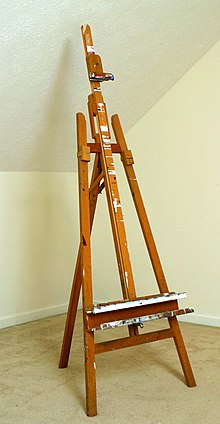
Easel (from German: Malbrett : board for drawing) - a stand, usually wooden, on which the artist places a painting , drawing , etc. Examples of easels include tripod easels, already known in the ancient era, and easels, consisting of vertical posts mounted on a horizontal base.
History
Initially, the easel was the basis of oil paintings on wooden or copper shields. In addition to Byzantine icons and Egyptian images from the late antiquity, easels were first used in the 11th and 12th centuries in the manufacture of altar stands (Latin Retabulus) or curtains (Latin Antependium) and in the 16th century were replaced by a canvas stretched on a wooden frame. Dutch artists, as well as their imitators, continued, however, to paint on easels in later periods. In the 19th century, wood chipboards were also used as easels.
Some sources mistakenly claim that the word Malbrett ( malbret in the correct transcription) is no longer used in German. The statement that the easel is not used in its primary sense can be considered more true. However, as a stand for drawing, for example, worn around the neck, easels can be found in art supplies stores.