Argentinosaurus [1] ( lat. Argentinosaurus ) is one of the largest dinosaurs ever living in South America .
| † Argentinosaurus | |||||||||||||||||||||||||||||||||||||||||||||
 Reconstruction | |||||||||||||||||||||||||||||||||||||||||||||
| Scientific classification | |||||||||||||||||||||||||||||||||||||||||||||
|---|---|---|---|---|---|---|---|---|---|---|---|---|---|---|---|---|---|---|---|---|---|---|---|---|---|---|---|---|---|---|---|---|---|---|---|---|---|---|---|---|---|---|---|---|---|
| |||||||||||||||||||||||||||||||||||||||||||||
| International scientific name | |||||||||||||||||||||||||||||||||||||||||||||
Argentinosaurus Bonaparte & Coria , 1993 | |||||||||||||||||||||||||||||||||||||||||||||
| Single view | |||||||||||||||||||||||||||||||||||||||||||||
† Argentinosaurus huinculensis Bonaparte & Coria, 1993 | |||||||||||||||||||||||||||||||||||||||||||||
| Geochronology 99.6—89.8 Ma
◄ Nowadays◄ Cretaceous-Paleogene extinction◄ Triassic extinction◄ Mass Permian Extinction◄ Devonian extinction◄ Ordovician-Silurian extinction◄ Cambrian explosion | |||||||||||||||||||||||||||||||||||||||||||||
Description
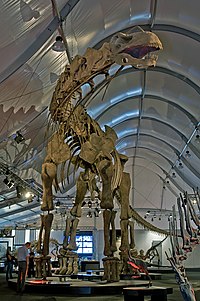
So far, only individual fragments of his skeleton have been found; therefore, estimates of its length range from 22 to 35 m (reconstruction at the Carmen Funes Museum is 39.7 m in length), and weights from 60 to 108 tons [2] [3] [4] [5] . Among the fragments found is a vertebra with a height of 159 cm. Fossil remains were found in Argentina by local paleontologists José Fernando Bonaparte and Rodolfo Coria and described as a new species Argentinosaurus huinculensis in 1993 [6] ; the found remains belong to the middle of the Cretaceous period ( 99.6–89.8 million years ago [7] ). Perhaps even larger were the Bruhatkayosaurus , Puertasaurus , Breviparop , Amphicelia , Diplodocus , and Super Saur .
Systematics
The exact systematic position of the Argentinosaurus remains unclear. For example, in 2005: Christina Curry Rogers assigned it to the subfamily Opisthocoelicaudiinae , L. Salgado and R. Koria - to the Titanosauridae family, and Sebastian Apestegia - to the Andesauridae family. After the work of 2013, R. Koria and colleagues put the genus in the clade Lithostrotia [7] .
Notes
- ↑ Zhuravlev A. Yu . A bit about dinosaurs // Before and after dinosaurs. - M .: Veche, 2006 .-- 352 p. - (Great secrets). - ISBN 5-9533-1258-X .
- ↑ Paul, Gregory S. (Fall 1994). " Big Sauropods - Really, Really Big Sauropods ." The Dinosaur Report. The Dinosaur Society. pp. 12-13.
- ↑ Paul, Gregory S. (1997). "Dinosaur models: the good, the bad, and using them to estimate the mass of dinosaurs." in Wolberg, DL; Stump, E .; Rosenberg, GD DinoFest International Proceedings. The Academy of Natural Sciences. pp. 129-154.
- ↑ Carpenter, Kenneth (2006). “Biggest of the Big: A Critical Re-Evaluation of the Mega-Sauropod Amphicoelias fragillimus Cope, 1878” Archived December 2, 2007. . in Foster, John R .; Lucas, Spencer G. Paleontology and Geology of the Upper Jurassic Morrison Formation. 36. New Mexico Museum of Natural History and Science Bulletin. pp. 131-138. Retrieved 2008-01-08.
- ↑ Mortimer, Mickey (2001-09-12). "Titanosaurs too Large?" Dinosaur Mailing List. Retrieved 2009-01-08.
- ↑ Bonaparte J., Coria R. (1993). Un nuevo y gigantesco sauropodo titanosaurio de la Formacion Rio Limay (Albiano-Cenomaniano) de la Provincia del Neuquen, Argentina (Spanish) . Ameghiniana 30 (3): 271-282.
- ↑ 1 2 Argentinosaurus . Paleobiology Database Classic . (Retrieved October 30, 2016) .