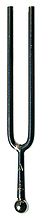
Camerton ( Kammerton - “ room sound ”) is a tool for capturing and reproducing the reference pitch [1] , also called the “ tuning fork ”. In performing practice it is used to tune musical instruments , choristers, etc. There are mechanical, acoustic and electronic tuning forks.
History
In 1711, the court trumpeter of the Queen of England, John Shore, invented a simple object necessary for all musicians and musical instrument tuners, similar to a metal fork with two teeth. This "fork" was called a tuning fork. If you hit a tuning fork, its ends begin to oscillate and a sound is heard, which serves as a benchmark of pitch when tuning musical instruments and singing. The tuning fork, invented by Shor, gave 419 vibrations per second [2] . The sound issued by the tuning fork was decided to be assigned to the note la , from which the other sounds were tuned. With many string instruments, most often with a violin, as the temperature changes, the tension of the strings changes, so the violinists often have to tighten the strings, and the tuning fork is irreplaceable here. Modern tuning instrument tuning fork produces a sound for the 1st octave frequency of 440 Hz.
Nowadays, symphony orchestras rarely use a tuning fork. In the orchestra, the role of a tuning fork is performed by the woodwind instrument oboe , since in its design the temperature does not affect the musical structure and its note A is always stable. But if the piano plays with the orchestra, then all the instruments of the orchestra are already tuned to the piano, and the piano before the concert should be well tuned to the tuning fork.
Tuning fork with resonator

To enhance the sound of a tuning fork, it is installed on a resonator - a wooden box open on one side. Its length is taken equal to 1/4 the length of the sound wave emitted by the tuning fork. When the tuning fork is sounding, its core vertically presses on the lid of the box with the frequency of oscillations of the legs of the tuning fork, which, with such a length of the box, coincides with the frequency of the main oscillation of air in the box. There is a resonant amplification of the sound wave leaving the box, with the important role played by the fact that the size of the box is closer to the length of the sound wave of the tuning fork than the diameter of the leg of the tuning fork [3] .
See also
- Tuner for tuning musical instruments
- Resonance
Notes
- ↑ BDT , vol. 12 (2008), p. 623.
- ↑ Tuning fork | Belcanto.ru
- ↑ Landsberg G.S. Elementary textbook of physics. - 13th ed. - M .: Fizmatlit , 2003. - T. 3. Oscillations and waves. Optics. Atomic and nuclear physics. - pp. 132-135. - 656 s. - ISBN 5922103512 .