Wanian Aguda ( Chinese trad. 完顏 阿骨打 , Exercise 阿骨打 , Pinyin : Wányán Āgǔdǎ ), Chinese name Wannian Min ( Chinese trad. 完顏 旻 , Pinyin : Wányán Mín ), temple name Jin Tai-tzu ( 1068 - 1123 ) - founder of the Jin Empire, in which the Jurchen tribes acquired historical significance, becoming the owners of the northeast half of China .
| Wanian Aguda | |
|---|---|
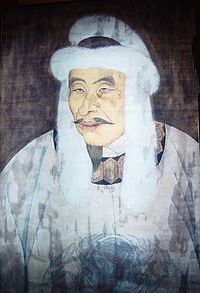 | |
| 1st Emperor of the Jin era | |
| Date of Birth | August 1, 1068 |
| Place of Birth | |
| Date of death | September 19, 1123 (55 years) |
| Reign time | 1115-1123 |
| Successor | Wanian Utsimay |
| Name options | |
| Traditional spelling | 完顏 阿骨打 |
| Simplified Writing | 完颜 阿骨打 |
| Pinyin | Wányán Āgǔdǎ |
| Wade-Giles System | [Wan-yen] A-ku-ta |
| Posthumous name | 乾 兴 运 昭德 定 圣 圣 圣 明 圣 圣 大 圣 帝 |
| Temple name | Tai Chi (太祖) |
| Motto of the board | Shougo (收 國) 1115-1116 Tianfu (天 輔) 1117–1123 |
| Other names | Wanian Ming (完顏) |
| Family | |
| Father | |
| Mother | |
| Wives | , , and |
Biography
The ancestor of Aguda, Khanpu, came out with relatives from Korea and settled on the banks of the river Puhan (Burhan) approximately in the 10th century . In 1113 power passed into the hands of Aguda, militant and reasonable. Aguda possessed the necessary qualities of a leader. In particular, when the Jurchen had a famine, it was Aguda who opposed the sale of people into slavery. According to the Jin Shi Chronicle, Aguda went into battle without a helmet, and possessed a weapon well. It is indicated that he shot from a normal bow at a distance of 320 steps.
In addition, Aguda knew the Khitan language well, which greatly helped him in the subsequent war with the Khitan. The strengthening of the Wanyan tribal union began to alarm the southern neighbor, Koryo. The riders began military actions more than once, and reached such extreme measures as mobilization of the 170,000-strong army, beating the Jurchen ambassadors and leaders at the talks. Aguda was able to mobilize the Jurchen troops to fight such a strong opponent and played an important role in the victory of the Jurchen over its southern neighbor.
The war with Koryo led to the fact that Wanyan was able to unite many tribes of Jurchen. But at the same time, Aguda tried to not conquer the tribes, but to conclude alliances with them, so as not to cause unnecessary conflicts. Only those tribes that refused allied relations were attacked by the Aguda detachments. The intervention of the Laoists into the Jurchen affairs led to the fact that Aguda began to plan the war against the Khitan state.
At the celebration of the First Fish, Aguda refused to dance in front of the Khitan emperor and challenged him.
The first battles ended with the victories of the army of Aguda. The key moment of the war came when the Liao Empire mobilized large forces and they were headed by the emperor himself. Many Jurchen leaders were afraid of the numerous Khitan troops and did not want to fight. Aguda could not get them to speak out against Liao. Many leaders demanded peace with the Khitan. Then he went to the trick. Taking advantage of the fact that most of the Jurchen leaders knew little Chinese writing, Aguda wrote a letter to the Khitan emperor asking for mercy, but he used such expressions that were offensive to imperial greatness. Infuriated by this, the Khitan ruler issued a manifesto in which he demanded the complete destruction of the Jurchen from his warriors. Aguda showed this manifesto to the Jurchen leaders and told them that he wanted peace, but the Liao emperor was against it. The manifesto of the Khitan emperor led to the fact that all the Jurchens threw doubts and decided to fight to the end. Aguda immediately took advantage of this, who took an oath from the Jurchen leaders to fight the Liao Empire until its complete destruction.
Mobile Jurchen cavalry took over the huge but poorly prepared Khitan army. The main mistake of the Liao emperor was his permission to arm at his own discretion. This led to the fact that most of the soldiers in his army were lightly armed, did not have strong armor, crossbows and long-range bows. In addition, there was little cavalry. Therefore, the Jurchens shot the enemy at a distance, imposing a close battle when they themselves wanted. This led to the defeat of the lao army.
In 1115, Aguda assumed the title of emperor (under the name of Min) and gave his dynasty the name gold ( Jin ). His victories follow one after another, and soon the whole of Manchuria recognizes as its ruler, then Khitan land — most of Mongolia and part of China — submits to him.
Jurchen were unfamiliar with the management of the population in large areas and in large cities. Therefore Aguda actively attracted the Bohai. The latter became the administrative foundation of the empire.
Aguda died in 1123 and was buried near the Upper Capital . In 1135, his remains were reburied on Hukhaishan Mountain in the headwaters of the Ashihe River. In 1153-1154 there was a second reburial of the body of Aguda on the spurs of the Dafanshan mountains in the suburb of modern Beijing. Thus, he left behind him a strong state, an unfinished war with the Khitan and the question of relations with the new neighbor, the Song Empire.
Family and children
Aguda had several wives and concubines, and many children. The history left a noticeable trace as follows:
- Tanga wife
- 5th son (oldest surviving) Wanian Shengo (完颜 Ш 果), Chinese name Wanian Zongjun (完 颜宗峻), father of the 3rd emperor of the Jin dynasty
- 7th son Wanian Ole (完颜 烏烈), Chinese name Wanian Zongchao (完顏 宗 朝)
- Wanyan Meililyan (完颜 没 里 野), Chinese name Wanyan Zongjie (完 顏宗傑)
- wife of the Peiman
- the eldest son Wanian Woben (完颜 斡 本), the Chinese name Wanian Zonggang (完顏 幹), the father of the 4th Emperor of the Jin Dynasty
- wife of the genus Hashile
- 2nd son Wanian Volibu (完颜 斡 離 不), Chinese name Wanian Zongwang (完顏 宗 望)
- 6th son Wanian Eluguan (完颜 訛 魯 觀), Chinese name Wanian Zongjun (完 顏宗雋)
- wife of the kind Busan
- the eldest son Wanian Elido (完颜 讹 里 朵), the Chinese name Wanian Zongyao (完 顏宗堯), father of the 5th Emperor of the Jin Dynasty
- Wujilun concubine
- 4th son Wanian Uchju (完顏 兀术), Chinese name Wanian Zongbi (完)
- The 8th son Wanian Alu (完顏 阿魯), the Chinese name Wanian Zongjiang (完 顏宗強)
- The 9th son Wanian Alubu (完顏 阿魯 補), the Chinese name Wanian Zongming (完)
Bibliography
- Aguda // Brockhaus and Efron Encyclopedic Dictionary : 86 t. (82 t. And 4 extra.). - SPb. , 1890-1907.
- Vasiliev, V.P. "History and Antiquities of the Eastern Part of Central Asia".
- Sparrows M.V. Zhurzheni and the state of Jin (X - 1234). - M .: Science, 1975.
- Malyavkin A. G. Jin-shi. 1 Chuan // Collection of scientific works of Przhevaltsy. - Harbin , 1942. - pp. 41-58.
- Rozov G.M. The History of the Golden Empire, Ed. V. Laricheva. - Novosibirsk: Publishing house of the Institute of Archeology and Ethnography of the Siberian Branch of the Russian Academy of Sciences, 1998.
- “History of the Jin Dynasty. Master Records. Tai Tzu "
- Kozhanov S. T. The initial period of the war between the empires of Song and Jin (1125-1127) // The Far East and the neighboring territories in the Middle Ages. History and culture of East Asia. - Novosibirsk: Science, 1990. - p. 39-48.
- Sobolev A. E., Sobolev A. S. Three tombs of Aguda - the founder of the Jurchen state // East Asia: problems of studying and preserving the historical and cultural heritage of the Amur region. - St. Petersburg: Rostok Publishing House LLC, 2018. - 242-250.