The Reynolds equations ( Eng. RANS (Reynolds-averaged Navier – Stokes) ) are the Navier – Stokes equations (equations of motion of a viscous fluid) averaged by Reynolds . Bred by O. Reynolds in 1895 [1] .
Used to describe turbulent flows . The Reynolds averaging method consists in replacing randomly changing flow characteristics (speed, pressure, density) with the sums of averaged and pulsating components. In the case of a stationary flow of an incompressible Newtonian fluid, the Reynolds equations are written in the form:
![\ rho \ frac {\ partial \ bar {u} _j \ bar {u} _i} {\ partial x_j} = \ rho \ bar {f} _i + \ frac {\ partial} {\ partial x_j} \ left [- \ bar {p} \ delta_ {ij} + \ mu \ left (\ frac {\ partial \ bar {u} _i} {\ partial x_j} + \ frac {\ partial \ bar {u} _j} {\ partial x_i } \ right) - \ rho \ overline {u_i ^ \ prime u_j ^ \ prime} \ right].](https://wikimedia.org/api/rest_v1/media/math/render/svg/3e6db087ae802dba0be2ebf9f2d53303f3b4d4b2)
Variables averaged over time are marked with a dash in this equation, and pulsating components with an apostrophe. The left side of the equation (non-stationary term) describes the change in the momentum of the liquid volume, due to the change in time of the averaged velocity component. This change is compensated (see the right side of the equation) by averaged external forces averaged by pressure viscous forces . In addition, apparent stresses ( Reynolds stresses , turbulent stresses ) are included in the right-hand side. taking into account additional losses and redistribution of energy in a turbulent flow (in comparison with a laminar flow ).


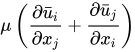

The Reynolds equations describe the time-averaged fluid flow; their peculiarity (compared with the original Navier-Stokes equations) is that new unknown functions have appeared in them that characterize apparent turbulent stresses. The Reynolds system of equations contains six unknowns and turns out to be open, and therefore it is necessary to attract additional information to solve it.
Very significant is the fact that Reynolds stresses are random variables , therefore, the calculations use statistical data on their size ( turbulence models ), which are obtained by analyzing the results of the experiment. It should also be noted that the Reynolds stresses are a flow property (and not a fluid property), therefore, if the conditions of the problem under consideration will differ significantly from the conditions under which statistical data on the Reynolds stress values were obtained, the calculation results may turn out to be qualitatively incorrect. To date, a significant number of turbulence models of varying complexity have been developed that allow one to estimate (simulate) the magnitude of turbulent stresses in various conditions.
Content
- 1 Other methods
- 2 See also
- 3 Literature
- 4 notes
Other methods
- Detached eddy simulation
- LES, Large Vortex Method
See also
- Hydrodynamics
- Computer-aided engineering
Literature
- Anderson D., Tannehil J., Pletcher R. Computational hydromechanics and heat transfer: In 2 volumes: Trans. from English - M.: Mir, 1990.
- Belov I.A., Isaev S.A., Korobkov V.A. Tasks and methods for calculating separated flows of an incompressible fluid. L. Shipbuilding, 1989, 256 pp.
- Belov I.A., Isaev S.A. Modeling of turbulent flows: Textbook / Balt. state tech. un-t SPb., 2001.108 p.
- Kurbatsky A.F. Modeling of turbulent flows. // Izv. SB USSR Academy of Sciences, 1989, no. 5, p. 119 146
- Ilyushin B. B. Modeling of transport processes in turbulent flows: a Training manual / Novosibirsk. Gos. Un. Novosibirsk, 1999
- Fletcher K. Computational methods in fluid dynamics. M. Mir, 1991, in 2 volumes
- Frick P.G. Turbulence: models and approaches. The course of lectures. / Perm. state tech. un-t Part I. Perm, 1998, 107 pp.
- Frick P.G. Turbulence: models and approaches. The course of lectures. / Perm. state tech. un-t Part II Perm, 1999, 136 p.
- Wilcox DC Turbulence modeling for CFD. 1998, 537 p.
Notes
- ↑ Reynolds O. Dynamic theory of motion of an incompressible viscous fluid and definition of a criterion // Problems of turbulence: Sat. translated articles, ed. M.A. Velikanova and N.T.Shveikovsky. - M.-L.: ONTI NKTP USSR, 1936. - S. 185-227 .