
 Play media file
 Play media file
Rail joint - the junction of two rails on the railway . The joint necessarily includes a gap for the free extension of the rails when the temperature changes (in subways where the air temperature is constant, the rails are stacked tightly to each other to prevent trains from swaying when moving). The rails are kept from sliding by a metal plate (insulating joints — a dielectric plate ( textolite , metal composite ) isolated from the rails by a set of side and end gaskets and bushes) a plate / plate pressed against rails by 4-6 bolts on both sides. In the classic rail joint, the holes for the mounting bolts in the pads have an oblong shape through one hole, that is, of the six holes, three are oblong. The holes opposite to each other in the overlays on different sides of the joint are obtained in different shapes - the round hole is opposite the oval. The oval hole has this shape due to the special oval part of the head of the butt bolts that enter the oval hole and do not turn when the nut of the butt bolt is tightened. The holes in the rails for the joint bolts are 20 mm larger than the diameter of the bolt, this is done in order to ensure that the end of the rail moves with temperature extension / shortening of the rail without causing shear forces in the bolts. A blind gap (absence of a gap) indicates the occurrence of a thermal compression stress in the rail, which can lead to a thermal path ejection . A gap of more than 20 mm indicates the occurrence of shearing forces in the butt bolts. With a gap of more than 20 mm, the speed of trains along the track with such a gap is limited. With a gap of more than 35 mm, the movement of trains in the section is closed until the joint malfunction is eliminated. In order to reduce noise from railway transport, reduce wear on wheels and rails and increase the speed of trains, sometimes rails with beveled joints at an angle [1] , [2] (shock-free joint) are sometimes used. Equalizing instruments can also be used instead of joints.
The solution to the problem of thermal clearance allowed the creation of the so-called jointless path . It is used on the railway. At the Moscow metro on the flyover of the Butovo line, work was carried out on the construction of a jointless track. This technology slightly reduces the energy loss and wear of the rails, and also significantly reduces the number of defects that occur in the metal of the rail upon impact in the joint, eliminates the problem of splashes at the joints and significantly reduces the noise level. Jointless tracks are also often used on tram tracks. The use of a continuous joint path refers to resource-saving technologies in track facilities.
To create (insert) a joint into a lash or link, two machines are used - a rail - cutting machine and a rail-boring machine . The rail-cutting machine can be in the form of a cutting wheel of a large diameter , like an angle grinder , driven by its own gasoline engine and a machine with a progressively moving blade. Drilling holes for butt bolts is carried out by a drilling machine, a drill with a carbide tip. The last two types of machine tools are powered by electricity generated by a portable power station "ZhES".
In railway terminology , the pronunciation of the word “joint” in the plural with emphasis on the ending is typical, for example: “joints”, “in joints”.
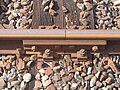
Joint on the sleepers [1]

Joint on connected sleepers with a common thrust bearing and welded butt connector [2]
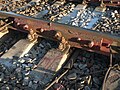
Insulating joint [2] with overlays and profile insulating gasket between fiberglass rail heads

Factory (in RSP -13) welded joint of a rail whip for a welded joint
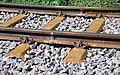
Welded joints after aluminothermic welding in place

Leveling joint of rail lashes and screwed butt connectors


![[1]](http%253A%252F%252Fwww.ljplus.ru%252Fimg4%252Fb%252Fi%252Fbiglebowsky%252Frail_joint_scaled.GIF%26_%3D1438627474403%26p%3D1%26text%3D%25D1%2581%25D0%25BA%25D0%25BE%25D1%2588%25D0%25B5%25D0%25BD%25D0%25BD%25D1%258B%25D0%25B5%2520%25D1%2581%25D1%2582%25D1%258B%25D0%25BA%25D0%25B8%2520%25D1%2580%25D0%25B5%25D0%25BB%25D1%258C%25D1%2581%25D0%25BE%25D0%25B2%26pos%3D50%26rpt%3Dsimage)
![[2]](http%253A%252F%252Feksperimentiki.ru%252Frels.jpg%26pos%3D20%26rpt%3Dsimage)
Notes
- ↑ Top structure (paths) / 3. Rails and fastenings // Technical Encyclopedia . Tom. 3. M.: Soviet Encyclopedia. 1928 487 p. Columns 550-564.
- ↑ 1 2 A.M. Terpigorev. Terminology of railway signaling, centralization of switches, signals and blocking , Academy of Sciences of the USSR / Committee for Technical Terminology. Issue 10, 1952 M.: Publishing House of the USSR Academy of Sciences. 54 sec S. 44.
Literature
- V.B. Kamensky, L.D. Humps. Handbook of the road foreman and foreman of the track // M .: Transport, 1985. 487 p. S. 68, 118, 154-200, 293-300, 327, 341, 351, 403-407.
- Barykin F.D., Brom-Berg E.M. Technical guide railroad . Volume 5. “Way and track economy” // M .: State Transport Railway Publishing House, 1951 597 p.
- Kreinis Z.L., Korshikova N.P. Maintenance and repair of the railway track // M .: UMK MPS of Russia, 2001, 768 p.
- Loktev A.A. , Sycheva A.V., Chernov O.V. Tasks of dynamic action on flat structures when modeling the work of a railway track. - Moscow: AISnT, 2014 .-- 288 p. - ISBN 978-5904640-02-6 .
Links
- Rail joint Advantages and disadvantages . The article is in the section "On the railway" on the website of Ural Railway Company LLC.