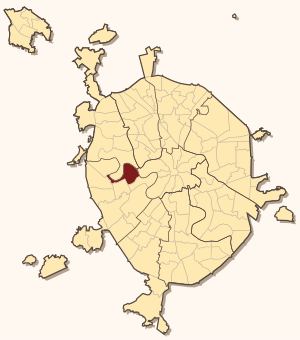
Filevsky Park is a district in Moscow located in the Western administrative district , as well as the corresponding inner-city municipality of the same name. On the territory of the district there is the MV Khrunichev State Space Research and Production Center , the Church of the Intercession of the Holy Virgin in Fili , the Gorbunov Palace of Culture , the Gorbushka shopping center, and the Filion shopping center.
| Filyovsky Park District | |||
|---|---|---|---|
| Municipal District Filevsky Park | |||
| |||
| Status | district / municipal district | ||
| Included in | Moscow city | ||
| Administrative District | Company | ||
| Area | |||
| Title | Filevsky Park | ||
| Date of formation | July 5, 1995 | ||
| Former status | Municipal District Filevsky Park | ||
| Head of the Board | Miroshnichenko Roman Evgenievich | ||
| OKATO Code | |||
| Municipal District | |||
| Title | Filevsky Park | ||
| Date of formation | October 15, 2003 | ||
| OKTMO Code | |||
| Characteristic | |||
| Square | 9.6243 [1] km² (41st place) | ||
| Population ( 2018 ) | ↗ 92 740 [2] people (0.74%, 74th place) | ||
| Population density ( 2018 ) | 9636.03 people / km² (93rd place) | ||
| Housing Area ( 2010 ) | 1605.9 thousand m² (68th place) | ||
| Metro stations |  Fili Bagrationovskaya Filevsky Park Fili Bagrationovskaya Filevsky Park | ||
| Court | Dorogomilovsky | ||
 | |||
| Official site of the district | |||
| Official website of the municipality | |||


History
The district got its name from Filevsky Park , located on its territory, which, in turn, was named after the Filka River, which flows into the Moscow River, long hidden in the pipe. At the mouth of the rivulet was the village of Fili , first mentioned in chronicles in 1454.
The village belonged to the boyar Mstislavsky, and then to his sister Irina. Judging by the description of 1627, it was quite extensive and rich possession. In the village itself there was a wooden church of the Intercession of the Virgin with an aisle of the Conception of St. Anne. The icons, books, candles, bells and utensils mentioned by the document belonged to the Mstislavsky. Near the church was a boyar's courtyard, which housed mansions consisting of several upper rooms with rooms separated by a canopy, standing on residential groundings. In the village itself there were 9 peasant yards and three yards of “backyard people”. After the death of Mstislavl Fili passed into the possession of the yard. At the time of Alexei Mikhailovich, the local area was famous for the abundance of birds and animals. The king made hunting trips here. In spring and summer they hunted birds with falcons, in autumn and winter - for wolves and bears with dogs and cattle.
In 1689, the village passed to Naryshkin Lev Kirillovich, who was the brother of Tsarina Natalia Kirillovna. In the village there were 17 peasant households . There were three villages in the village: Gusarevo with 3 yards, Ipskoye with 3 residential yards and one empty and Mazilovo with 12 yards. In April 1690, Naryshkin bought the neighboring Kuntsevo to Fili and began arranging his estate. The boyar’s farm began with the construction of a new stone church and a choir.
The peasant population of the village of Fili Naryshkin transferred to the big Mozhaisk road, about 1.5 kilometers from the church, and founded the new village of Fili there, in which in 1704 there were 22 yards and 99 peasants . Under the name of the village of Fili, they began to understand the boyar estate, where only one yard people lived.
On June 7, 1763, during the coronation of the village, Catherine II visited the village, showing her highest and most gracious Grace to Leo Alexandrovich and Alexander Alexandrovich . Near the village of Fili, the teachings of army regiments were arranged. [3]
In 1812, the famous council passed at Fili, deciding the fate of Moscow. On the evening of September 1, Kutuzov convened a council in the hut of the peasant Frolov. At that council, Kutuzov’s famous words were heard: “With the loss of Moscow, Russia is not lost! My first duty is to preserve the army and get closer to the troops coming to our reinforcements. By the very concession of Moscow, we prepared the death of the enemy. From Moscow I intend to go along the Ryazan road. I know that responsibility will fall upon me, but I sacrifice myself for the Good of the Fatherland! ”
During the stay of the Napoleonic troops, part of the village of Fili burned down. The French stood in the village, on the lower floor of the church they kept horses, and the upper turned into a trash. After the war, the temple was repaired, and the burnt part of the village was rebuilt again.
At the end of the 19th century, the village was already adjacent to Moscow. Most of the population was engaged in gardening and gardening, focused on sales in the city. At Fili, there was a large dyeing and printing factory of the merchant Sergei Dmitrievich Kuzmichev with 589 workers .
In 1870, the Moscow-Brest Railway passed through Fili and a railway station appeared, which stands, as it were, on the border between the old village of Pokrovsky Fili and the village of Fili.
January 30, 1931 Fili became part of Moscow [4] and became a large industrial area .
Creation of an area
Municipal district "Filyovsky Park" was created during the administrative reform of 1991 in part of the territory of the former Kiev district of Moscow and was part of the Western administrative district [5] . After the adoption of the law on the territorial division of the city of Moscow in 1995, he received the status of the Filevsky Park district [6] .
Territory and borders
The border of the "Filevsky Park" district runs along: [7]
axis of the right of way of the Smolensk direction of the Moscow Railway, then along the axes: Minskaya Street , Bolshaya Filyovskaya Street , projected driveway No. 1345, Zvenigorodskaya Street (excluding residential households on the even side of Zvenigorodskaya Street), Rublevskoye Shosse, southwestern border of the Filevsky (Suvorovsky) park, axis Krylatskaya street, the axis of the bed of the Moscow river to the Smolensk direction of the Moscow Railway.
District Indicators
According to 2010 data, the area of the district is 962.43 ha [1] . The population density is 8373.9 people / km², the housing area is 1605.9 thousand m² (2010) [1] .
Population
| Population | ||||||
|---|---|---|---|---|---|---|
| 2002 [8] | 2010 [9] | 2012 [10] | 2013 [11] | 2014 [12] | 2015 [13] | 2016 [14] |
| 66,775 | ↗ 89 513 | ↗ 89 949 | ↗ 90 243 | ↗ 90 827 | ↗ 91 288 | ↗ 91 974 |
| 2017 [15] | 2018 [2] | |||||
| ↗ 92 168 | ↗ 92 740 | |||||
Guide
The head of the council of the district Filevsky Park is Miroshnichenko Roman Evgenievich.
Attractions
In the district are located:
- Naryshkin Manor in Kuntsevo
- DK named after Gorbunov
- Moscow Cultural Folklore Center under the direction of Lyudmila Ryumin
Orthodox churches
- Church of the Intercession at Fili . Address: Novozavodskaya street , 6.
- Temple of Seraphim of Sarov in Filevskaya floodplain . Address: Filevsky Boulevard , 44-46.
- The Church of All Saints in the Filevsky floodplain (under construction). Address: Filevsky Boulevard , 44-46.
Transport
There are 3 metro stations on the Filyovskaya line in the district:
- Fili
- Bagrationovskaya
- Filevsky park (on the border with the Fili-Davydkovo district)
Ecology
The ecological situation of the Filyovsky Park district is assessed as favorable, despite industrial zone No. 40 Fili , in whose territory the GKNPTs im. Khrunicheva , a plant for the manufacture of reinforced concrete products, the Rubin plant and the Moscow Pipe Plant. Also, in addition to industrial zone No. 40, in the district there is industrial zone No. 40a "West Port" , which, in turn, is preparing for residential development [16] [17] .
Parks in the area
- Filevsky Park (also includes Suvorov Park and the former Filevsky PKiO)
- Children's Park "Fili"
Notes
- ↑ 1 2 3 Indicators of municipalities. Filevsky Park . The territorial body of the Federal State Statistics Service for Moscow. Date of treatment December 21, 2011. Archived February 9, 2012.
- ↑ 1 2 Population of the Russian Federation by municipalities as of January 1, 2018 . Date of treatment July 25, 2018. Archived July 26, 2018.
- ↑ The Chamber-and-Fourier Journal, June 1763
- ↑ Resolution of the All-Russian Central Executive Committee of January 30, 1931
- ↑ Order of the Mayor of Moscow dated September 12, 1991 No. 146-PM “On Establishing the Temporary Borders of Moscow Municipal Districts” (as amended and supplemented on December 16, 1991, March 2, 1992, September 28, 1993, April 1, December 22, 1994)
- ↑ Law "On the territorial division of the city of Moscow" No. 13-47 of July 5, 1995
- ↑ Law No. 13-47 of July 5, 1995 on the Territorial Division of the City of Moscow ( revised December 4, 2002 )
- ↑ 2002 All-Russian Population Census. Tom. 1, table 4. The population of Russia, federal districts, constituent entities of the Russian Federation, regions, urban settlements, rural settlements - district centers and rural settlements with a population of 3 thousand or more . Archived February 3, 2012.
- ↑ VPN-2010. Appendix 1. Population by districts of the city of Moscow . Date of treatment August 16, 2014. Archived on August 16, 2014.
- ↑ Population of the Russian Federation by municipalities. Table 35. Estimated resident population as of January 1, 2012 . Date of treatment May 31, 2014. Archived May 31, 2014.
- ↑ The population of the Russian Federation by municipalities as of January 1, 2013. - M.: Federal State Statistics Service of Rosstat, 2013. - 528 p. (Table 33. The population of urban districts, municipalities, urban and rural settlements, urban settlements, rural settlements) . Date of treatment November 16, 2013. Archived November 16, 2013.
- ↑ Table 33. The population of the Russian Federation by municipalities as of January 1, 2014 . Date of treatment August 2, 2014. Archived on August 2, 2014.
- ↑ The population of the Russian Federation by municipalities as of January 1, 2015 . Date of treatment August 6, 2015. Archived on August 6, 2015.
- ↑ Population of the Russian Federation by municipalities as of January 1, 2016
- ↑ The population of the Russian Federation by municipalities as of January 1, 2017 (July 31, 2017). Date of treatment July 31, 2017. Archived July 31, 2017.
- ↑ Draft plans for the production zones Beskudnikovo, Oktyabrskoye Pole, Krasny Stroitel and Zapadny Port are planned to be approved this year, said the head of the Moscow City Planning Policy Department, Sergey Lyovkin.
- ↑ ECOLOGY OF THE AREA FILYOVSKY PARK