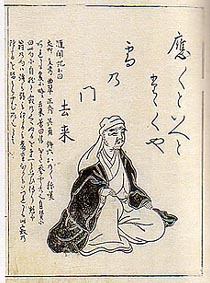
Mukai Körai ( Japanese 向 井 去 来 , 1651 , Nagasaki - October 8, 1704 , Kyoto ) is a Japanese poet, student and friend of Matsuo Basho . He is also known as Rakusisya ( 落 柿 舎 ).
| Mukai Korei | |
|---|---|
| 向 井 去 来 | |
 | |
| Date of Birth | 1651 |
| Place of Birth | Nagasaki |
| Date of death | October 8, 1704 |
| Place of death | Kyoto |
| Citizenship |  Japan Japan |
| Occupation | Poet |
| Direction | waka , haiku |
| Language of Works | Japanese |
Biography
Born in Nagasaki in the family of a Confucian scientist and doctor. At the age of eight, he moved to Kyoto with his family. In 1666, he became the adopted son of his uncle, Kume Masuaki, and moved with him to Fukuoka, where he studied martial art.
In 1675 he returned to Kyoto, where he helped his elder brother, who inherited the practice of his father, improved in martial art and was adopted at court as a Confucian scholar, the continuer of family traditions. Later he became interested in poetry, at first he devoted much time to studying classical waka , but he soon met Basho and, having joined his school, became a professional haiku poet. He traveled a lot.
In addition to the collections of numerous three-poems, he left a poetic treatise "Koroise" ( 1702 ), in which he summarized everything he had ever heard about poetic art. This treatise is a rich material for the study of Basho's poetic principles.
Links
- Wikimedia Commons has media related to Rakusis
- Mukai Körai at Encyclopædia Britannica
- O Rakusisya (Japanese)
- Mukai's grave (jap.)