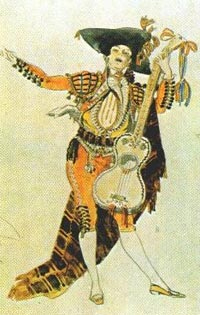
Figaro ( Figaro , fr. - Figaro , isp. Figaro ) - the hero of three Beaumarchais's plays and operas created on their basis; Spaniard from Seville , a clever rogue and rogue, initially a hairdresser (barber), then a servant of Count Almaviva. The name has become a household name.
The name Le Figaro in 1826 was taken by the French daily.
Figaro is also the name of a short Spanish jacket, ending over the waist and not fastening on the chest, worn by the character of Figaro and which became popular in Paris after the premiere.
Personality
Character
Figaro is inventive, witty, cheerful and energetic. He is a representative of the lower class. Extremely quick-witted, he easily invents intrigues and achieves his goals.
Figaro, like his predecessor in Comedy del arte - Brigella , is an intelligent and quick-witted liar, he is indiscriminate in money, he is distinguished by a good mood, he is always ready to help, he is brave, although sometimes his words are bitter and cynical. In a normal mood, he is calm and collected, but in his anger his quick wits sometimes refuse him.
Figaro has many talents and skills. In the preface to the “Barber of Seville”, the author lists them: rubbish, poetry writer, singer and guitarist.
Living in Seville, he successfully shaved his beards, composed romances and arranged marriages, with equal success he owned both the surgeon's lancet and the pharmacist's pestle, and it was a thunderstorm of husbands and the wife’s favorite [1] .
He has the gift of words: in Andalusia, his poems, puzzles and madrigals were published in newspapers, which is why he was fired from public service. He wrote plays, worked in the theater (here are the personality traits of Beaumarchais himself). In the difficult period of his life, he walked all over Spain, and used to be in prison.
Figaro is dressed smartly - his costume is described in the list of actors of the “Barber of Seville”, as the Spanish “ mahoes ” dressed.
Name
The name Figaro was probably coined by Beaumarchais himself. In the manuscript of the first play, The Barber of Seville , he used instead of Figaro a more gallitized version of the writing - Fiquaro . But later he changed it, and made it not only audibly, but also visually similar to the Spanish word picaro .
The word "pícaro" was originally an adjective and meant "cunning, crafty, roguish . " But in the Spanish literature of the New Age, it acquired a new meaning. Picaro is the main character of the rogue novel. Picaresca is a rogue novel [2] . A large number of rogue novels, where the main character was Picaro, a cunning deceiver, sometimes hired to serve, was created in Spain since the Renaissance. In France, such a literary tradition did not exist. “ Gilles Blas ”, completed by Lesage by 1735, is based on Spanish sources.
Frederic Grendel suggested that Figaro's name comes from Fils-Caron ("Karon-son", from the author's real name is Karon . He took the noble name de Beaumarchais later).
Biography
Origin
Figaro is an illegitimate child of Dr. Bartolo and former servant of Marcelina. Before leaving the woman with the baby, Bartolo, then still a caretaker, glowed with his putty knife and put a mark on his son’s hand to recognize him if he ever met again. When the boy was six years old, his mother asked the gypsies , then wandering around Andalusia , to predict his future. They kidnapped the child. Since then Figaro bears his name and is engaged in wickedness [1] . He does not know who his parents are.
Career and Wandering
Shortly before the start of the first play, Figaro serves in Madrid with Count Almaviva. Leaving, he gives him a recommendation to the ministry and asks him to find a place. Figaro is appointed pharmacist assistant at the Andalusian stud farm. After some time, he is fired. Returning to Madrid, Figaro tries his hand in the theatrical field, but fails. With a knapsack over his shoulders, he wanders throughout Spain and finally settles in Seville.
Since then, Figaro's mother managed to grow old and leads the house with her old lover, Dr. Bartolo, who lives in Seville. The doctor is the guardian of the young and beautiful Rosina. Count Almaviva falls in love with her and walks under the windows of her house in Seville. But Bartolo himself is going to marry his pupil and holds her locked up. Count Almaviva accidentally encounters Figaro, his former valet. He just lives in the doctor’s house and owes him 100 ecu . And he helps the count to marry Rosina under the guardian’s nose [3] .
Sedentary Life and Marriage
A few years later, he lives in the castle of Count and Countess Almaviva "Aguas Freskas", serves as a valet count and housekeeper [4] . He has a bride - Suzanne, a girl from a local courtyard, a chambermaid of the countess. But the Count of Almaviva, showing interest in Susanna, is going to either prevent the marriage, or agree with her about the right of the first night . The count refused this right on the occasion of his marriage, but then, according to Susanna, “regretted” about it. Figaro, Suzanne and the Countess are doing everything to prevent the Count. Almaviva allows Marcelina to sue Figaro for outstanding debt. Marcelina, not knowing that Figaro is her son, presents a receipt and demands, according to her, money or marriage with Figaro. Suddenly, according to the mark left by Bartolo, it turns out that Figaro is a child of Bartolo and Marcelina, lost thirty years ago. Dr. Bartolo agrees to marry Marcelin, Figaro becomes the legalized fruit of marriage. As a result of the intrigue Almaviva remains in the cold, and Figaro and Suzanne are married.
Old Age
Character Evolution
Throughout the Beaumarchais trilogy, the image of Figaro undergoes changes.
In the Barber of Seville , he is, above all, a cheerful, witty and cheerful little fellow who has passed through fire and water, sometimes letting out rather well-aimed witticisms and ironic remarks, but not yet risen to caustic satire and full of indignation of convictions.
In The Marriage of Figaro , especially in the well-known monologue of the fifth act, Figaro already acts as the spokesman of public and political protest, like-minded encyclopedists, the predecessor of figures in 1789
In the third part of the trilogy (“ Guilty Mother ”), Figaro, aged and broken by his life, is, as it were, the shadow of the old Figaro; he turned into an exemplary servant and an ordinary moralist, waging a struggle with very petty and insignificant opponents, and even then only in the interests of his masters.
Literary predecessors
A type of dexterous, witty, kind of talented and somewhat roguish “jack of all trades” was repeatedly created before Figaro. These are cunning, superior minds of their masters servants who often met in comedies and farces of European literature, harlequins comedia dell'arte , slaves Plavt and Terence . In France, it is Moliere's Sganarelle and similar characters from the 18th century comedies. In Spain, Figaro's predecessors are a long string of heroes of a rogue novel that has stood out in a separate national genre, starting with Picaro Lazarillo from Tormes [5] and ending with Quevedo .
On the other hand, Figaro with some traits of his character resembles the quirky, dexterous, sometimes roughly cynical Panurge , one of the heroes of “ Gargantua and Pantagruel ” Rabelais , or Gilles Blaz, who in the image of Lesage is a person who has experienced a lot, well studied the weaknesses and weaknesses of people, accustomed to endure the hardships of life, sometimes resorting to tricks and transactions with conscience.
Value
Figaro is the most vivid literary image created by the dramatic art of the 18th century, the embodiment of the enterprising initiative of the third estate, his critical thought, his optimism.
But, possessing the resourcefulness and wit of these characters, performing, like them, the functions of the main engine of stage intrigue, Figaro is more significant and higher than the entire clan group.
The image of Figaro is saturated with great political pathos; his sharp attacks against the "noble masters" rise to protest against all social inequality, oppression and humiliation of man, and these features of the image preserved his sound for a century and a half and introduced him in a number of so-called. century-old images .
The merit of Beaumarchais, who artistically recreated this type, informed him of many of his views and aspirations, made him respond to the burning questions of French reality, at least disguised as an imaginary Spanish outfit, nevertheless remains undoubted.
Artwork
Pieces
- Le Sacritan, an early play by Beaumarchais (c. 1765 ), featuring Figaro and Count Almaviva.
The main trilogy
- The Barber of Seville, or Vain Precaution , Beaumarchais , Le Barbier de Seville ou la précaution inutile, 1775
- “ Crazy Day, or The Marriage of Figaro, ” a play by Beaumarchais , ( La folle journée ou le Mariage de Figaro, 1784 )
- “ Guilty Mother, or Second Tartuffe ” (“The Crime Mother”), a play by Beaumarchais , ( La mère coupable ou l'autre Tartufe, 1792 )
Other authors
The image of Figaro often inspired other authors to create a continuation of the story. Among them:
- Les premières armes de Figaro, a play by Sardoux ,
- “Figaro is getting divorced” (Figaro läßt sich scheiden) , a play by Eden von Horvath , ( 1936 ),
- “Le roman de Figaro”, book by F. Vitus (Frédéric Vitoux) , ( 2005 ).
Beyond the History of Real Figaro
- "Funeral of Figaro (Operatic Whodunnit)", a detective novel by British writer Ellis Peters . The action takes place today. One after another kills baritones performing the part of Figaro.
Opera
Unlike the original names of the plays written in French, the names of the operas are in Italian (according to the language of the libretto).
- The Barber of Seville , opera by Giovanni Paisiello , ( Il barbiere di Siviglia, ovvero La precauzione inutile, 1782 )
- The operas on the plot of The Barber of Seville are F. L. Bend ( 1782 ), I. Schulz ( 1786 ), N. Izuar ( 1797 ).
- “Crazy Day, or The Marriage of Figaro”, opera Marcush of Portugal / La pazza giornata ovvero Il matrimonio di Figaro ( 1799 )
- The Barber of Seville , Rossini Opera, ( Il barbiere di Siviglia , 1816 )
- “ The Marriage of Figaro ”, Mozart’s opera, ( Le nozze di Figaro ossia la folle giornata, 1786 )
- “Guilty Mother,” opera by D. Millau (Darius Milhaud) (La Mère coupable), written as early as the 20th century.
Opera outside the trilogy
- The Ghosts of Versailles , opera by D. Corigliano, 1991 . The ghost of Beaumarchais staged an opera to entertain the ghost of Marie Antoinette . She "resurrects" the old days preceding the French Revolution, including a scam with a necklace . The protagonists of the trilogy coexist with real historical figures. Beaumarchais and Figaro together are trying to save the queen from execution.
Some artists
- Preville ( Préville ) (1721-1799) was the creator of the image of Figaro in the Beaumarchais Seville Barber at the first production ( 1775 ).
- Dazincourt ( Dazincourt ), - the performer of the role of Figaro, who came to taste Beaumarchais
- Nikolai Batalov played his first big role on the Moscow Art Theater in the performance of 1927 (director Konstantin Stanislavsky , artist Alexander Golovin )
- Ermek Serkebaev - performer of the role of Figaro in the opera The Barber of Seville (State Academic Opera and Ballet Theater named after Abay (Alma-Ata)
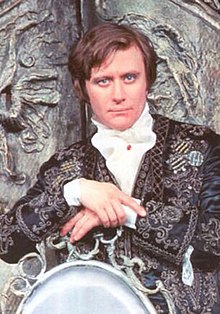
- The Russian actor Andrei Mironov repeatedly played this role (a television version of the play was made), in addition, playing this role on the stage, he received a stroke, as a result of which he died in the hospital
- Dmitry Pevtsov - directed by M. Zakharov [6] [7] [8] [9] / Lenkom , 1993
- Evgeny Mironov - in the play “Figaro. One Day Events , dir. Kirill Serebrennikov [10] [11] / “The Theater Company of Evgeny Mironov ”, 2006
- Sergei Bezrukov - in the play "Crazy Day, or the Marriage of Figaro" , dir. Konstantin Bogomolov / Snuffbox , 2009
- Sergey Radchenko - in the play “ Crazy Day, or The Marriage of Figaro ”, dir. Eugene Radomyslensky / Theater Studio of a film actor , 2014 . Currently, the role is played by Denis Bondarkov
- Andrei Zobov - in the play “ Crazy Day, or The Marriage of Figaro ”, dir. Gulnara Galavinskaya / Michurinsky Drama Theater , 2014
Figaro in popular culture
- Figaro is the name given to a kitten created by Disney artists. The first appearance is in Pinocchio . He later migrated to the Mickey Mouse universe as a cat belonging to Minnie Mouse . A constant adversary of Pluto is a dog owned by Mickey Mouse. The most memorable appearance is in the movie “House of Mouse”. Figaro is also the name of the cat in the children's books of the writer Marie-Therese Eglsaer and the horse in the works of the children's writer Rebecca Anders.
- Tony Figaro is the owner of a hairdresser in the cartoon "The Barber of Seville" (USA, 1944).
- Figaro is the name of a fictional kingdom in Final Fantasy VI .
- Figaro is a retro car model created by Nissan in 1991 in limited quantities.
- Figaro - the nickname of the writer Mariano José de Larra
- Figaro - nickname dachshunds in the films " Four taxi drivers and a dog ", " Four taxi drivers and a dog 2 "
- FIGARO is the largest international modeling agency that created the world's first Online Model School for distance learning model art.
- Le Figaro - daily French newspaper
See also
- First night right
Notes
- ↑ 1 2 Beaumarchais. The Barber of Seville. “A discreet letter of failure and criticism of the Seville Barber” (Preface to the play). Per. N. M. Lyubimova.
- ↑ A. L. Stein, “The History of Spanish Literature”, M., 1994.
- ↑ Beaumarchais. The Barber of Seville
- ↑ Beaumarchais. "Crazy Day, or The Marriage of Figaro"
- ↑ "The Life of Lazarillo from Tormes, His Luck and Misfortune," 1554
- ↑ [1] Archived January 22, 2009 on Wayback Machine (unavailable link)
- ↑ [2] (inaccessible link)
- ↑ The famous metropolitan theater celebrated the 10th anniversary of its most sparkling performance
- ↑ [3] (inaccessible link)
- ↑ In Moscow, the premiere of the new “Marriage of Figaro": director - Serebrennikov, starring Mironov
- ↑ [4] Archived October 15, 2008 on Wayback Machine (inaccessible link)
Literature
- Marc Monnier, Les aneux de Figaro (Par., 1868);
- Pierre Toldo, “Figaro et ses origines” (Milan, 1893);
- Willow Ivanov, “The Political Role of the French Theater” (M., 1895).
- Claude Petitfrère, “1784, le scandale du Mariage de Figaro: prélude à la Révolution française”