A chemical equation (chemical reaction equation) is a conditional record of a chemical reaction using chemical formulas , numerical coefficients and mathematical symbols .
The chemical reaction equation gives qualitative and quantitative information about a chemical reaction, reagents and reaction products; its compilation is based on the laws of stoichiometry , primarily the law of conservation of mass of substances in chemical reactions. In addition to equations, complete and brief schemes of chemical reactions are used - conditional records that give an idea of the nature of the reagents and products, that is, qualitative information about the chemical reaction.

History
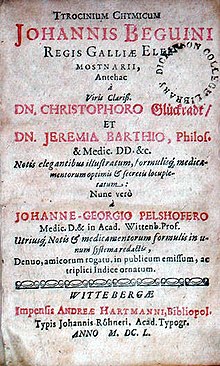
At the beginning there was no idea of chemical equations, the basic chemical laws were not yet known, but already in the alchemical period of the development of chemistry, chemical elements began to be denoted by symbols.
With the further development of chemistry, ideas about the symbolism of chemical elements and sky recordings using chemical formulas changed. The first to propose the use of chemical equations was Jean Beguin in 1615 in one of the first chemistry textbooks Tyrocinium Chymicum ( The Beginning of Chemistry ).
Late 18th — early 19th centuries - the establishment of the laws of stoichiometry . At the origins of these studies was the German scientist I.V. Richter . In his student years, he was greatly impressed by the words of his teacher, the philosopher I. Kant , that in some areas of the natural sciences there is as much true science as there are mathematics in it. Richter devoted his dissertation to the use of mathematics in chemistry. Not essentially a chemist, Richter introduced the first quantitative equations of chemical reactions and began to use the term stoichiometry .
Compilation Rules
For the preparation of equations of chemical reactions, in addition to knowledge of the formulas of the reactants and reaction products, it is necessary to correctly select the coefficients. This can be done using simple rules [1] . On the left side of the equation, formulas (formula) of the substances that have entered into the reaction are written, connecting them with a plus sign. On the right side of the equation, formulas (formula) of the resulting substances are written, also connected by a plus sign. Between the parts of the equation put an equal sign or arrow. Then find the coefficients - the numbers that stand before the formulas of substances, so that the number of atoms of the same elements in the left and right sides of the equation is equal.
The following symbols are used to indicate various types of reactions:
- " »Is used when a stoichiometric ratio is observed.
- " »Is used to indicate a direct reaction .
- " "Is used to denote a reaction proceeding in both directions .
- " "Is used to indicate chemical equilibrium .
The law of conservation of mass states that the amount of matter of each element before the reaction is equal to the amount of matter of each element after the reaction. Thus, the left and right sides of the chemical equation must have the same number of atoms of one or another element. The chemical equation must be electrically neutral, that is, the sum of the charges on the left and right side of the equation must be zero.
As a rule, chemical equations are written with the smallest integer coefficients. If there is no coefficient before the chemical formula, it is assumed that it is equal to unity. Checking the material balance, that is, the number of atoms on the left and right sides, can be as follows: the coefficient 1 is placed in front of the most complex chemical formula. Next, the coefficients are placed in front of the formulas so that the number of atoms of each of the elements on the left and right side of the equation is . If one of the coefficients is fractional, then multiply all the coefficients by the number in the denominator of the fractional coefficient. If coefficient 1 is before the formula, then it is omitted.
One way to equalize the number of atoms in a chemical equation is to select the coefficients.
The arrangement of the coefficients in the chemical reaction of methane combustion:
- 1CH 4 + O 2 CO 2 + H 2 O
The number of carbon atoms on the left and right sides is the same. The next element to be balanced is hydrogen. On the left are 4 hydrogen atoms, on the right 2, in order to equalize the number of hydrogen atoms, a coefficient of 2 should be placed in front of water, as a result of
- 1CH 4 + O 2 CO 2 + 2H 2 O
Checking the correct placement of the coefficients in any chemical equation is carried out by counting the number of oxygen atoms, if the number of oxygen atoms in the left and right parts is the same, then the coefficients are placed correctly.
- 1CH 4 + 2O 2 CO 2 + 2H 2 O
Before the molecules of CH 4 and CO 2 the coefficient 1 is omitted.
- CH 4 + 2O 2 CO 2 + 2H 2 O
For more complex cases, the mathematical method of balancing reactions is used by compiling a system of linear algebraic equations and the Garcia method (an analogue of the mathematical Gauss method).
Redox reactions
Redox reactions are counter-parallel chemical reactions that occur with a change in the oxidation state of the atoms that make up the reacting substances, which are realized by the redistribution of electrons between the oxidizing atom and the reducing atom. Any redox reaction is a unity of two opposite transformations - oxidation and reduction, occurring simultaneously and without separation of one from the other.
In the preparation of the equation of the redox reaction, it is necessary to determine the reducing agent, oxidizing agent and the number of electrons being sent and received. As a rule, the coefficients are selected using either the electronic balance method or the electron-ion balance method (sometimes the latter is called the half - reaction method).
Writing Ionic Equations
Ionic equations are chemical equations in which electrolytes are written as dissociated ions. Ionic equations are used to record substitution reactions and exchange reactions in aqueous solutions. Example, an exchange reaction, the interaction of calcium chloride and silver nitrate with the formation of a precipitate of silver chloride:
- CaCl 2 (g) + 2AgNO 3 (g) Ca (NO 3 ) 2 (g) + 2AgCl (tv)
complete ionic equation:
- Ca 2+ + 2Cl - + 2Ag + + 2NO 3 - Ca 2+ + 2NO 3 - + 2AgCl (tv)
M. Language of chemists // Chemistry and life. - 2000.-№ 1. - S.50-52.
- Kudryavtsev A. A. Compilation of chemical equations - 4th edition, revised. and add., 1968-359 p.
- Berg L.G. Gromakov S.D. Zoroatskaya I.V. Averko-Antonovich I.N. Methods for the selection of coefficients in chemical equations - Kazan: publishing house of Kazan University, 1959.- 148 p.
- Leenson I.A. Chet or Odd - M .: Chemistry, 1987. - 176 p.
See also
- Chemical reactions
- Stoichiometry
- Thermochemical equations
Notes
- ↑ Chemical equations / Gabrielyan O.S. Chemistry. 8th grade. - M. Drofa, 2013 .-- 288 p. (S. 160)